For Singapore offices under 500 sq ft or with fewer than five rooms, individual split aircon units ($800–$2,500 each installed) are simpler and cheaper upfront. For larger offices needing eight or more indoor units, centralised cooling across multiple zones, or future expansion, a VRV (Variable Refrigerant Volume) system ($15,000–$60,000 depending on capacity) cuts long-term energy bills by 30–40%, reduces outdoor-unit clutter, and allows independent room control. The crossover point is typically six to eight indoor units: below that, splits win on cost and flexibility; above that, VRV wins on efficiency, scalability, and total cost of ownership over five years.
What VRV and Split Systems Actually Are (and Why It Matters for Your Office)
Split Aircon: One Outdoor Unit, One Indoor Unit
A split system pairs one outdoor compressor with one indoor fan-coil. You install as many pairs as you need. Each operates independently: if the meeting room is off, that compressor is off. Installation is straightforward—drill one 65 mm core hole per pair, run refrigerant piping and drain, done. Typical lead time in Singapore is two to five days from booking to installation for up to four units.
VRV System: One Outdoor Unit, Multiple Indoor Units
VRV (Daikin's trademark; other brands call it VRF, Variable Refrigerant Flow) connects one large outdoor compressor to eight, twelve, or even twenty indoor units via a single refrigerant network. The compressor modulates speed and refrigerant flow to match real-time demand across all zones. Only the rooms that need cooling draw power; unused zones contribute zero load. Installation requires careful piping design, a larger outdoor footprint (or high-floor crane access), and typically two to four weeks lead time including design, MCST or landlord approval, and commissioning.
Why This Distinction Matters in Singapore Offices
Singapore's commercial electricity tariff averages $0.28–$0.32 per kWh (2025 market rate). An office running aircon 10 hours/day, 22 days/month, will spend $150–$250 per month per 2.5 HP split unit at full load. VRV systems, by contrast, rarely run at full load; the inverter compressor idles at 20–40% capacity when only a few zones are occupied, cutting that same cooling load's cost to $100–$150 per equivalent indoor unit. Over five years, the energy delta pays for the higher upfront cost—but only if you actually use enough indoor units to justify the central outdoor investment.
Upfront Cost Comparison: Installation, Equipment, and Hidden Extras
| System Type | Indoor Units | Equipment + Installation (SGD) | MCST / Landlord Approval | Lead Time |
|---|---|---|---|---|
| Split (non-inverter) | 1–5 | $800–$1,500 per unit | Usually notification only | 2–5 days |
| Split (inverter) | 1–5 | $1,200–$2,500 per unit | Usually notification only | 2–5 days |
| VRV (8 indoor units) | 8 | $15,000–$25,000 total | Structural + facade approval required | 2–4 weeks |
| VRV (16 indoor units) | 16 | $30,000–$50,000 total | Structural + facade approval required | 3–5 weeks |
What's Included (and What's Extra)
Split-system quotes typically cover the indoor and outdoor units, standard 3-metre piping, electrical wiring to an existing isolator, core drilling, bracket fabrication, and one-year manufacturer warranty. Extras that push the price up: high-floor installation (above 12th storey adds $150–$300 per outdoor unit for gondola or boom-lift access), concealed trunking if your office has exposed ceilings, and any upgrade from R410A to R32 refrigerant (about $100–$150 more per unit, but 10% better efficiency).
VRV quotes should include design drawings, all indoor units, the outdoor condensing unit, full refrigerant piping network, branch boxes, controls (wired or wireless per-zone thermostats), commissioning, and typically a two-year manufacturer warranty. Watch for exclusions: some contractors quote ex-works (you arrange crane access), some exclude the electrical sub-board upgrade (VRV outdoor units draw 15–40 A at 415 V three-phase; your office panel may need a new breaker), and almost none include MCST application fees (typically $200–$500 as an admin charge).
Running Cost and Energy Efficiency: Where VRV Wins Big
Part-Load Performance
Split systems are either on or off. A 2.5 HP non-inverter compressor draws roughly 2.0 kW at full blast; when the thermostat is satisfied it cycles off, then cycles back on. Cycling wastes energy (inrush current every restart) and wears the compressor. Inverter splits are better—they ramp down to 0.5–0.8 kW at low load—but each unit still operates independently.
VRV systems pool the load. If your twelve-indoor-unit system has only three zones occupied (say, 25% load), the outdoor inverter compressor runs at 25–30% speed, drawing perhaps 3–4 kW total instead of the 12–15 kW you'd draw from three separate 2.5 HP splits running near full speed. Real-world measurements in Singapore office retrofits show 30–40% energy savings for VRV versus non-inverter splits, and 15–25% versus inverter splits, when at least half the zones are idle during business hours.
Heat Recovery (Advanced VRV Only)
Some VRV models (Daikin VRV IV Heat Recovery, Mitsubishi Electric City Multi HVRF) can simultaneously cool one zone and heat another by redirecting rejected heat. This is niche in Singapore—our offices rarely need heating—but can matter in server rooms (cool the equipment, warm the adjacent storage room to prevent condensation on documents) or restaurants (cool the dining area, heat the kitchen exhaust-air recovery). Heat-recovery VRV adds 20–30% to the equipment cost and is overkill for typical open-plan offices.
Five-Year Total Cost of Ownership Example
Consider an office with ten zones, each needing one 2.5 HP indoor unit, operating 10 hours/day, 22 days/month.
- Ten inverter splits: Installation $1,800 × 10 = $18,000. Monthly energy (assume 60% average load, 1.2 kW per unit) = 10 × 1.2 kW × 220 hours × $0.30/kWh = $792/month = $9,504/year. Five-year energy = $47,520. Servicing $45 per unit twice/year = $900/year = $4,500 over five years. Total: $70,020.
- One VRV with ten indoor units: Installation $22,000. Monthly energy (assume system runs at 50% average capacity, 8 kW total) = 8 kW × 220 hours × $0.30/kWh = $528/month = $6,336/year. Five-year energy = $31,680. Servicing (contract for full system) $600/year = $3,000 over five years. Total: $56,680.
The VRV saves $13,340 over five years—enough to justify the higher upfront cost and complexity. But if your office only needs five indoor units, the split-system total drops to $35,010 (half the units, half the servicing), and a five-indoor VRV still costs around $18,000 installed plus $15,840 energy plus $3,000 servicing = $36,840. At that scale, splits are cheaper overall.
Installation Constraints and Approval Headaches
HDB Shophouse or Mixed-Use Buildings
HDB commercial ground-floor units allow split outdoor units on rear or side facades, provided brackets are within your lot boundary and discharge air does not blow onto walkways. VRV outdoor units are larger (often 1.2 m wide × 1.8 m tall × 0.8 m deep, weighing 150–250 kg) and noisier at startup; you may need acoustic enclosures to meet NEA's 65 dB(A) daytime limit at the nearest noise-sensitive point. Submit a simple notification to HDB Building Control for splits; for VRV, expect a formal structural-load letter from a PE (Professional Engineer) if mounting above ground level.
Condo Office Units or Strata Commercial
MCST approval is non-negotiable for facade penetrations and external brackets. Splits usually pass if you use the developer-designated aircon-ledge positions. VRV outdoor units often exceed ledge load limits (most ledges are rated for 80–100 kg; VRV units are 150–250 kg), requiring a structural engineer's endorsement and sometimes ledge reinforcement (add $1,500–$3,000). MCST processing takes two to four weeks; budget time accordingly.
High-Floor and Crane Access
Installing VRV outdoor units above the tenth storey in Singapore usually requires boom-lift or building-maintenance-unit access, especially if the unit cannot fit in the service lift. Boom-lift hire is $800–$1,500 per day; the building may restrict access to weekends or after 7 PM, stretching installation to two visits. Some contractors include this in the quote; others list it as 'owner's scope.' Clarify upfront.
When to Choose Split Systems
- Fewer than six indoor units needed: The upfront cost and complexity of VRV cannot be justified; splits are faster and cheaper.
- Phased expansion: If you're leasing 400 sq ft today and may take the adjacent 300 sq ft next year, add splits as you go. VRV requires sizing the outdoor unit upfront for future load, risking over-investment if your plans change.
- Independent department billing: In serviced offices or co-working spaces where tenants pay their own electricity, individual splits let each suite have a separate meter and breaker. VRV pools all zones into one three-phase connection—sub-metering is possible but adds cost and controller complexity.
- High-churn tenancy: If your office layout changes every 18–24 months, split systems are easier to relocate or decommission unit-by-unit. Reconfiguring VRV piping and branch boxes after a major renovation can cost $2,000–$5,000 in re-commissioning and refrigerant top-ups.
- Budget or approval constraints: If the landlord or MCST rejects the VRV outdoor-unit size or noise, splits are the fallback that still gets you operational in one week.
When to Choose VRV
- Eight or more indoor units: Energy savings and reduced outdoor clutter cross the break-even line.
- Simultaneous heating and cooling needs: Server room + office, or kitchen + dining in F&B—heat-recovery VRV captures waste heat for productive use.
- Limited outdoor space: One VRV condensing unit replaces eight to twelve split outdoor compressors, freeing up facade or ledge space and improving aesthetics.
- Centralised control and monitoring: VRV systems integrate with building-management systems (Modbus, BACnet) for scheduling, fault alarms, and energy dashboards. Individual splits can be retrofitted with Wi-Fi controllers (Daikin Onecta, Mitsubishi Electric kumo cloud), but coordinating twelve separate apps is tedious.
- Long tenancy (five years minimum): The payback period on energy savings requires sustained use; short-term tenants see only the capex pain.
Common Mistakes When Specifying Office Aircon
Under-Sizing Because of 'Green' Pressure
BCA Green Mark and energy consultants sometimes push for minimal cooling capacity to hit EUI (Energy Use Intensity) targets. In reality, a 2.0 HP unit struggling at 100% duty cycle in a 20-person meeting room consumes more energy per degree of cooling and wears out faster than a properly sized 2.5 HP unit cruising at 70%. Size for peak occupancy plus 15–20% margin, then let inverter modulation handle part-load efficiency.
Ignoring Fresh-Air Requirements
Neither splits nor VRV bring in outside air by default—they recirculate indoor air. SS553 (Code of Practice for Air-Conditioning and Mechanical Ventilation) requires 6–8 litres/second of fresh air per person in office spaces. You need a separate fresh-air system (a dedicated AHU with heat-recovery wheel, or simply operable windows if your office is below the sixth storey and not facing heavy traffic). Don't expect your aircon to solve stuffiness if the space is sealed and packed with twenty people.
Forgetting About Electrical Load
Ten 2.5 HP splits draw roughly 2 kW each at peak, 20 kW total, easily handled by standard single-phase 40 A breakers per pair. A VRV outdoor unit rated for the same cooling load draws 15–18 kW but at 415 V three-phase. If your office sub-board is single-phase only (common in older strata units), upgrading to three-phase involves the building's LVDB (Low Voltage Distribution Board) and SP Group application—add two to four weeks and $1,500–$3,000 in electrical works. Confirm your electrical supply before signing the VRV contract.
Maintenance, Servicing, and Lifespan
Split Systems
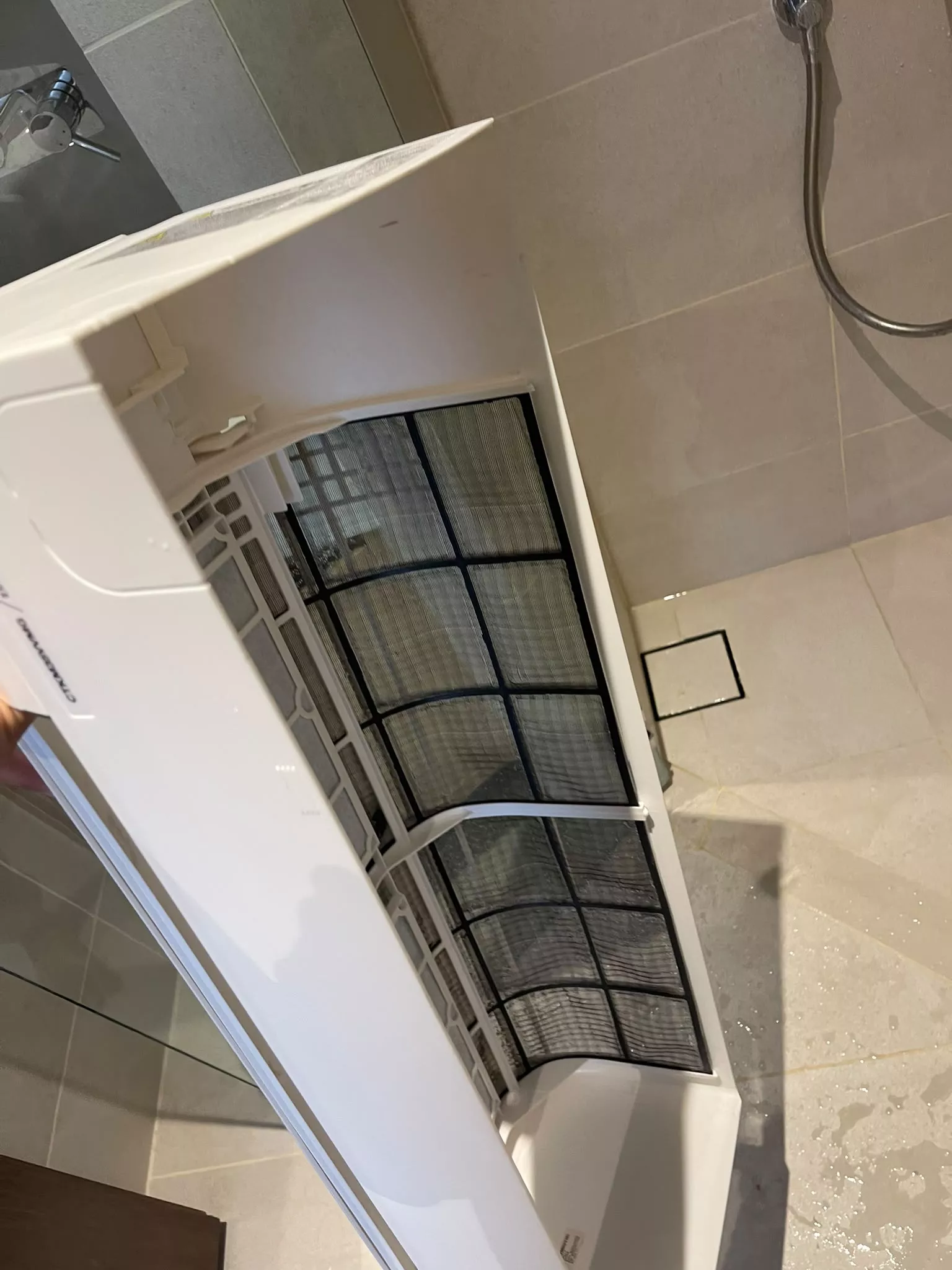
Each indoor unit should be serviced every six to eight weeks in a dusty office environment (quarterly is acceptable for cleaner spaces). Standard servicing—filter wash, coil vacuum, drain flush, refrigerant pressure check—costs $45 per unit as a minimum (that's the aircons.sg rate, covering the visit, 9-point pre-check, and basic cleaning). Multiply by your unit count: five units twice a year = $450/year. Outdoor compressors need annual coil jet-wash ($60–$80 per unit). Lifespan is eight to twelve years for the compressor, fifteen-plus for the indoor fan-coil if maintained.
VRV Systems
Quarterly or bi-annual contract servicing is the norm, covering all indoor units, outdoor unit coil cleaning, refrigerant-circuit leak check, and software diagnostics. Expect $150–$200 per visit for an eight-indoor system, $250–$350 for sixteen indoors. Many contractors bundle this into an annual maintenance contract ($600–$1,200/year). Compressor lifespan is ten to fifteen years; refrigerant top-ups (if the system develops a slow leak) cost $80–$150 per kg, and a large VRV may hold 20–40 kg total—expensive if you ignore a leak. The good news: a single leak in one branch affects only that zone; the rest of the system keeps running. With splits, a compressor failure kills that entire room's cooling until you replace the outdoor unit ($600–$1,200 parts and labour).
Frequently Asked Questions
Can I start with splits and upgrade to VRV later?
Technically yes, but it's wasteful. The split outdoor units and piping become scrap; you're essentially paying for two full installations. If you anticipate growing beyond six zones within three years, design for VRV from day one, even if you only connect four indoor units initially. The outdoor unit and piping backbone will accommodate future branches at a fraction of the cost of a forklift retrofit.
Do VRV systems qualify for any government grants or incentives?
The Energy Efficiency Grant (EEG) administered by Enterprise Singapore covers up to 50% of qualifying energy-efficient equipment for SMEs, capped at $30,000 per project. VRV systems with inverter compressors and a minimum EER (Energy Efficiency Ratio) typically qualify, but the grant requires pre-approval before purchase. Splits generally do not meet the per-item cost threshold ($5,000 minimum per line item). Check the latest EEG criteria; rules change yearly.
Which refrigerant should I specify for a new VRV system in 2025?
R32 is the current standard for new installations—lower global-warming potential than R410A, 10% better efficiency, and widely available in Singapore. Daikin, Mitsubishi Electric, and Midea all offer R32 VRV lines. Avoid R22 entirely; it's been phased out under the Montreal Protocol, and top-ups are expensive ($120–$180/kg) and scarce. If a contractor quotes R410A for a new system in 2025, ask why—it's not wrong, but R32 is the better long-term bet.
How loud is a VRV outdoor unit compared to split condensers?
A single VRV outdoor unit rated for ten indoor zones produces 58–65 dB(A) at one metre (similar to a normal conversation). Ten separate split outdoor units, each producing 48–54 dB(A), create a cumulative noise level of roughly 58–62 dB(A) if clustered. The difference is marginal in absolute terms, but the VRV unit is a single low-frequency hum, whereas multiple splits create a chorus of high-pitched compressor whines that some neighbours find more irritating. For noise-sensitive sites (medical clinics, recording studios), spec a low-noise VRV variant or acoustic enclosure.
What happens if the single VRV outdoor compressor fails?
All connected indoor units lose cooling until the compressor is repaired or replaced. This is the major operational risk of centralised systems. Mitigation: choose a brand with local Singapore parts stock (Daikin, Mitsubishi Electric, and LG all have Authorised Service Centres here), buy the extended warranty (typically $800–$1,500 for two extra years), and keep a maintenance contract with four-hour response SLA. For mission-critical spaces (data centres, 24/7 call centres), consider a redundant outdoor unit or hybrid setup—VRV for general office zones, dedicated split for the server room.
Get Transparent Advice and a Fixed-Price Quote
Choosing between VRV and splits isn't about 'better' or 'worse'—it's about right-sizing the system to your actual space, usage pattern, budget, and growth plans. At aircons.sg, we size both split and VRV installations daily for Singapore offices, and our quote always breaks down equipment, labour, electrical, MCST application, and any high-floor access charges as separate line items—no hidden charges (quoted prices are final), no surprise 'site-condition' surcharges after we visit. Every installation includes a 2-year workmanship warranty and same-day service availability if you need urgent repairs or servicing later. WhatsApp us at +65 9107 2601 with your floor plan or a simple sketch showing room count and rough square footage; we'll give you a fixed-price comparison of split versus VRV options within 24 hours, so you can make the call with real numbers in hand.