Rattling usually signals loose panels or debris; hissing means refrigerant leak or expansion-valve noise; clicking during start-up is normal compressor relay action, but continuous clicking points to electrical faults; buzzing indicates failing capacitor or contactor; grinding suggests worn bearings in the blower motor. Most noises warrant a technician visit — aircons.sg includes a 9-point pre-check with every service booking (from $45 for 1 unit) to pinpoint the cause and quote any repair transparently.
Rattling and Vibration Sounds
Loose Panels or Cover Screws
The most common rattle comes from the front cover or side panels vibrating against the chassis. HDB and condo units installed 3+ years ago often have screws that have worked loose from constant on-off cycling and Singapore's humidity causing slight expansion and contraction. Open the front cover: if it wobbles or you can lift it slightly without resistance, the mounting clips or screws need tightening. This is a 5-minute fix during any service visit — no parts cost, just labour included in the $45 minimum booking.
Debris in the Fan Housing
High-floor units (above 10th storey) still collect dust, insect husks, and occasionally small twigs blown in during storms. When the blower wheel spins at 800–1,200 RPM, even a small twig creates a loud rattle. Technicians remove the blower assembly, clear debris, and check the wheel balance. If the wheel itself is cracked (common in older Mitsubishi and Daikin units with plastic blowers), replacement costs $60–$120 for the part plus labour, quoted after the pre-check.
Compressor Mounting Bolts (Outdoor Unit)
If the rattle is loudest outside, check the compressor mounting. Rubber grommets that isolate the compressor from the condenser frame perish after 5–7 years in direct sun. The compressor then vibrates against metal, creating a low-frequency rattle that neighbours will complain about. Replacement grommets cost $30–$50 per set; the work takes 20 minutes. MCST rules in condos often require you to inform the management if outdoor-unit work involves temporary noise or access to the ledge — a courtesy SMS usually suffices.
Hissing and Whooshing Noises
Normal Expansion-Valve Sound vs. Refrigerant Leak
A soft hiss for 3–5 seconds when the compressor starts is normal — that's refrigerant rushing through the expansion valve (also called the TXV or electronic expansion device in inverter models). You'll hear it from the indoor unit near the copper pipes. If the hiss is continuous, loud, or accompanied by ice build-up on the pipe insulation, you have a refrigerant leak. R32 and R410A (the two refrigerants legal for new installations in Singapore since 2021) both hiss audibly when escaping; R22 (phased out but still in older units) hisses less because it's lower pressure.
Diagnosing and Fixing Leaks
Leaks most often occur at flared joints (where the copper pipe connects to the indoor or outdoor unit) or at brazed joints if the installer used too much heat during installation. A technician will use a soap-bubble test or electronic leak detector during the pre-check. Small leaks at a flared joint can be re-flared and re-tightened (labour ~$80–$120). Leaks in the evaporator coil or condenser coil usually mean coil replacement: $180–$350 for a standard 9,000 BTU indoor coil, $220–$450 for a 12,000–18,000 BTU outdoor coil, plus refrigerant top-up ($80–$120 for R32, $100–$150 for R410A per kg). If your unit is over 10 years old and needs a coil, replacement often makes more economic sense than repair.
High-Pitched Whistle from the Fan
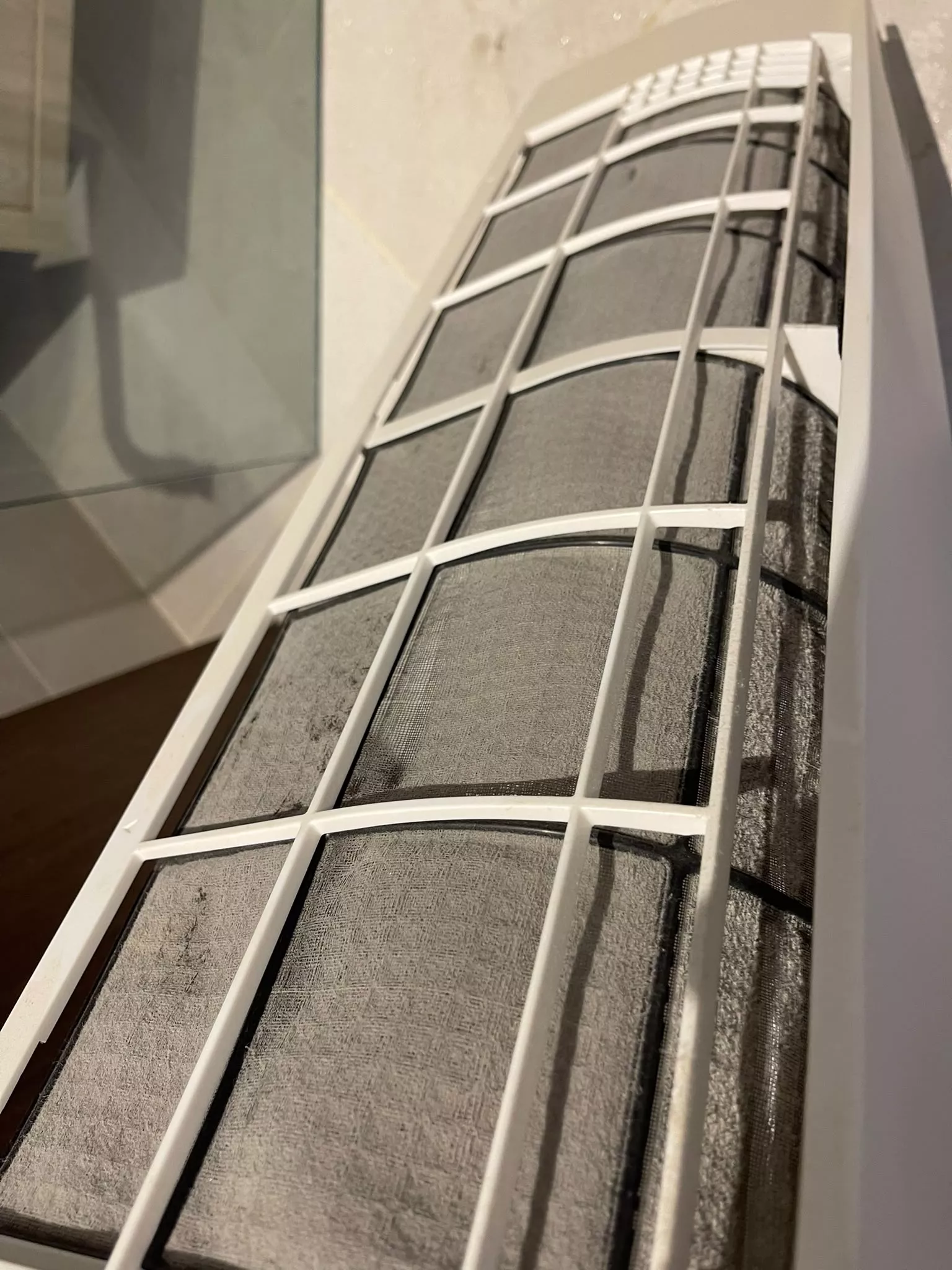
A whistle or whoosh that rises and falls with fan speed points to a partially blocked air filter or a gap in the ductwork (for ducted systems in landed homes). Clean or replace the filter first — homeowners can do this themselves every 4–6 weeks. If the whistle persists, the blower wheel may have a bent blade or the evaporator coil fins are clogged with dust. A chemical overhaul (dismantling the indoor unit, soaking the coil and blower in alkaline cleaner) costs $120–$180 for a single split and eliminates 95% of airflow-related whistles.
Clicking Sounds: Normal vs. Fault
Start-Up and Shut-Down Clicks
One or two clicks when you press the remote's power button are normal — that's the compressor relay and contactor engaging. Inverter aircons (Daikin, Mitsubishi, Midea) also produce a faint click every few minutes as the inverter board modulates compressor speed. Non-inverter units click once at start-up, run continuously, then click once at shut-down. If you hear this pattern, no action needed.
Rapid Clicking (Every 1–3 Seconds)
Continuous clicking without the compressor starting indicates a faulty start capacitor, run capacitor, or contactor. The capacitor provides the voltage surge needed to start the compressor motor; when it fails (typical lifespan 4–6 years in Singapore heat), the relay keeps trying and clicking. Capacitor replacement is $50–$90 for the part plus labour. Contactor replacement (the electromagnetic switch that routes power to the compressor) costs $60–$100. Both are diagnosed during the pre-check; the technician will measure capacitance with a multimeter (healthy start capacitors for residential splits are usually 30–50 µF; run capacitors 5–10 µF).
Clicking from the Indoor Unit PCB
If the click comes from behind the display panel, the main PCB (printed circuit board) relay may be cycling due to a sensor fault — often the thermistor (temperature sensor) reading erratically. Thermistor replacement is $40–$70; PCB replacement (if the relay itself has burnt contacts) is $150–$350 depending on model. Daikin and Mitsubishi PCBs are more expensive but widely stocked; generic Chinese brands (Midea, Haier) have cheaper boards but longer lead times (2–5 days).
Buzzing and Humming
Electrical Buzzing from the Outdoor Unit
A loud buzz (50 or 60 Hz mains hum) from the condenser means the contactor is buzzing because the coil inside it is worn or the contact points are pitted. This is an electrical-fire risk if ignored: pitted contacts create arcing, which generates heat and can melt the contactor housing. Replacement is urgent. Cost: $60–$100 for the part, 20 minutes labour. If you smell burning plastic near the outdoor unit, switch off the aircon at the isolator (the small metal box next to the condenser) and WhatsApp a technician immediately.
Compressor Hum Without Cooling
If the compressor hums but doesn't start, and the outdoor fan spins normally, the compressor motor windings may be failing or the start capacitor is dead. A technician will measure the capacitor first (quick fix if faulty). If the compressor itself is seized or has burnt windings (detectable by a burning smell or abnormal resistance reading across the terminals), compressor replacement costs $350–$650 for a 9,000–12,000 BTU unit, $500–$900 for 18,000–24,000 BTU. At that price point, and given labour to evacuate the system, replace the compressor, braze the pipes, vacuum-test, and recharge refrigerant, many customers opt for a new outdoor unit or full system replacement — a 9,000 BTU Daikin or Mitsubishi system-3 set costs $650–$950 installed.
Transformer Hum (Indoor Unit)
A faint hum from the indoor unit when it's off but still plugged in is the transformer on the PCB. Normal. If the hum is loud or accompanied by a burning smell, the transformer is overheating — switch off at the circuit breaker and call for service. Transformer replacement (part of the PCB) is covered under the PCB replacement cost above.
Grinding, Squealing, and Scraping
Blower Motor Bearings
A grinding or squealing noise that speeds up and slows down with the fan is a worn blower-motor bearing. Blower motors in Singapore aircons run 8–12 hours a day on average; bearings wear out after 8–12 years (faster if the unit was under-serviced and dust built up, increasing friction). Motor replacement costs $100–$180 for a standard single-split. The technician will remove the blower assembly, unbolt the old motor, fit the new one, and rebalance the blower wheel. Total time: 45–60 minutes.
Fan Blade Scraping the Housing
If you hear scraping on every revolution, the blower wheel or outdoor fan has shifted on its shaft, or the shaft itself is bent. This happens after a technician removes and refits the wheel carelessly during chemical cleaning. Realigning the wheel and tightening the set-screw is a no-cost fix if caught during a service visit. If the shaft is bent (usually from impact — something dropped into the outdoor unit), the entire fan assembly needs replacement: $80–$150 for outdoor condenser fans, $100–$180 for indoor blower assemblies.
Compressor Internal Damage
A grinding noise from the compressor itself (distinct from the fan) means internal mechanical failure — worn piston rings, damaged reed valves, or a scored cylinder. This is end-of-life for the compressor. Replacement cost is the same as the 'Compressor Hum' scenario above ($350–$900 depending on capacity). Compressor failure under 5 years is rare and usually covered by manufacturer warranty (Daikin and Mitsubishi offer 5-year compressor warranties; Midea and Haier 3 years). Check your purchase invoice; if still under warranty, the manufacturer supplies the part free, you pay labour only (~$150–$250).
When to Call for Service: Noise Decision Table
| Sound | Likely Cause | Urgency | Typical Repair Cost (SGD) |
|---|---|---|---|
| Rattle (indoor) | Loose panel, debris in blower | Low — book within 1 week | $45 (included in service) to $120 if blower wheel cracked |
| Rattle (outdoor) | Loose compressor mounts | Medium — vibration damages pipes over time | $30–$50 grommets + labour ($45 min) |
| Continuous hiss | Refrigerant leak | High — unit won't cool, leak worsens | $80–$450 (joint repair to coil replacement) + gas top-up |
| Rapid clicking | Faulty capacitor or contactor | High — compressor won't start, potential electrical fault | $50–$100 parts + labour |
| Electrical buzzing | Worn contactor | Urgent — fire risk | $60–$100 |
| Grinding (blower) | Worn motor bearings | Medium — motor will seize if ignored | $100–$180 motor replacement |
| Grinding (compressor) | Internal compressor failure | High — unit will not cool | $350–$900 compressor, or replace system |
| Soft hiss at start-up | Normal expansion valve | None | No action needed |
| Single click start/stop | Normal relay operation | None | No action needed |
Preventing Noise Issues
Regular Servicing Every 3–4 Months
Most noise problems develop gradually: dust builds up, bearings dry out, screws vibrate loose. A quarterly service (standard for Singapore humidity and usage) catches these early. During a $45 standard service for 1 unit, the technician removes and cleans the filter and front panel, checks all mounting screws, inspects the blower wheel for cracks, and listens to the compressor start-up. If something sounds abnormal, it's flagged and quoted before it becomes a $200+ emergency repair.
Chemical Wash Every 12–18 Months
A chemical overhaul ($120–$180 per indoor unit) prevents the dust and mould build-up that causes blower imbalance and airflow whistles. For households with pets, smokers, or located near construction (common in HDB estates undergoing upgrading), every 12 months is recommended. Landed homes with ducted systems benefit from duct inspection and cleaning every 24 months ($250–$450 depending on duct length).
Outdoor Unit Shelter and Clearance
Condenser units mounted in direct sun (west-facing facades especially) run hotter, aging capacitors and contactors faster. If permitted by MCST or HDB town council rules, install a simple metal or polycarbonate shelter above the unit (maintain 30 cm clearance on all sides for airflow). This extends compressor and electrical component lifespan by 20–30%. Cost for a DIY shelter: $40–$80 at hardware stores; professional installation ~$100–$150.
Frequently Asked Questions
Is it safe to keep using a noisy aircon?
Depends on the noise. Rattles and soft hisses at start-up are safe to ignore short-term, but buzzing, continuous clicking, or grinding should be addressed within 48 hours. Electrical buzzing especially is a fire risk. If in doubt, switch off the unit and WhatsApp a photo or video of the noise source — most technicians can give an urgency assessment remotely before booking a visit.
Can I fix aircon noises myself?
Homeowners can safely tighten visible front-panel screws, clean or replace the air filter, and clear debris from around the outdoor unit. Do not open the outdoor unit cover (risk of electric shock from the capacitor, which stays charged even when powered off), do not attempt refrigerant work (illegal without a licensed technician under NEA rules), and do not dismantle the indoor blower unless you're confident reassembling it — incorrect reassembly causes the scraping noises described earlier.
How much does a diagnostic visit cost if I don't proceed with repair?
At aircons.sg, the 9-point pre-check is included with any service booking from $45 for 1 unit. That $45 covers the technician visit, the inspection, and standard servicing (filter clean, basic exterior wipe-down, functionality test). If additional work like capacitor replacement or gas top-up is needed, it's quoted transparently on-site; the $45 forms part of the total bill. If you choose not to proceed with the recommended repair, the $45 covers the visit and diagnosis — we don't waive it because the technician's time and the inspection work have already been delivered.
Do inverter aircons make less noise than non-inverter?
Yes, typically. Inverter compressors ramp speed gradually and run continuously at lower RPM, producing 40–50 dB indoor vs. 45–55 dB for non-inverter units that cycle on-off abruptly. However, inverter PCBs add faint electronic clicking and the outdoor inverter module can emit a high-frequency whine (14–16 kHz) that some people find annoying, though most adults over 35 can't hear it. If you're noise-sensitive, Daikin's Comfort and Mitsubishi's Starmex ranges have additional noise-damping and are rated ~38 dB indoor.
Will a new aircon eliminate all noise?
No aircon is silent. Expect 38–45 dB from the indoor unit (comparable to a library or quiet bedroom) and 50–60 dB from the outdoor unit (normal conversation level) when standing 1 metre away. Installation quality matters: if the brackets aren't level or the pipes aren't secured with clamps every 50 cm, vibration noise will appear within 6 months even on a premium unit. A good installer torques all flare nuts to spec (25–30 Nm for 1/4-inch and 3/8-inch pipes), uses rubber-lined P-clips for pipe runs, and tests the unit under load before leaving. aircons.sg includes installation quality checks in its workmanship warranty — 2 years on a new installation, 90 days on a repair.
Book a Diagnostic Visit Today
Aircon noise rarely fixes itself — it's a symptom of wear, damage, or installation issues that worsen over time. Whether you're hearing rattles, hissing, grinding, or electrical buzzing, a technician visit identifies the root cause and gives you a transparent quote for the fix. aircons.sg includes a comprehensive 9-point pre-check with every service booking, starting from $45 for a single unit. You'll know exactly what's wrong and what it costs before any work begins, backed by our 90-day workmanship warranty. Quoted prices are final. Same-day appointments available across Singapore. WhatsApp us at +65 9107 2601 with a quick description of the noise (or a short video clip), and we'll get you booked in.