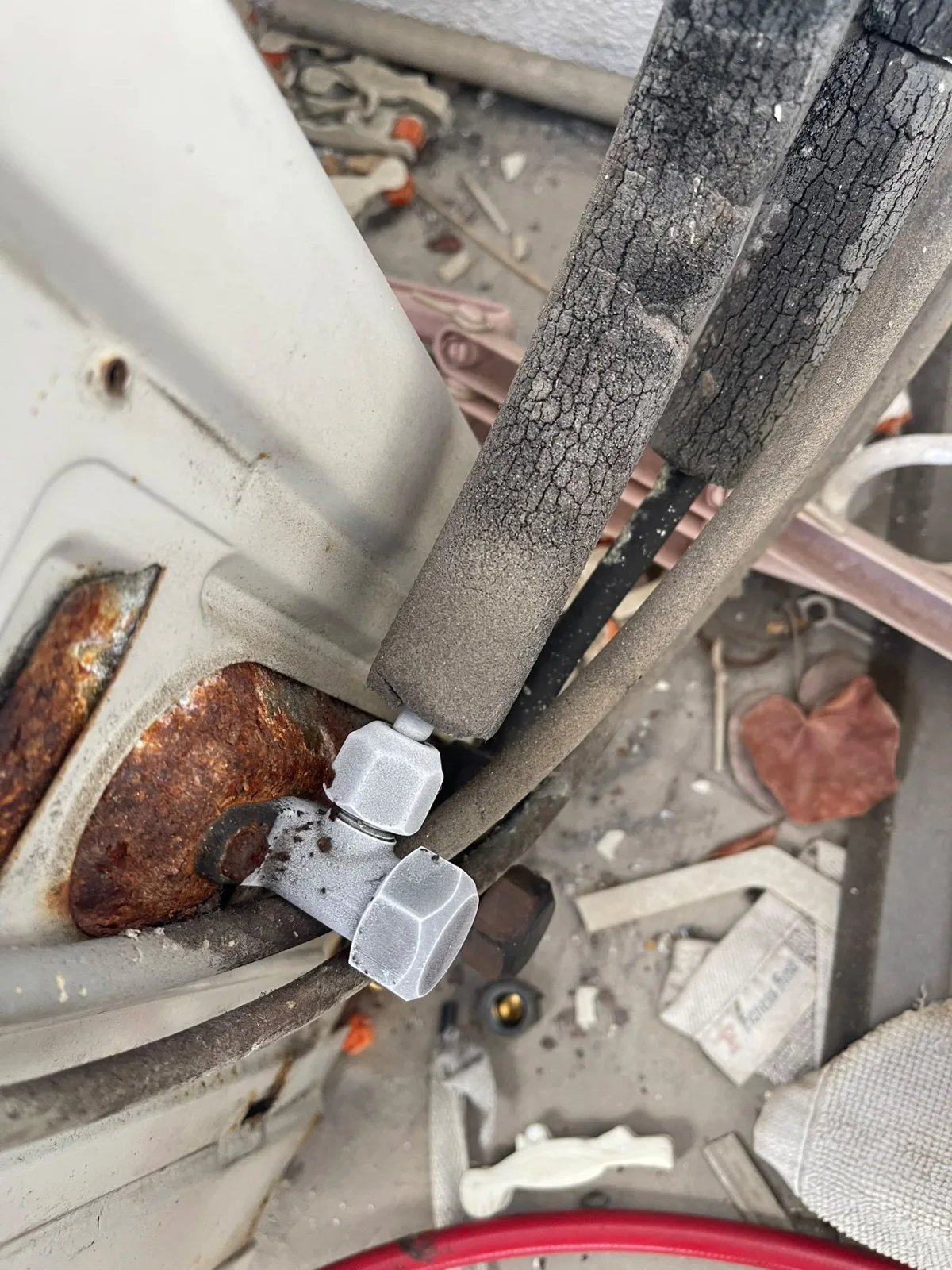
Pictured: the service valve on the outdoor unit of a 2011 Daikin at a Central home, covered in frost during the gas check. The home's ceiling cassette had stopped cooling.
When an aircon stops cooling, most people book the service they have heard of: a wash. It is a sensible guess, because dirt is the commonest reason a unit cools badly. But it is a guess, and on a unit that has lost gas it is money spent on the wrong job. A wash cleans. It does not put refrigerant back, and it does not find where the refrigerant went.
This post uses one real job from 18 November 2026 to show how the two causes look different, why the gas gets read before anything is cleaned, and what you can tell a technician on the phone so the visit starts in the right place. Prices are the ones on our pricing page and our aircon gas leak repair cost page.
The job: a ceiling cassette that was not cooling
A Central home had a Daikin ceiling cassette that was not cooling. Our team checked the outdoor unit, which dated from 2011, and found a gas leak, with a frosted service valve. The cassette's coil was also dirty and had not been serviced. So this unit had both problems at once, which is common, and it is exactly why guessing from the symptom is risky: either one on its own can leave a room warm.
After the owner agreed, our team topped up R410A on the one outdoor unit instead of carrying out a service. The job record has the reasoning in one line: low refrigerant from a leak is why a cassette can stop cooling and frost up at the valve, which is why a gauge check comes first. You can see the photos and details on the Central gas top-up job page.
What frost on the outdoor pipe or valve can mean
Frost or ice on the copper pipes is one of the signs we list for a gas leak: ice forming on the pipes or the indoor coil, which then melts, drips and looks like a water leak. On this job the frost was at the outdoor unit's service valve. We are not saying frost always means a leak. Airflow problems from a dirty filter, coil or blower can also push a coil cold enough to ice over, and we cover that side in our guide to ice on an aircon in Singapore. The point is that frost is a reason to measure, not a diagnosis.
Why gas and dirt need different jobs
Refrigerant is not used up the way fuel is. It circulates in a sealed loop between the indoor and outdoor units, and in a healthy system the same gas keeps circulating for the life of the aircon. So when a system is low, the gas went somewhere: a loosened flare joint, a corroded coil, a pinhole in the piping. That makes "how much does a top-up cost?" the second question. The first is "where is the gas going?"
| If the cause is | What you tend to notice | What fixes it |
|---|---|---|
| Dirt (filter, coil, blower, drain) | Weak airflow, slow cooling, smell, water from the unit | Servicing or a chemical wash, depending on how dirty |
| Low gas from a leak | Air that blows but is not cold, cooling that fades over weeks, ice on the pipes or coil, hissing, a top-up that did not last | Find the leak, then top up (and repair if a pipe or coil is leaking) |
| Both, as at the Central home | A mix of the above | Both need dealing with, and the gas decides whether the unit can cool at all |
That last row is reasoning, not a published rule: a unit that is low on gas will not cool however clean its coil is.
How the pre-check separates them
Every service booking with us includes a 9-point pre-check before anything is dismantled. Two of the nine points decide this question. The temperature drop measurement compares intake and output air, and it tells us whether the issue is gas-related or cleaning-related. The compressor pressure reading uses professional gauges to check refrigerant pressure (R32, R410A or R22), which detects gas leaks before they damage the compressor. A third point, the filter and coil dirt assessment, is where we tell you whether you need a general service or a chemical wash. The pre-check takes about 10 to 15 minutes.
The full list of what is checked is on the 9-point pre-check page. The reason it is done first is simple: if the work started with a wash, a gas problem could be discovered only afterwards, after you had paid for the wash.
What each path costs, on the published prices
These are the figures on our pages. Read them as a map of the decision, not a quote for your unit.
- The visit: $55 for 1 wall unit (general cassette servicing is $60 per unit). It covers the technician visit, the 9-point pre-check (including the gas pressure check) and standard servicing if that is what the unit needs.
- If gas is the problem and a top-up is the practical fix: R22 $115, R410A $130, R32 $170, per outdoor circuit. It is priced per outdoor circuit, not per indoor unit, so indoor units that share one outdoor unit share one circuit.
- If the leak has to be found: a nitrogen pressure test at $180 per fan coil unit (System 3 is $540), and the aircon cannot be used for 2 to 3 days.
- If a pipe is the leak: piping replacement is HDB $520 per fan coil unit, or condo $700 per fan coil unit. A corroded coil or concealed pipe work is quoted after the pressure test.
- The wash you might have booked instead: for a cassette, general servicing is $60 and a chemical cassette clean is $340 per unit. For a wall unit, a chemical wash is $135 for 1 unit. Our guide to cassette cleaning prices explains why a cassette is not priced like a wall unit.
Put side by side, the point is clear. If the problem is gas, a $340 chemical cassette clean does not touch it. If the problem is dirt, a top-up does not touch that. Booking by symptom alone can mean paying for the wrong one.
A slow leak and a fast leak are different decisions
Not every leak is urgent. A very slow leak may lose gas over a year or more, and an occasional top-up can genuinely be the practical choice; when that is the case, we say so. A fast leak that empties the system in weeks is different: you are renting gas, not fixing the aircon, and three or four top-ups can cost more than the actual repair. The only way to know which you have is to check the pressure, and to ask when the system was last topped up.
If you already had a repair done and the cooling is fading again, our guide on how to tell a gas leak repair held covers the 90-day workmanship warranty that repair work carries.
What to do before you book
- If there is ice, stop cooling. Switch to fan-only and let it thaw before you do anything else, as in the ice guide above. Do not chip it.
- Check the filter. A clogged filter is the one dirt cause you can rule in or out yourself.
- Read the sticker. The refrigerant type is printed on the nameplate sticker on the outdoor condenser, or on the side of the indoor unit. As a rough guide, older systems use R22, many mid-2010s systems R410A and newer inverter systems R32. A photo of the sticker saves a round of questions, and it tells us which top-up price applies.
- Write down the pattern. Did it fail overnight, or fade over weeks? When was the last service, and was there ever a top-up? A sudden failure points one way, gradual fading another.
- Ask one question. "Will you read the gas pressure before you clean anything?" A company that answers yes is working out the cause first.
If you decide not to go ahead
The pre-check page is clear on this. If the fix needs more than standard servicing, you get a transparent quote, and if you proceed, the $55 minimum is part of the total, so you are not charged twice for the diagnosis. If you decide not to proceed, because the cost is too high or you want to think it over, the $55 covers the visit and the diagnosis. For a leak that has to be located, a pressure test already carried out is charged, and nothing is charged towards a repair you did not approve. Our post on what you owe if you want time to think goes through it step by step.
Send us the details
The message below opens in WhatsApp with the fields laid out. Fill in what you know and leave the rest blank. WhatsApp us on 9107 2601 and we will tell you what the visit covers and the price on our published table.