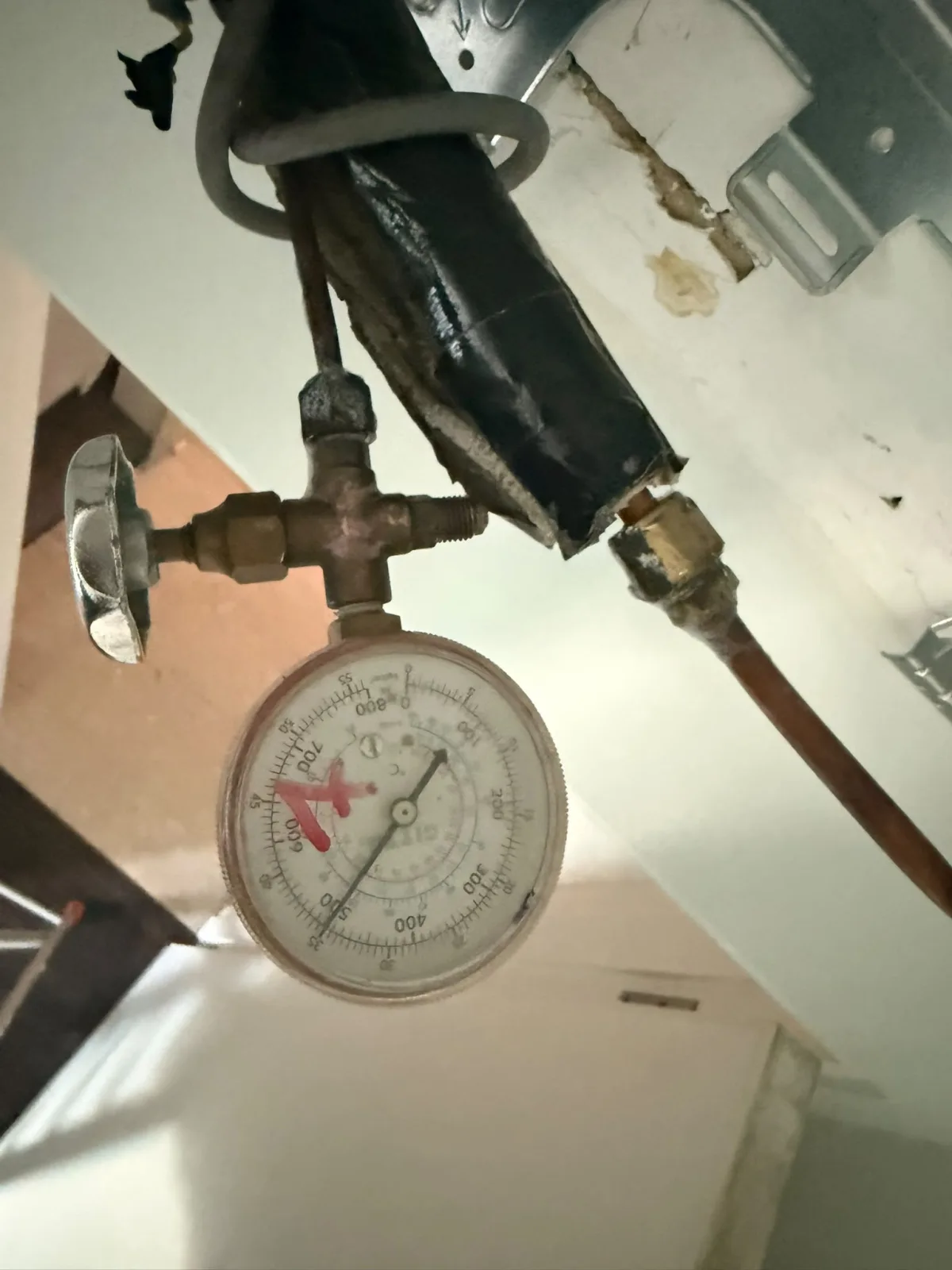
Pictured: a pressure gauge connected to the piping of an indoor unit during a nitrogen pressure test on one of our jobs. A reading like this is how a leak is confirmed, and it is also the kind of thing worth asking to see when a leak repair is finished.
The technician has gone, the aircon is cold again, and the invoice says gas leak repair or gas top-up. Most people stop thinking about it at that point. The better moment to think about it is now, because a leak repair is the one aircon job where "it works today" and "it was fixed" are not the same thing. A system can be cold on the day because it has been refilled, and still be losing gas through the same joint.
This post is about the weeks after the visit: what you should be holding, what is worth noting down, what fading looks like, and what to do inside the 90-day workmanship warranty that repair work carries on our published pages. Prices are the ones on our aircon gas leak repair cost page.
Three things may have been done to your aircon
"Gas leak repair" on an invoice can describe three quite different outcomes. Which one you had decides what you should watch for.
| What was done | What it tells you about the leak | What to watch |
|---|---|---|
| Gas top-up only (R22 $115, R410A $130, R32 $170 per outdoor circuit) | The refrigerant was replaced. The place it escaped from may not have been found or fixed. | Whether cooling fades again, and how fast |
| A leak found and repaired (a joint re-made, a pipe section or the piping set replaced) | The cause was dealt with, and the system was refilled afterwards. | Whether the same unit still loses cooling |
| A pressure test that found nothing | The circuit held its reading, so the problem may be elsewhere (dirt, airflow, a fault). | Whether the symptom changes at all |
The first row is not wrong. Refrigerant is not used up, because it circulates in a sealed loop and the same gas should keep circulating for the life of the system. A very slow leak can take a year or more to empty it, and for that kind of leak an occasional top-up can honestly be the practical choice. But it is a different thing from a repair, and an invoice that does not say which one you bought leaves you unable to judge what happens next.
What you should be holding before the technician leaves
Ask for these on the day, on paper or in your phone. They cost nothing and they settle most later arguments.
- Which unit, which refrigerant. The refrigerant type is printed on the sticker on the outdoor unit (older systems tend to be R22, many mid-2010s systems R410A, newer inverter systems R32). The invoice should match your sticker.
- Whether a leak was located. "Topped up" and "leak found at the flare joint on the bedroom unit and re-made" are different sentences. If a leak was found, the invoice should say where.
- What was measured. The 9-point pre-check includes a gas pressure check. A steady reading on a pressure test means the circuit is sealed, and a falling one confirms a leak. Ask what the reading was and whether it held.
- The date, and the line the warranty belongs to. Repair work carries a 90-day workmanship warranty on our service pages. Ask which line of your invoice that attaches to, and write the date it starts next to it.
If any of these are missing, ask for them in a WhatsApp message the same evening, while the visit is fresh. A message with a date on it is far easier to act on in week nine than a recollection.
A simple log for the first 90 days
Nothing in this section is a published rule. It is how we would keep an eye on a repaired system in our own home, and it needs nothing more than your phone.
- On the day: note how long the room takes to feel properly cool after you switch on, at the temperature you normally use. That is your baseline. A guess is enough.
- Around week one, week four and week eight: run the unit for the same stretch in the same kind of weather and compare. You are looking for the baseline getting worse, not for a precise number.
- Look at the copper pipes at the indoor unit and listen near the outdoor unit once in a while. Ice on the pipes or the indoor coil, or a hissing sound, are on our published list of signs of a leak.
- Glance at the electricity bill in the months after. A low-gas system runs longer for the same cooling, so a bill that creeps up with no other change is a prompt to check the log.
The point of the log is to turn "it feels a bit weaker" into "it was fine on 17 November and by early January it takes much longer". The second sentence is one a technician can work with.
What fading looks like after a repair
A leak that was not really fixed usually announces itself slowly. On our published list the first sign is cooling that fades gradually over weeks rather than failing overnight, with the aircon still blowing air but not cold. After that comes ice forming on the copper pipes or the indoor coil (which then drips and looks like a water leak), hissing from the unit or the piping, and the bill creeping up.
A sudden loss of cooling is a different pattern, and it is worth ruling out the simple causes first. A dirty filter or a blocked drain can make a repaired unit feel weak without any gas being involved. Our guide to what to check when an aircon is still not cold after servicing covers those checks. Gas is the cause only when the pressure says so, which is why the pressure reading is the thing to ask for.
Inside the 90 days: what to send us
If the cooling fades again while the warranty is running, do not top up again on your own account. Message us with the invoice. The warranty is a workmanship warranty: it covers the work that was done, not the age of the machine, and our guide to what a workmanship warranty covers explains where that line sits.
The service page says that repair work carries the 90-day workmanship warranty. It does not spell out how a visit that was only a gas top-up is treated, and we are not going to guess at that here. That is exactly why the earlier question matters: get the line written on the invoice, and if you are unsure, ask the company that did the work (including us) to confirm in writing what the 90 days covers on your invoice.
To make the message useful, include:
- The date of the repair and the date cooling started to fade.
- The refrigerant type from the outdoor unit sticker.
- Which room or unit, and whether you have a multi-system (a System 3, for instance, has three indoor units on one outdoor unit and one refrigerant circuit).
- Any ice, hissing or drips, with a photo of the pipes if you can.
When the repair did not hold
If the unit is losing gas again, the useful question changes from "how much is a top-up?" to "where is the gas going?". A top-up on a system that empties in weeks means you are paying for gas that leaves again. On our price list the next step is a pressure test at $180 per fan coil unit (a System 3 is $540), and the aircon cannot be used for 2 to 3 days while it is done. We wrote about planning around that in the nitrogen pressure test and the 2 to 3 days without the unit.
If the test finds a leaking pipe, a pipe change is HDB $520 per fan coil unit or condo $700 per fan coil unit. A corroded coil or concealed pipe work is quoted after the test, and you see the figure before any work starts. If you decide not to go ahead, you pay only for the visit and any pressure test already carried out, and nothing towards the repair. The questions to put to any company before approving are in our guide to checking an aircon gas leak quote.
After the 90 days
The warranty window ending does not mean the question is closed. A slow leak can take longer than 90 days to show, so keep the invoice and your note of the baseline. The next normal service visit includes the 9-point pre-check with its gas pressure check, which is a natural moment to say "this system had a leak repaired in November" and ask for the pressure reading to be compared with what you were told then. Our piece on why an aircon keeps losing gas lists the usual places it escapes if you want to know what to ask about.
The short version
- A cold aircon on the day of a leak repair proves the system was refilled, not that the leak is fixed.
- Get the unit, the refrigerant, the place the leak was found (or a note that it was not) and the pressure reading on the invoice.
- Repair work carries a 90-day workmanship warranty on our pages; write the start date on the invoice.
- Note how long the room takes to cool on day one, then compare around weeks 1, 4 and 8.
- Cooling that fades gradually, ice on the pipes or hissing points back at gas. Do not keep topping up: ask for the leak to be found.
If you would like us to look
The message below opens in WhatsApp with the fields laid out. Fill in what you know and leave the rest blank. WhatsApp us on 9107 2601 and we will tell you what the visit covers and the price on our published table.