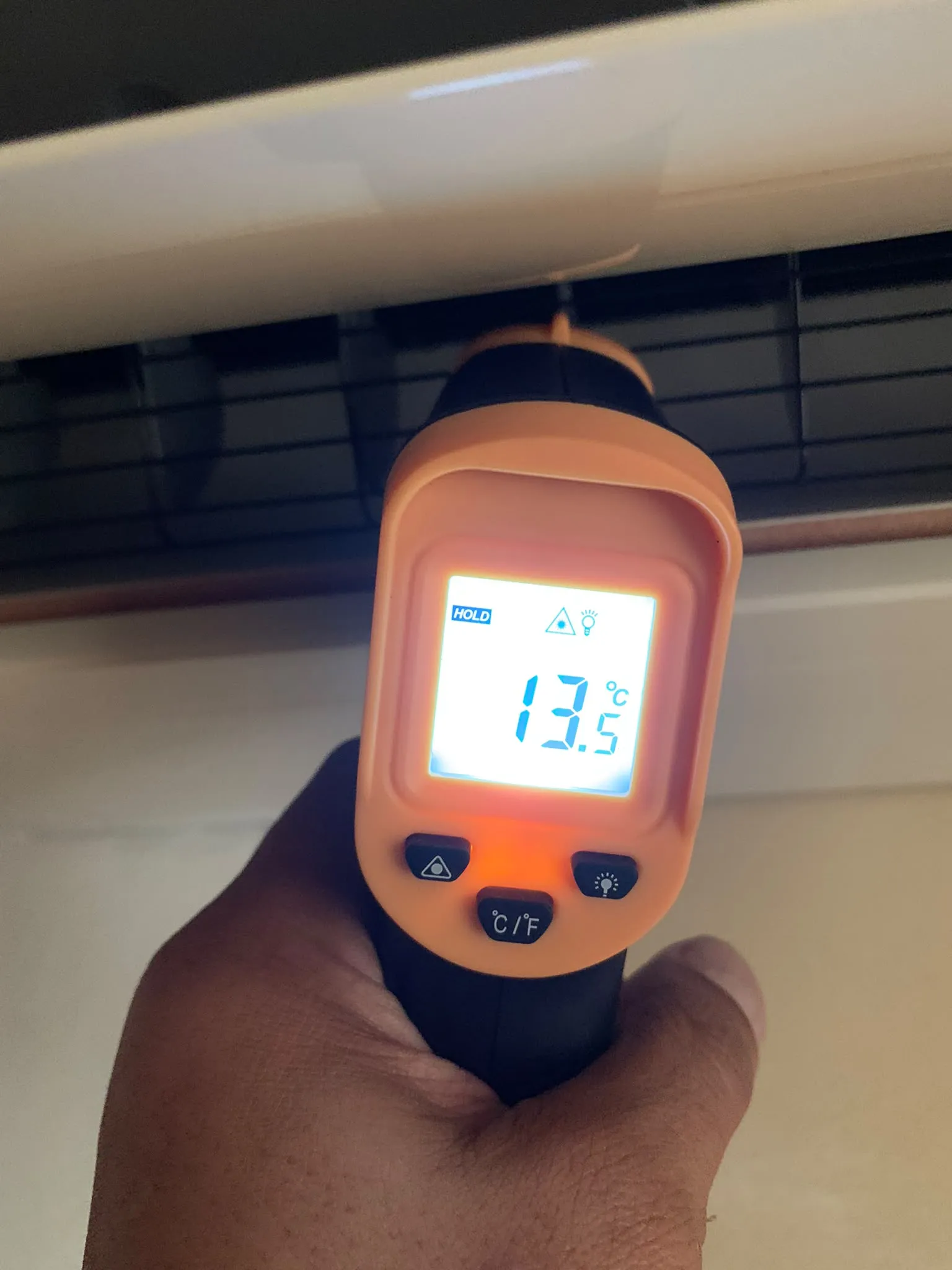
Pictured: an infrared thermometer reading the air at the vent of an indoor unit during a service on one of our jobs. A reading like this is one of the things we use to decide whether a unit that "is not cold" is short of refrigerant or just dirty.
"My aircon has a gas leak. Is it dangerous? Should I move the kids out of the room?" It is one of the questions we get most often, and it is usually asked in a worried tone by someone who has just been told the words "gas leak" by a technician or read them on a forum. The honest answer is calmer than the phrase suggests, but it is not "ignore it". This post separates the two meanings of "gas leak", says what is worth worrying about and what is not, lists what to do at home while you wait for a visit, and sets out what it costs on our published prices.
Two different things people call a gas leak
The first is the one you smell near a cooker or a gas pipe. That is cooking gas, it has nothing to do with your aircon, and it is an emergency for the gas supplier or the emergency services, not for an aircon company. If that is your situation, stop reading this and deal with it first.
The second is what we mean here. An aircon is a sealed loop of copper pipe, and inside it a refrigerant circulates between the indoor unit and the outdoor unit. Refrigerant is not used up the way fuel is, so a system that is "low on gas" has lost some of it through a loose flare joint, a corroded coil or a pinhole in the piping. That is what "aircon gas leak" and "aircon gas leakage" both mean. We cover the usual places it escapes in why your aircon keeps losing gas.
Is it dangerous?
For a home split system, generally no. The refrigerants in Singapore homes are R22, R410A and R32, and none of them is toxic in the small quantity a household system holds. R32, the one in newer inverter units, is classified as mildly flammable. That is a reason to keep naked flames, torches and anything hot away from the pipework, and a reason to leave any brazing or joint work to a technician. It is not a reason to panic, and it is not something that turns a normal evening in the flat into an emergency.
Where the real damage lies is in the money. A system running low on refrigerant overworks the compressor, which is the most expensive single part of the unit. So the useful way to think about a leak is not "will it hurt us tonight" but "what does it cost me every week I leave it". Fix it promptly, but there is no need to rush into a decision you do not understand.
One caution on the other side: a burning smell is a different problem and should not be waved off as "just the gas". If that is what you have, read what to do first when an aircon smells of burning.
How to tell it is gas, and not dirt or a fault
Not every warm room means a leak, and this matters because a top-up on a system that is not short of gas does no good. These are the signs we treat as pointing at refrigerant:
- The aircon blows air, but it is not cold, or the room takes much longer to cool than it used to.
- Ice forming on the copper pipes or the indoor coil. When it melts it drips and looks like a water leak.
- Hissing from the indoor unit or along the piping.
- Cooling that fades gradually over weeks rather than failing overnight.
- An electricity bill that creeps up, because a low-gas system runs longer for the same cooling.
- A previous top-up that did not last.
Of these, a top-up that did not last is the strongest. If your last top-up faded within a month, that is a significant leak, and a third or fourth top-up is renting gas rather than fixing the aircon. Our guide to telling a top-up job from a leak repair sets out the other tells, and the one on an indoor unit that freezes over explains why ice can mean low gas or a false alarm.
What to do at home while you wait
- Do not keep running a unit that is clearly not cooling. It will not fix itself, and a low-gas system makes the compressor work harder every hour it is on. Run a fan or the other rooms' units if you have them.
- If there is ice, switch to fan-only or off and let it thaw. Do not chip it. Put a towel under the unit, because the meltwater can be a lot.
- Look at the filter first. A choked filter can also cause ice and weak cooling, and it takes two minutes to check. If it is clean and the problem is still there, a leak becomes more likely.
- Do not do anything with heat or flame on the pipes yourself, and do not try to "top it up" from a can or a kit. The right amount depends on the system, and adding gas to a system that has not been tested only hides the leak for a short time.
- Write down when it was last topped up and how long that lasted. That one fact tells a technician more than any other.
- Photograph the nameplate sticker on the outdoor unit. It states the refrigerant type, which decides the top-up price, and you can read it without climbing anywhere if the unit is reachable safely. Do not climb out onto a ledge for it.
What a visit finds out
The first step is the same whatever the cause. The visit with the 9-point pre-check includes a gas pressure check, and it is $55. That tells us whether the system really is low, which is the thing you cannot see from the floor. You get the finding and an exact quote before any work starts, and you decide.
If a leak is suspected and has to be found, the next step is a nitrogen pressure test of the piping. It is the only step that takes the aircon out of use for a while, 2 to 3 days, so plan for it. We explain what that means for a household in planning for 2 to 3 days without the unit.
What it costs, from our published prices
These are on our gas leak repair cost page and our pricing page. The price you are quoted is the price you pay.
- Visit with 9-point pre-check, including a gas pressure check: $55.
- Gas top-up, flat, per outdoor circuit: R22 $115, R410A $130, R32 $170.
- Nitrogen pressure test: $180 per fan coil unit (a System 3 is $540). The aircon cannot be used for 2 to 3 days.
- Piping replacement: HDB $520 per fan coil unit, or condo $700 per fan coil unit.
- Concealed pipe work or coil repair: quoted after the pressure test, because it depends on where the leak is, how easy the pipe is to reach and how long the run is.
- Compressor replacement, if it comes to that: quoted on site, and the price varies by site.
- Repair work: covered by a 90-day workmanship warranty.
Most cases come down to the flat top-up. Remember the units trap: the top-up is per outdoor circuit, so a System 3 is one top-up and not three, while the pressure test and the piping replacement are counted by fan coil unit. If a quote does not say which it is counting, ask. Our guide to checking an aircon gas leak quote before you approve it goes through the questions line by line.
When a very slow leak can wait
Not every leak is urgent. A very slow leak can lose gas over a year or more, and an occasional top-up can then be the practical choice. When that is the case, we say so. A fast leak that empties the system in weeks is the other end, and there the arithmetic goes against topping up. The only way to know which you have is to check the pressure, so do not guess from the room temperature alone.
What to tell us when you WhatsApp
- Which unit or room is affected, and how many indoor units are on the system.
- A photo of the sticker on the outdoor unit, which shows the refrigerant type.
- When the gas was last topped up and how long it lasted.
- Whether there is ice on the pipes, hissing, or cooling that faded slowly.
- Any quote you already have, and what it says it covers.
The short version
- A household aircon gas leak is generally not dangerous to the people in the room. R32 is mildly flammable, so keep heat and flame away from the pipes.
- The real cost of a leak is a compressor that works too hard, so do not leave a clearly weak unit running for weeks.
- Do not top up repeatedly. If one did not last a month, test for the leak instead.
- The $55 visit with the 9-point pre-check and gas pressure check is the first step, and you get an exact quote before any work starts.
If you would like us to look
The message below opens in WhatsApp with the fields laid out. Fill in what you know and leave the rest blank. WhatsApp us on 9107 2601 and we will tell you what the visit covers and the price on our published table.