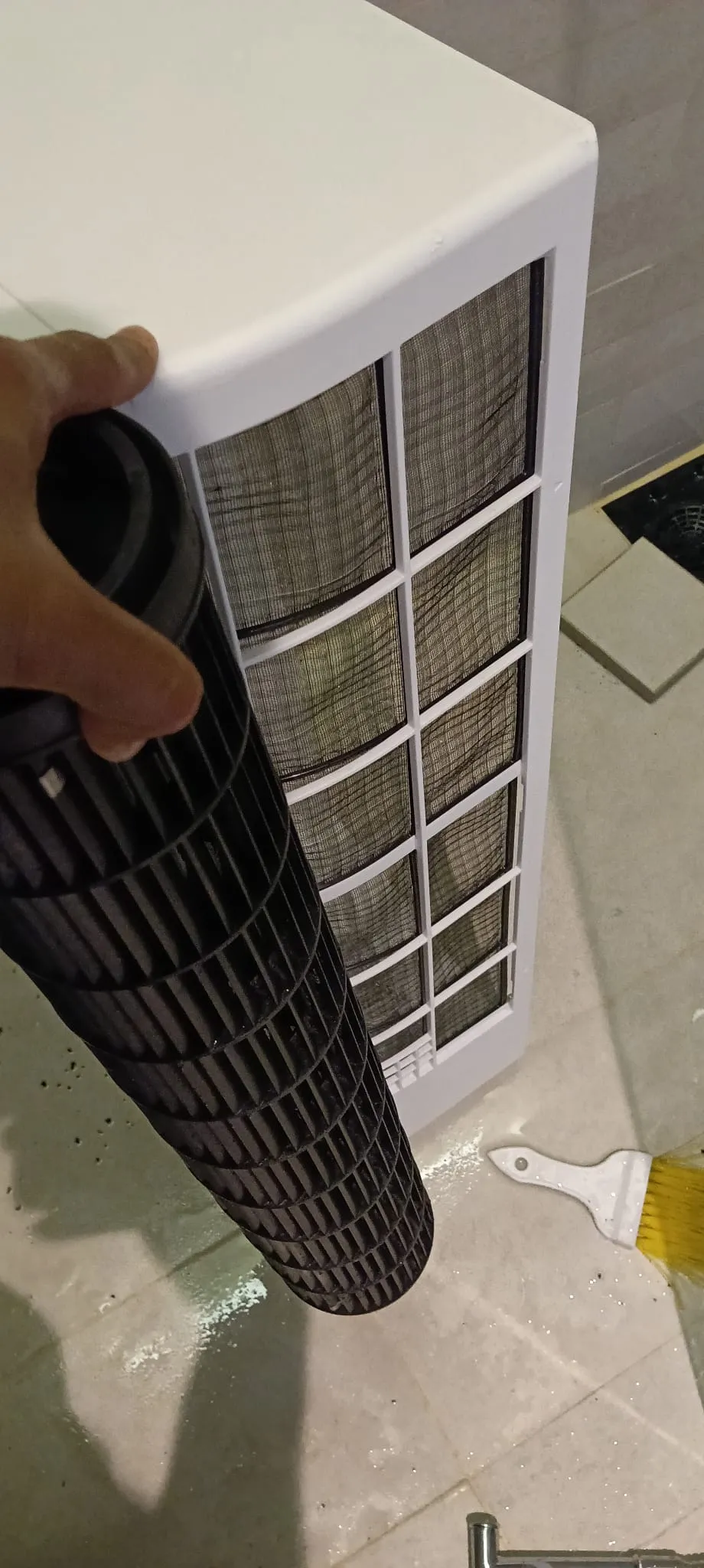
Pictured: a blower barrel, the dark drum fan from inside an indoor unit, held next to the unit's filter mesh during a service on one of our jobs. This is the part that decides how much cold air actually leaves the unit, and it is one of the two things we look at first when a room is warm in the afternoon.
A message we get fairly often goes like this: "My aircon is fine in the morning. By three in the afternoon the room is warm and the unit is running non-stop. Is it spoilt?" Sometimes it is the unit. Just as often, the unit is working as it always did and the room has simply become a harder job, because the sun has moved onto the window or the wall. The trick is telling those two apart before you pay for the wrong fix. This post sets out how we separate them, what you can check yourself with a torch and a bit of patience, and what a service can and cannot change.
First, which pattern is yours?
Write down what you actually see for two days. Most cases fall into one of three patterns, and each points somewhere different.
- Cool all morning, weaker only from early afternoon to evening, and fine again after dark. This follows the sun, so the room is gaining heat faster than before. The unit may be healthy, or it may be healthy but with no spare capacity left.
- Never really cold, at any hour. That is not the sun. Look at our guide to an aircon that is still not cold after a service and the longer not cold enough troubleshooting guide.
- Used to cope in the afternoon, stopped coping recently. Something changed. Either the unit slipped (dirt, airflow, charge), or the room did (curtains or window film taken down, more people at home during the day, a door left open to the next room).
The first pattern is the one this post is about, because it is the one people most often blame on the machine.
Why the afternoon is harder than the morning
An aircon does not make cold. It removes heat from the room and carries it outside. When the afternoon sun hits a window or a west-facing wall, more heat comes into the room than in the morning, so the same unit has more to remove. A unit with room to spare absorbs that and you never notice. A unit that has lost some of its performance to a dirty coil, a furred blower barrel or a choked filter has no room to spare, and the afternoon is the first time it shows.
That is the part only a site visit can tell you, and it is why we read the figure on point 2 of our 9-point pre-check, the temperature drop between the air going into the unit and the air coming out. If that drop is poor at any hour, the problem is in the unit. If it is where it should be and the room is still warm at three, the unit is doing its job and the room is asking too much of it. We do not quote a target number in this post, because it differs by unit and we will not give you a figure that fits no model in particular.
What you can check yourself
You need your phone torch and a chair you can stand on safely. Switch the unit off at the remote before you touch anything, and do not touch the coil: the fins bend and cut easily.
- Feel the air at the vent in the morning, then again at about three. Hold your hand a short distance in front of the louvre, not on it. If the air feels just as cold at both times and the room is still warm, that points at the room. If the air itself is clearly less cold in the afternoon, that points at the unit or the outdoor side.
- Repeat the afternoon with the curtains or blinds closed. Do it on a day with similar weather. If the room holds much better with the sun blocked, you have your answer, and no technician needs to open the unit to prove it.
- Close the door and the gap under it. A bedroom door left ajar to a hot corridor or an open kitchen quietly adds to the load all afternoon. Our guide to a room that never gets cold covers the air-path causes in more detail.
- Take the filter out and hold it up to the light. If you cannot see light through it, it is choked. We set out how to wash it and where DIY stops in our filter washing guide. Put it back dry and fully seated.
- Look at the outdoor unit if you can see it safely. Is it in direct afternoon sun with something stacked in front of it, or boxed in so the fan has nowhere to push the hot air? Do not climb out to a ledge for this. Look from a window or ask us to look.
If steps 2 and 3 fix it, the unit is fine. If they do not, and the filter is clean, the next suspect is what you cannot see: the coil and the blower barrel behind the filter.
The part you cannot see: coil and blower
The coil is the finned surface behind the filter. Dust that gets past the filter sticks to it, and in a humid country the layer stays damp and builds up. The blower barrel, the drum in the picture above, collects a felt of dust on its blades and moves less air as it does. We cover why a normal service does not reach it in our post on the blower wheel.
A unit with a dirty coil and a furred barrel can feel acceptable at ten in the morning, when the room is only lightly loaded, and be beaten by three. That is why "fine in the morning, weak in the afternoon" is so often the first sign of a unit that needs a chemical wash, not a sign of a broken one.
What a service can fix, and what it cannot
A service or wash can fix:
- Airflow lost to a choked filter, a fouled coil or a furred blower barrel.
- A drainage line that is partly blocked.
- Small things the pre-check catches that you would never see from the floor, such as an outdoor fan that is not turning as it should.
A service will not fix:
- A large west-facing window with no curtain, film or blind. That is a heat gain from the building, not a fault in the unit.
- A unit that was too small for the room from the start, or a room that was extended or opened up afterwards. Our BTU sizing guide explains why a chart on the internet can get this wrong.
- A room that now holds more people, more equipment or more hours of use than when the unit was fitted.
The pre-check is how we tell you which list you are on. If it is the second one, we say so and you decide, and you are not sold a wash that cannot help. If we find the unit is the cause, we quote the right job. The $55 for one unit covers the visit and the pre-check.
What it costs, from our published prices
Everything below is on our pricing page, and the price shown is the price you pay.
- Normal servicing (wall unit): $55 for 1 unit, $90 for 2, $120 for 3, $160 for 4, then $35 per unit from 5. The $55 covers the visit, the 9-point pre-check and standard servicing.
- Chemical wash: $135 for 1 unit, $245 for 2, $345 for 3, $425 for 4, then $100 per unit from 5. See the chemical wash page.
- Chemical overhaul: $200 for 1 unit, $370 for 2, $515 for 3, $640 for 4, then $150 per unit from 5. See the chemical overhaul page.
If the pre-check shows something else, such as low refrigerant or a part, we explain it and quote it on the spot. If you go ahead, the $55 is part of the total and you are not charged twice for the diagnosis. If you decide not to, the $55 covers the visit and diagnosis and nothing more.
What to do while you wait for the visit
- Close the curtains or blinds on the sunny side from about noon. It costs nothing and it makes the test above meaningful.
- Do not drop the set temperature to the lowest figure and leave it. It does not cool the room faster, and a unit that is already struggling will just run flat out.
- Keep the filter clean, and do not spray anything into the vent. It does not clean the coil and the unit blows it into the room.
- Do not stack things in front of the outdoor unit or cover it.
What to tell us when you WhatsApp
- Which direction the window faces, if you know, and whether it has a curtain, blind or film.
- What time of day the room starts to get warm, and what it does after dark.
- The number of indoor units, and when each was last washed or serviced.
- What the curtains-closed test showed, if you tried it.
- Whether the filter was clean when you looked, and whether the air from the vent felt as cold in the afternoon as in the morning.
The short version
- Weak only in the afternoon often means the room has become a harder job, not that the unit has failed. Test with the curtains closed and the door shut before you call anyone.
- If the unit has no spare capacity because the coil, blower or filter is dirty, the afternoon is where it first shows. That is a wash, and the pre-check tells you which one.
- A service cannot cancel out a big sunny window or a unit that was too small. The pre-check will tell you if that is your case, and we will say so.
If you would like us to look
The message below opens in WhatsApp with the fields laid out. Fill in what you know and leave the rest blank. WhatsApp us on 9107 2601 and we will tell you which job fits and the price on our published table.