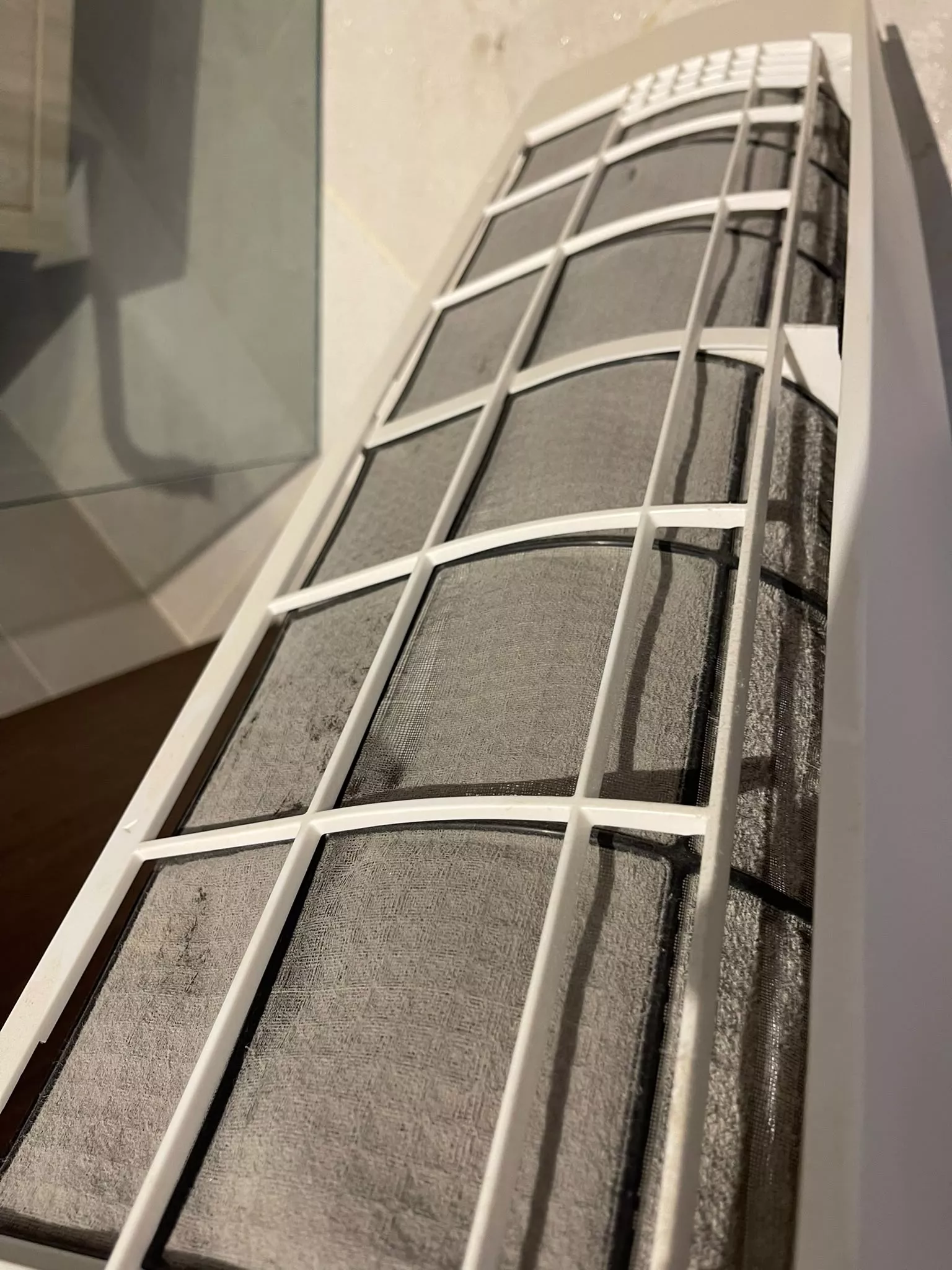
The filter is the only part of an aircon you are meant to touch. Everything else behind that front panel is a technician's job. And yet it is the part most households either never touch at all, or touch in a way that quietly makes things worse.
This is worth getting right, because a blocked filter is not a cosmetic problem. It is the thing that makes a healthy unit behave like a failing one — weak airflow, a room that will not get cold, a bill that climbs — and it is the one fault you can fix yourself in ten minutes with a tap and a towel.
Here is how often to do it, how to do it without damaging anything, and the exact point where washing filters stops being the answer.
The filter protects the coil, not you
People assume the filter is there to clean the air. It is not, really. It is a coarse mesh whose job is to stop dust reaching the evaporator coil — the finned aluminium block behind it that gets cold. That coil is wet whenever the unit runs, and dust landing on a wet cold surface does not blow off again. It packs in.
So there are two separate consequences of a neglected filter, and they arrive in order.
First, airflow falls. A mat of dust across the mesh is a restriction. Less air passes over the coil, so less cold air comes out. The room takes longer to cool and never quite gets there, so the thermostat gets set lower, and the unit runs longer for the same result. That is where the electricity bill goes.
Then the dust gets past. A filter thick with dust starts letting fines through and around the edges, and those land on the coil, where you cannot reach them. That is the transition from "wash the filter" to "book a wash", and it is one-way.
How often, honestly
There is no single number, because it depends on the room rather than the unit. What matters is how many hours it runs, and what is in the air.
- Monthly is the sensible default for a bedroom unit running most nights.
- Every two weeks if the flat faces a main road or a construction site, if there are pets, if anyone smokes, or if there is renovation going on anywhere in the block.
- Every two to three months is enough for a living room unit that runs a few evenings a week.
Rather than trusting the calendar, look at it. Pull the filter out once and hold it up to a light. If the light comes through evenly, leave it. If it looks like felt, you are late. After two or three checks you will know your own interval and can stop guessing.
None of this replaces servicing. Our own recommended cycle — a general service roughly every three months, a chemical wash every six to twelve — assumes the filters are being kept clean in between. Washing filters is what makes that cycle work, not a substitute for it.
Doing it properly, in ten minutes
- Switch the unit off at the wall isolator or the breaker, not just with the remote. A remote-off unit is still live, and the swing vane can move.
- Open the front panel. On most wall-mounted units it hinges upward and holds itself open. Do not force it past its stop.
- Note which filter came from which side before lifting both out. They are often not identical, and a filter fitted to the wrong side sits proud and lets air bypass it.
- Rinse from the back — from the clean side, pushing the dirt back out the way it came in. Rinsing from the dirty face drives the dust deeper into the mesh.
- Cool or lukewarm water only. Hot water warps the plastic frame, and a warped filter never seats properly again.
- No brush, no scrubbing. The mesh is fragile. A stiff brush opens holes you cannot see, and after that the filter is decorative. If the dirt will not rinse off, the filter needs replacing, not more force.
- Dry it fully, in the shade. Not in direct sun, which distorts the frame. Damp is the point of the whole exercise: a wet filter refitted into a cold, dark unit is how mould gets started.
- Wipe the front panel and the vanes while the filters dry. This is the part everybody skips, and it is where visible dust and black specks collect.
- Refit and check the seating. The filter should sit flat against its frame with no gap at the edge. Air takes the easy route, and a gap is the easy route.
Two things not to do. Do not spray or pour water into the open unit to "rinse the coil" — behind that coil are electronics, and water finds them. And do not run the unit with the filters out, even for one night: everything the filter would have caught goes straight onto the coil, and one dusty night undoes months of care.
Where DIY stops
This is the honest part, because it is the part that sells nothing until it is actually needed.
There are three places in a wall-mounted unit that hold the dirt that matters, and you cannot reach any of them with the front panel open:
The back face of the coil. Air is pulled through the coil in one direction, so the dust packs into the entry face, which is the side you cannot see. A coil can look clean from the front and be blocked solid behind. Reaching it means the covers coming off and a proper chemical clean.
The blower barrel. The long black cylinder with dozens of small blades that actually moves the air. Fouling builds unevenly between the blades, so airflow drops slowly enough that nobody notices — and the barrel is where the smell lives. If your aircon smells musty within a day or two of a freshly washed filter, the smell was never coming from the filter. It is coming from here, and we wrote about that in why your aircon smells musty.
The drain pan and the first stretch of drain pipe. Condensate collects here and biofilm grows in it. This is the origin of most water dripping from an indoor unit, and it is not reachable through the front panel — the pan sits under the coil.
If you want the plain version of the distinction: washing filters keeps the system from getting worse. It cannot make a dirty system clean again. That is what a chemical wash is for, and the signs that you have crossed the line are set out in the note on when a general service is no longer enough.
Four signs the filters are no longer the problem
- A musty smell returns within days of cleaning the filters. The smell is on the blower barrel and the coil.
- Airflow is weak with a clean filter fitted. Either the coil face is blocked or the barrel is fouled.
- Water drips from the indoor unit. Usually the drain pan or a partial choke in the drain line — a clean filter has no bearing on it.
- The room cools but never holds. If the filters are clean and this persists, it is a refrigerant or capacity question rather than a cleaning one, and there is a walk-through in what to check before calling a technician.
The two cases where the advice changes
Ducted or false-ceiling units. If the fan coil sits above a false ceiling, whether you can clean the filter at all depends entirely on whether somebody put an access panel in the right place when the ceiling went up. Where there is no panel, filter cleaning is not a homeowner task and every service costs more, which is the whole argument in the aircon access panel note. Ducted units also sit on their own lines of the price list, set out in what ducted aircon cleaning costs.
Rented rooms and shared flats. If nobody owns the task, it does not happen. Filters in shared flats are reliably the worst we see. Agreeing who does it — and how often — is worth doing at the start of a tenancy, alongside the servicing question covered in tenant or landlord.
The short version
Wash the filters roughly monthly, more often with pets, a main road or building works nearby. Isolate the power, rinse from the clean side in cool water, no brush, dry fully in the shade, wipe the panel and vanes, and refit so the filter seats flat with no gap. Never run the unit with the filters out. And when the smell comes back within days, or airflow stays weak with a clean filter, stop cleaning and book the deeper job — the dirt has moved somewhere your hands do not reach.
For reference, our published rates are $55 for a general service on one unit and $135 for a chemical wash on one unit, with the per-unit price falling as you add units; the full table is on the pricing page and the displayed price is the final price.
If you keep your filters clean and the aircon still is not right, that is useful information and worth telling us. WhatsApp us on 9107 2601 — tell us what the unit is doing and how often you clean the filters, and we will tell you whether you need the $55 job or the $135 one. We would rather put you on the cheaper one and be right.
Also worth reading: the blower wheel - the part of your aircon a general service does not reach.
Also worth reading: prepaid aircon maintenance contracts: what to check before you pay
Washing your filters is also the one thing worth doing on your way out the door before a long trip — see what your aircon needs before, during and after an extended absence for the rest of the pre-trip checklist.
If the unit has frosted over even with a clean filter, see what to do when the indoor unit or pipe freezes over.
If you have a dog or cat, the interval between filter washes is shorter than the usual advice. See how pets change your aircon service schedule for what to look for on the filter and which job to book.
Also read: aircon near an open kitchen: how cooking grease changes your service interval