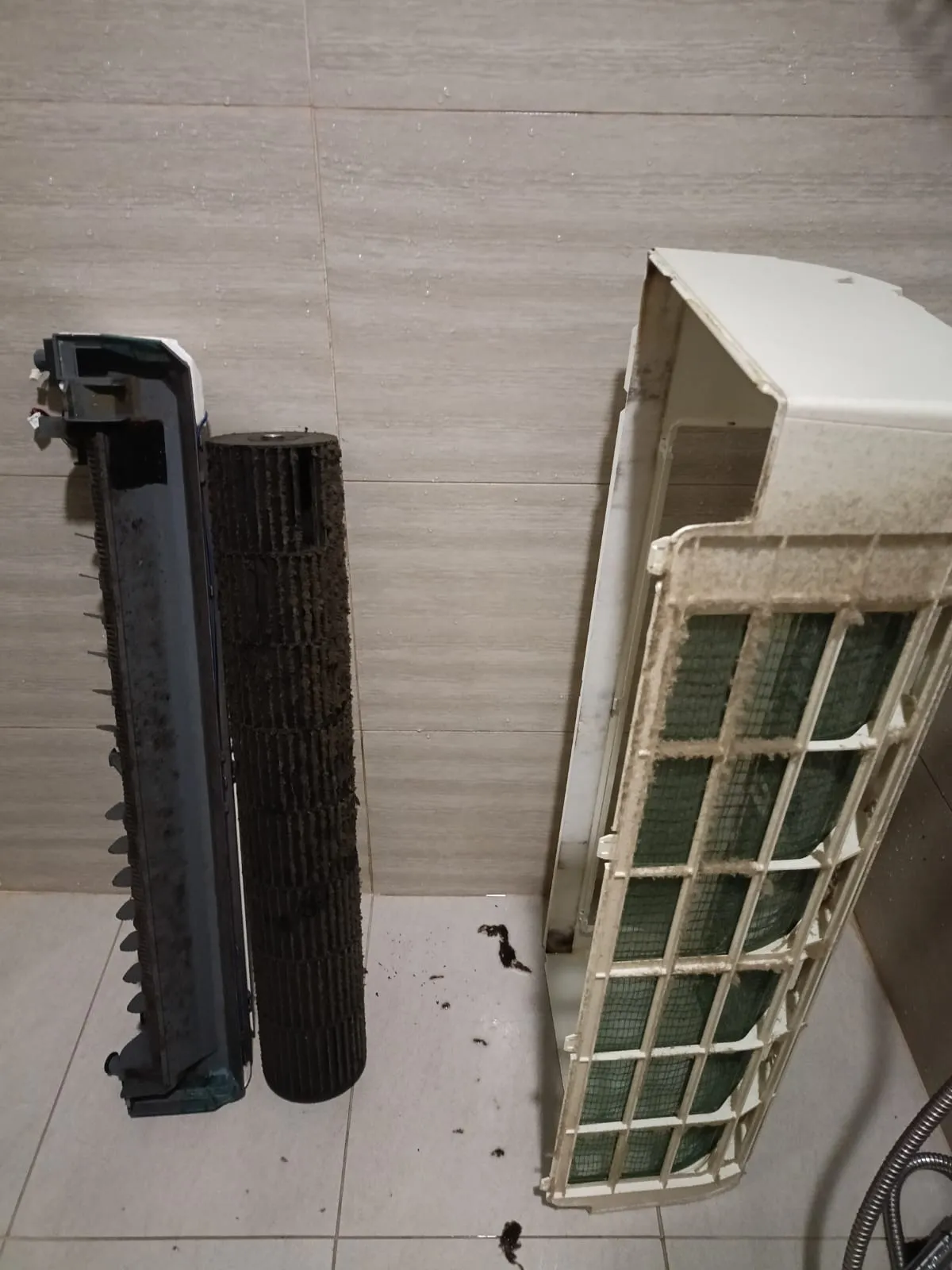
Most advice on how often to service an aircon assumes the air it pulls in is dusty and nothing else. In a lot of Singapore homes that is not true. The flat is open-plan, the kitchen has no door, and the living room unit sits a few metres from the wok. Every time you fry something, the air that comes off the stove goes wherever the room's air goes, and some of that air goes through the aircon.
This is a short guide to what that does to a unit, what you can do about it between visits, and how to decide between a general service, a chemical wash and a chemical overhaul when the unit lives near a kitchen. One thing up front: we do not publish a separate "kitchen schedule", and nothing below pretends we do. The point is to show you how to read the signs, so you do not pay for a bigger job than you need or wait too long for one you do.
What cooking does to the air a unit breathes
Cooking, especially frying and stir-frying on high heat, puts a fine mist of oil and moisture into the air. Dust is dry and mostly brushes off. Oil mist is sticky. When it reaches the filter and the fins of the coil behind it, it does not just sit there: it glues ordinary household dust, lint and fibres to the surface. What would have been a loose layer of dust becomes a film.
We would not put numbers on how fast that happens, because it depends on how often you cook, how much of it is frying, whether the hood is on, and how far the unit is from the stove. What is safe to say is the direction: a unit that shares air with a cooking area collects a stickier layer, and a stickier layer is harder to remove with a wipe than loose dust is.
The grime then follows the same path as in any home. The filter takes the first load. The coil behind it is wet while the aircon runs, so anything that gets past a loaded filter sticks to the fins. The blower wheel, the long barrel that pushes the air, picks up a coating on its blades. And the drain pan takes whatever the condensate washes down. If you want the part-by-part picture, our article on the blower wheel a general service does not reach covers the part most people never see.
The photo at the top, and what it does and does not show
The image above is one of our servicing jobs: an indoor unit taken apart, with a dark coating on the blower wheel and the coil frame and dust matted onto the front panel. We are not claiming this one came from a kitchen, because we do not know that. It is what a heavily fouled unit looks like once the cover comes off, and it is the kind of build-up a surface wipe leaves untouched.
Signs the unit near your kitchen is falling behind
- Weaker airflow with a filter that looks clean. If you have just washed the filter and the air coming out is still weak, the restriction is further in, at the coil or the blower wheel.
- A greasy or tacky feel on the louvres or the front panel. Wipe a finger along the air outlet. A film that does not come off like dust is a warning.
- A smell that is not simply musty. Stale cooking smells coming from the unit when it starts up point to the unit holding what it has pulled in. Our guide to why an aircon smells musty goes through the other causes so you can tell them apart.
- Water dripping from the front of the unit. Oil and lint in the drain pan feed the slime that blocks the drain. We cover why clearing it once does not always hold in why the aircon drain keeps choking.
- The room takes longer to cool than it used to.
What you can do yourself between visits
- Use the cooker hood or the kitchen exhaust, and use it while you cook, not after. The oil mist is in the air while the pan is hot.
- Close the kitchen door while you fry, if you have one. If the flat is open-plan, running the extraction while you cook matters more than anything you do to the aircon.
- Wash the filters more often than the usual advice, and look at them each time. A filter with a tacky coat on it is telling you how much oil is reaching the unit. How to take them out and where DIY stops is in washing your aircon filters yourself.
- Do not spray a household degreaser into the unit. The coil fins are thin aluminium, and what is on the coil needs rinsing out properly, not just loosening. That is a job for a technician with the right setup.
None of this replaces a service. A clean filter still leaves the coil, the blower wheel and the drain to be cleaned by someone with the right tools.
Which job to book
The published intervals on our pages are general servicing about every 3 months, a chemical wash every 6 to 12 months for a daily-use home, and a chemical overhaul every 2 to 3 years or sooner for heavy use. We say to go every 6 months on the wash if anyone has allergies or asthma, if the unit runs 8 or more hours a day, or if you have pets. Cooking is not on that published list, but the logic is the same: a unit that is fouling faster than normal belongs at the short end of the range.
- General service for a unit that is only starting to show a tacky filter and slightly weaker airflow. It covers a filter clean, a coil wipe, a drainage flush and a gas check.
- Chemical wash when the coil itself is coated: weaker cooling that a clean filter did not fix, a smell on start-up, or a water drip. It cleans the coil in place, without taking the unit apart.
- Chemical overhaul when the problem is deeper than the coil: the smell or weak cooling came back soon after a wash, or there is heavy grime on the blower wheel or inside the casing. The indoor fan coil is fully dismantled and each part cleaned individually. It takes about 2 to 3 hours per indoor unit.
You do not have to guess. The 9-point pre-check is included with any service booking, and it tells you whether a general service is enough or the unit needs a wash or an overhaul. Anything extra found is quoted before work starts. For the longer comparison of which to choose, see chemical wash every aircon or just one, because in most open-plan homes only the unit nearest the kitchen needs the shorter schedule.
What each job costs
Our prices are published in full and the displayed price is the final price. General servicing:
- 1 unit: $45
- 2 units: $70
- 3 units: $95
- 4 units: $115
- 5 or more: $25 per unit
Chemical wash:
- 1 unit: $135
- 2 units: $245
- 3 units: $345
- 4 units: $425
- 5 or more: $100 per unit
Chemical overhaul: $200 for 1 unit, $370 for 2, $515 for 3 and $640 for 4, then $150 per unit from 5. The full list is on our pricing page, with the detail for each job on the chemical wash and chemical overhaul pages.
In an open-plan flat with three units, a sensible plan is usually this: a general service for all three in one visit, and the chemical wash only on the unit that shares air with the kitchen. The per-unit price falls as the unit count rises, and booking together means the technician is already on site.
Common questions
Does cooking make my aircon dirtier than normal?
Oil mist in the air sticks to filters and coils and binds dust into a film, so a unit near a kitchen can foul faster than one in a bedroom. How much faster depends on how much you cook and how well the kitchen is extracted.
How often should the unit near my kitchen be washed?
Our published range for a daily-use home is every 6 to 12 months. A unit that is fouling faster than normal belongs at the 6-month end, and the pre-check will say whether it needs a wash or only a general service.
Can I clean grease off the coil myself?
No. Wash the filters and wipe the outer panel, but the coil needs a proper rinse after the cleaning solution, which is what a chemical wash does.
Is a chemical overhaul better for a greasy unit?
Only when the problem is deeper than the coil. If a wash fixes the cooling and the smell, the overhaul is not needed. If the symptoms come back soon after a wash, that points to the overhaul.
WhatsApp 9107 2601 to book a service and tell us which unit is nearest the kitchen, and we will say which job it needs before anyone comes out.
Related reading: aircon chemical wash · full price list · pets and your service schedule · running your aircon all day