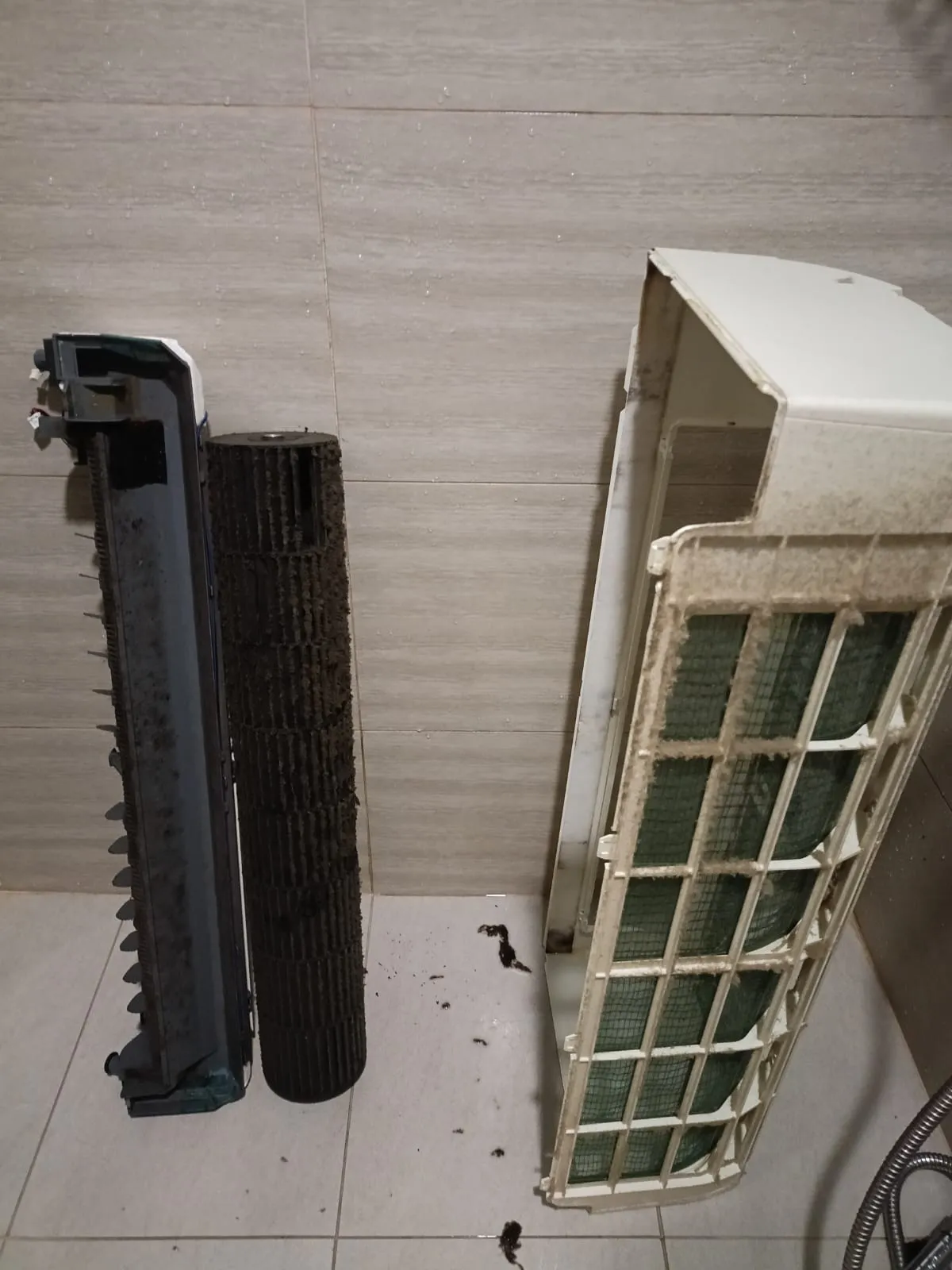
Pictured: a wall unit taken apart for cleaning, with the cover on the right furred with grey dust and the blower wheel in the middle dark with grime. This photo is from an ordinary servicing job, and a photo cannot tell you what produced the grime. We use it because it shows the two places that matter in this post: the front cover and filter area, and the blower wheel behind it.
Many Singapore homes burn something indoors. Joss sticks at an altar, incense at a prayer corner, a smoker who lights up in the bedroom with the aircon on. If that is your home, you have probably wondered whether the smoke ends up inside the aircon, whether it changes how often the unit needs washing, and whether the faint stale smell from the vents is connected. This post sets out what we can say, how to check your own unit without opening anything, and which of our published jobs fits which situation.
One limit first: we are an aircon servicing company, not a health or fire-safety adviser, so this post says nothing about what smoke does to people. It is only about the unit and what you pay to keep it clean.
Why smoke is not the same as ordinary dust
An indoor aircon unit does not make fresh air. It pulls the air of the room through the filter, over the cold coil and back out through the blower, for as long as it runs. Whatever is floating in that room air goes through the same path. Ordinary household dust is dry and fluffy, and most of it stays on the filter, where it brushes or washes off.
Smoke from incense and cigarettes is different in one way that matters to you: the residue tends to be sticky rather than dry. A sticky film does two things. It coats the coil and the blower wheel, and it holds ordinary dust on those surfaces instead of letting it fall away. That is why a unit in a smoky room can look and smell worse than a unit of the same age in the next room, even though both were serviced on the same day. We cannot give you a rule of thumb such as "twice as fast", because the amount of smoke varies far too much from home to home. What we can give you is a way to look.
Ten minutes of checks from the floor
None of these needs a tool or a ladder beyond a stool, and none involves opening the unit beyond the front panel and filters you already remove for routine cleaning. Switch the unit off at the remote first.
- Feel the filter. Lift the front panel and slide a filter out. Dry grey dust that lifts off with a finger is ordinary. A filter that feels slightly tacky, or has a yellow or brown tinge in the mesh that you cannot see on a filter from a smoke-free room, is the signal to note.
- Wipe a vane. Run a white tissue along one of the horizontal flaps at the outlet. A brownish tint on the tissue means a film on the surface, not just loose dust.
- Look at the blower wheel with a torch. Shine it up through the outlet slot and look at the wheel. A thick dark coating between the blades, as in the photo at the top, is the same area an overhaul cleans.
- Smell the filter and the first minute of air. Hold the filter to your nose, then run the unit on cooling and smell the air for the first minute. A stale smoky smell on the filter alone points to the filter. A smell that comes with the cold air and does not go away after the filters are washed points further inside.
- Compare with another unit. If you have two or more indoor units, repeat steps 1 to 3 on one in a room where nothing is burned. The difference between the two is more useful than any single reading.
If you only do one thing, do the comparison. A unit that looks the same as its smoke-free neighbour can stay on the normal rhythm. A unit that looks clearly worse has told you its own schedule.
Which of our jobs fits which finding
The prices below are the ones on our pricing page. Each is final, and the 9-point pre-check is included with any service booking.
| What you found | Job | Published price |
|---|---|---|
| Filter slightly tacky, blower wheel only lightly coated, no smell with the cold air | Normal servicing | $55 for 1 unit, $90 for 2, $120 for 3 |
| Film on the vanes and filter, smell on first start-up, cooling still fine | Chemical wash (the unit stays on the wall) | $135 for 1 unit, $245 for 2, $345 for 3 |
| Thick coating on the blower wheel or casing, or the smell returned soon after a wash | Chemical overhaul (the unit comes off the wall) | $200 for 1 unit, $370 for 2, $515 for 3 |
The overhaul row follows how our own overhaul page describes the signs: heavy mould or thick grime on the blower wheel or inside the casing, or a musty smell that came back soon after a chemical wash. The first two rows follow the same logic one step down. If you are not sure which row you are in, that is what the pre-check is for. It includes a filter and coil dirt assessment, and the technician tells you honestly whether you need a general service or a chemical wash before anything is done. If you decide not to go ahead with the recommended work, the $55 covers the visit and the diagnosis only.
What a schedule could look like
For most homes our published rhythm is routine servicing every 3 months, a chemical wash every 6 to 12 months in between, and a chemical overhaul every 2 to 3 years, sooner for units that run heavily or sit in dusty places. A room with regular smoke is closer to the heavy end of that. As a suggestion, and not a published rule: put the unit in that room at the shorter end of each range, and let the check above move it either way.
The money is easy to work out from the table. For one unit, a chemical wash at the shorter 6-month interval is two visits a year at $135 each, $270 in all. Keeping the same unit on 3-monthly normal servicing is four visits at $55 each, $220. Neither figure is a promise of what your unit needs. They are the arithmetic for one bedroom unit so that you can see what the shorter interval costs before you decide.
What you can change at home
- Move the smoke away from the intake. Burning incense directly under or beside the indoor unit sends the plume straight into the filter. Moving the altar or prayer corner to the other side of the room, or near a window, changes how much reaches it.
- Open a window while burning. If it is practical, an open window or door gives the smoke somewhere other than the aircon's intake to go.
- Smoke on the balcony. For a smoker, the balcony or a spot away from the indoor unit does more for the unit than any cleaning schedule.
- Wash the filters more often. Filters are the one part you can clean yourself between visits, and a tacky filter is the first to show a problem. See our guide to washing the filters yourself and where DIY stops.
What not to do
- Do not spray perfume, deodoriser or air freshener into the unit to hide the smell. It adds to the film and the smell comes back.
- Do not pour bleach, detergent or other chemicals into the unit or its drain. If the smell needs more than a clean filter, it needs a technician.
- Do not keep the unit running with a thick film on the wheel because the cooling still seems fine. A heavily coated wheel usually moves less air, so the cooling you feel in the room can drop even before the unit stops cooling the air itself.
When it is something else
A burning smell is not the same as a smoky stale smell. If the smell is sharp, like hot plastic or an electrical burn, switch the unit off at the isolator or breaker and read aircon burning smell: what to do first before you run it again. And if the specks coming out of the vent are the problem rather than the smell, see black specks from the vent. Airborne grease from cooking works in a similar way to smoke, and the reasoning in how cooking grease changes your service interval carries over to a smoky room.
Before you message us
These details let us tell you which row of the table you are probably in, before anyone visits:
- How many indoor units, and which one is in the smoky room.
- What is burned, roughly how many hours a day, and whether a window is open.
- What the filter, the vane tissue and the blower wheel looked like in the check above, and a photo if you can take one.
- When the unit was last serviced or washed, and whether the smell came back afterwards, and how soon.
The short version
- Smoke residue tends to be sticky, so it coats the coil and blower wheel and holds ordinary dust on them.
- Check the filter by feel, a vane with a white tissue, and the blower wheel with a torch, and compare with a unit in a smoke-free room.
- Match the finding to the job: normal servicing from $55, chemical wash from $135, chemical overhaul from $200, all for 1 unit.
- Run a unit in a smoky room at the shorter end of the usual intervals, and let the check move it from there.
- Move the smoke away from the intake, wash the filters more often, and never spray anything into the unit.
Every price in this post comes from our pricing page, and the full wall-unit breakdown is on the chemical wash cost page. How the overhaul itself works is on the chemical overhaul page, and what the pre-check covers is on the 9-point pre-check page.
If you would like a straight answer for your unit
Send us the details above and we will tell you which job we think fits, what it costs on our published prices, and we quote before any work starts. WhatsApp us on 9107 2601 and we will tell you what to expect before we come.