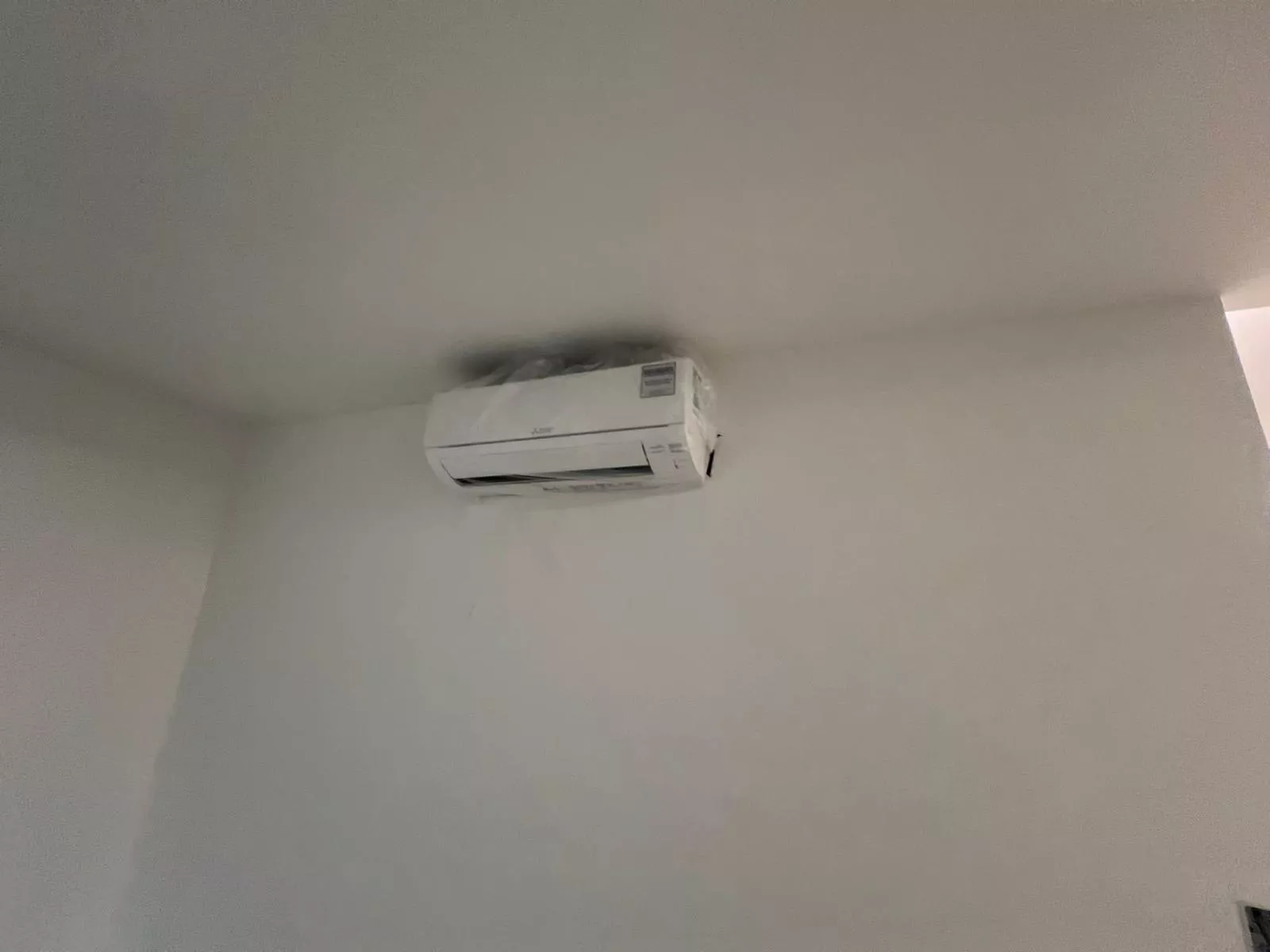
You switch the aircon on, or you walk back into the bedroom, and there it is: a sharp smell of something hot. Not the damp-cloth smell you have learned to ignore. Something closer to melting plastic.
Most people switch it off at the remote and go to bed, or switch it back on ten minutes later "to see if it happens again". Neither is right, and the second turns a small electrical fault into a bigger one. Here is what to do in the first minute, how to work out whether it is really burning and where it is coming from, and what it costs to have it looked at.
The first minute
Switch it off at the isolator or the breaker, not just the remote. A unit switched off by its remote is not electrically dead — the board is still powered and waiting for a signal. The isolator is the local switch near the unit that exists precisely so the machine can be made dead. If you cannot find it, switch off the aircon's breaker at the distribution board.
If you can see smoke, flame or sparks, or the isolator or socket is crackling, do not touch it. Switch off at the distribution board only if you can reach it safely without going near the unit. If there is smoke or fire that does not stop once the power is off, get everyone out and call 995.
Do not switch it back on to test. An overheating connection or motor does not fix itself, and every restart puts current back through whatever was getting hot. The evidence — discolouration, a warm switch plate, a smell that lingers at one spot — is more useful to the technician if nobody has kept running it.
Once the power is off and nothing is visibly burning, you are no longer in an emergency. You are in a diagnosis, and you can take the next few steps calmly.
Is it actually a burning smell?
Three different smells get described as "burning", and they mean completely different things.
- Sharp, acrid, hot plastic or hot rubber. This is the electrical one. It tends to get stronger the longer the unit runs, not weaker, and it usually hangs around one place. Treat it as a fault until someone has shown you otherwise.
- Dusty or musty, strongest in the first minutes after switch-on. Particularly after the unit has been off for a while. This is almost always damp dust and biofilm on the coil and the blower wheel being pushed out with the first air, not anything burning. It is a cleaning problem, and our note on the blower wheel, the part a general service does not reach explains where it comes from.
- Smoke that smells like cooking, incense or burning paper. A standard wall-mounted split does not bring outside air into the room. It pulls in the air that is already in the room, cools it and blows it back. So if a neighbour's cooking, joss paper burned downstairs or haze has come in through a window or the gap under the door, the aircon will spread it around the room very efficiently, and it will seem to be coming from the vents.
The quickest way to separate the third case from the first: with the aircon off, stand in the corridor, the living room and at the window. If the smell is just as strong in places the aircon does not reach, it did not start in the aircon.
Find where it is strongest — without opening anything
With the power off, go and smell, and look, at four places. Do not take any covers off, and do not lean out over a ledge to reach the outdoor unit.
1. The indoor unit. Stand under it and smell at the air outlet and along both ends of the casing. Look at the display lights — if any are blinking in a pattern, take a short video. On most units a blinking pattern is the machine reporting a fault, and it saves time later.
2. The isolator or the socket. Look for brown or black marks around the switch or the screws, a plastic plate that has gone yellow or soft, or a switch that feels warm even though everything is off. If it is feeding off an ordinary socket or an extension cord rather than a proper point, note that as well.
3. The outdoor unit. From the window or the service yard, and only as far as you can see safely: any smell at the condenser, any discolouration, whether the fan was spinning before you switched off.
4. The distribution board. Did the aircon's breaker trip? Is there any smell or warmth at the board itself?
What each location usually points to
Strongest at the indoor unit
The two usual suspects are the fan motor and the electrical board. A fan motor with a failing bearing has to work harder to turn the blower wheel, and a motor that is straining runs hot. If the unit had also become noisier, or the airflow had dropped off before the smell appeared, the motor is the likely candidate. The other possibility is a component or a connection on the control board or its terminal block overheating. Both need the unit opened and the parts tested, and both are jobs for a technician, not for a torch and a screwdriver.
Strongest at the isolator or socket
This is heat at a connection: a terminal that has worked loose, a switch that has worn, or a supply that was never meant to carry an aircon. An aircon motor draws hard on start-up, and a borrowed socket, a multi-way adaptor or an extension cord running out to the service yard is exactly where that heat shows up first. We set out why in the power point nobody quotes for.
Work on the aircon itself is aircon work. New wiring, extending the electrical installation, or anything at the distribution board has to be carried out or supervised by an EMA-licensed electrical worker. So if the fault turns out to be on the supply side of the isolator rather than the aircon side, the honest answer from an aircon technician is to tell you so and not to quietly run a new cable.
Strongest at the outdoor unit
The outdoor unit holds the compressor, the outdoor fan motor and their electrical parts, so a smell here usually means one of those was running hot or has failed. This is the location where you are most likely to be told something expensive, so it is also where you should ask for evidence. Before you accept that a compressor has gone, read how to check that diagnosis before you pay — a failed capacitor can look very similar and costs a fraction as much.
The breaker tripped as well
A smell together with a tripped breaker means the protection did its job. Leave the breaker off. Resetting it repeatedly to see whether it holds sends current back through the fault each time, and that is how a component that could have been replaced becomes one that took something else with it.
What to have ready when you message a technician
- Where the smell was strongest, from the four checks above.
- What it smelled like — hot plastic, dusty, or smoke.
- A photo of the isolator or socket, close up, and of the unit's nameplate if you can reach it safely.
- A short video of any blinking display lights.
- Whether the breaker tripped, and whether the unit had been noisier, weaker or leaking before this happened.
- Roughly how old the system is and when it was last serviced.
What it costs to find out
These are the figures on our published price list, and they are final.
The visit and diagnosis: $45 for one unit. That covers the technician coming out and the 9-point pre-check, which starts with a power and thermostat test — confirming the electrical supply, the board's response and the remote — and includes a fan blower spin test and an inspection of the outdoor condenser. If you go ahead with the fix, the $45 is part of the total rather than charged on top. If you decide not to, the $45 covers the visit and the diagnosis, and nothing more.
A standard electrical repair: $80. Fan motor and bearing replacement, and diagnosis of the board and electrical components, are part of our repair work; compressor and PCB replacement are quoted on-site, after the pre-check has confirmed what actually failed. You get that figure before any work starts. Repairs carry a 90-day workmanship warranty, and parts carry the manufacturer's warranty.
If it happens at night. Our standard hours are 9am to 9pm Monday to Saturday and 10am to 6pm on Sunday, with no weekend surcharge. An after-hours emergency call between 10pm and 7am carries a $50 surcharge. Here is the honest way to think about that: once the unit is switched off at the isolator and nothing is smoking, it is safe to leave off overnight, and the surcharge buys you speed, not a different diagnosis. Where it is worth paying is when someone in the home genuinely cannot get through the night without cooling.
What not to do
- Do not keep resetting the breaker or switching the unit back on to check.
- Do not open the casing. Switching off at the remote does not make the unit safe to work on, and the parts most likely to be involved are the electrical ones.
- Do not spray cleaner into the unit to get rid of the smell. If it is electrical, you have added liquid to the problem; if it is not, you have not reached the coil or the blower wheel anyway.
- Do not "fix" a warm socket by moving the plug to an extension cord or another socket. The heat was telling you the supply is not right for the load.
When the technician does come, ask to see what they found before the covers go back on — a scorched terminal, a motor that does not turn freely, a burnt component. What your aircon technician should show you before they leave covers the rest of that habit.
The short version
Switch off at the isolator or breaker, not the remote, and do not switch it back on to test it. Hot plastic that gets stronger is electrical; dusty on switch-on is dirt; smoke everywhere in the flat came from outside. Find where the smell is strongest, photograph what you see, and have it checked before it runs again.
Smelled something burning and want it checked? WhatsApp us on 9107 2601 — tell us where the smell was strongest and send a photo of the isolator, and we will tell you what we need to look at and when we can come.