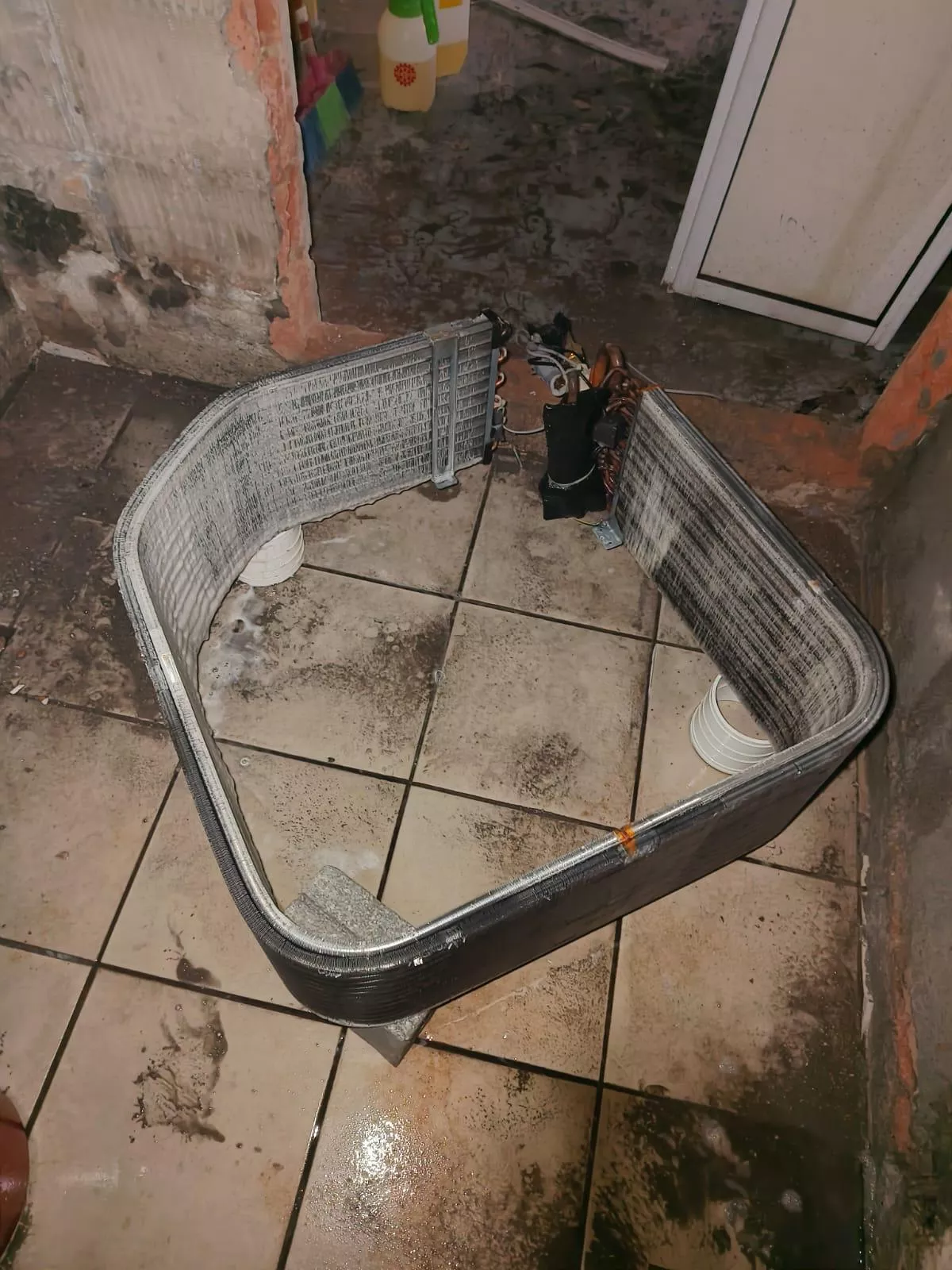
Pictured above: the coil of a ceiling cassette unit lifted out on the floor during one of our repair jobs. Some faults end like this, with the unit in pieces and a part on order. Many more end with a two-minute check done by the owner. On the night itself, the job is to work out which one you are dealing with.
It is 11pm, the bedroom is 30 degrees, and the aircon has just stopped. Maybe it went dead. Maybe it is blowing warm air, or blinking a light at you, or dripping onto the bed. You are deciding whether to call someone out now or sweat it out until morning.
Most night breakdowns can wait until morning. A few cannot. The wrong call either way costs something: money if you pay for a night visit that achieves nothing, or real damage if you leave the one fault that should not be left. This is how we would sort it out if it were our own flat.
First, is this a safety problem or a comfort problem?
Everything else follows from this question.
It is a safety problem if:
- You can smell burning or hot plastic, or see scorching on the unit, the isolator or the socket.
- The breaker has tripped, and it trips again when you reset it.
- Water is running onto a power point, an extension board, the isolator or anything electrical.
- Water is coming through the ceiling or down the wall into the unit below yours.
It is a comfort problem if the unit is dead, not cold, blinking a code or making a new noise, and none of the above is happening. That is miserable on a hot night, but nothing gets worse if it waits a few hours with the power off.
A safety problem does not automatically mean a night call-out. It means you have to make the unit safe right now, whatever you decide about the technician.
Making it safe: the first five minutes
- Switch off at the isolator or the breaker, not the remote. A unit that has been switched off by its remote is still powered, with the board waiting for a signal. The isolator is the local switch near the unit, and it is there so the machine can be made fully dead. If you cannot find it, switch off the aircon's breaker at the distribution board.
- If there is smoke, flame or sparks, keep away from the unit. Switch off at the distribution board only if you can get there without going near it. If smoke or fire continues after the power is off, get everyone out and call 995. We cover this in more detail in what to do first when your aircon smells like burning.
- Do not keep resetting a breaker that keeps tripping. The breaker is doing its job. Each reset sends current back through whatever caused the trip.
- For water, stop the source and then the spread. With the power off, the unit stops making condensate within a few minutes. Put a towel or a basin under the drip and move anything electrical out of the way. If water is reaching the flat below, knock on their door or leave a note tonight. A neighbour who hears about it at 11pm is easier to deal with than one who finds a stained ceiling in the morning. Our post on water dripping onto a neighbour's unit explains how that usually unfolds.
Once the unit is dead and nothing is burning or flooding, most safety problems have become ordinary repair jobs. They still need fixing, but they no longer need fixing at 2am.
The free checks before you pay for anything
A surprising number of "breakdowns" at night are not breakdowns. Before calling anyone, spend ten minutes on these:
- The remote. Look at the batteries, and check whether it is in fan mode instead of cool, or has a timer or child lock set.
- The isolator and the breaker. Isolators get switched off by accident, especially by cleaners or during renovation. A breaker that tripped once and stays on when you reset it is not the same as one that keeps tripping.
- The filters. If the unit is running but the air is weak or barely cool, pull the front panel up and look. A filter matted with dust can choke the airflow enough to make a working unit feel dead.
- One unit or all of them? On a System 2, 3 or 4, check whether the other rooms are still cooling. If they are, the shared outdoor unit is running, and the fault is local to one fan coil. That is almost always a daytime job.
- The blinking light. If the unit starts, stops and blinks, count the blinks or note the code on the display. Photograph it. Do not keep power-cycling it to see whether it clears.
Our full list, including the manual button on the indoor unit, is in the checks to do when your aircon will not turn on.
What a night visit can and cannot fix
This is the part people usually find out after they have paid. Arriving at night does not change what the technician can actually do, and some jobs cannot be finished at any hour.
Often fixable on the spot: a choked drain, a loose or burnt connection, a tripping fault traced to a component that can be replaced there and then. Our published price for a standard repair (drainage or electrical) is $80.
Diagnosed that night, fixed later: a failed compressor or a failed PCB. Both are quoted on-site after diagnosis, and if the part has to be ordered, it cannot be fitted that night however fast the technician arrived. The night visit tells you what is wrong and what it will cost. It does not get you cold air before morning.
Not a night job at all: a unit that has slowly got warmer over weeks. That is usually low refrigerant, and low refrigerant means a leak somewhere. A top-up without finding the leak just starts the countdown again, which we explain in where refrigerant leaks actually happen. Finding a leak properly takes a pressure test and time, so it belongs in daylight.
A drip that has been getting worse for weeks is similar. If your drain has already been cleared two or three times, why a recurring drain choke keeps coming back is the article to read before booking anyone, at any hour.
What it costs: tonight versus tomorrow
Every figure below is from our published price list:
- Standard hours are 9am to 9pm Monday to Saturday and 10am to 6pm on Sunday. Within those hours there is no weekend surcharge.
- A service visit minimum is $45 (1 unit), covering the visit and the 9-point pre-check. Additional work is quoted after diagnosis, before it is done.
- Standard repair (drainage, electrical) is $80. Compressor and PCB replacement are quoted on-site.
- Gas top-up is priced per outdoor circuit: R22 $115, R410A $130, R32 $170.
- After-hours emergency repair calls between 10pm and 7am carry a $50 surcharge.
That makes the decision easy to frame. Calling out between 10pm and 7am costs you $50 more than waiting for a morning slot, for exactly the same work. Same-day service is usually available during weekday business hours, so on a weekday night the real question is often "is a few hours of sleep in a hot room worth $50?"
For a healthy adult with a fan and another cool room in the flat, usually not. For a household with a newborn, an elderly parent, or someone unwell who genuinely cannot cope with the heat, it may well be. That is a judgement only you can make. What you should not do is pay the surcharge for a fault that cannot be fixed tonight anyway, such as a compressor that needs a part.
If you decide to wait
- Leave the faulty unit off at the isolator. Do not "try it once more" before bed.
- Move to a room that still cools, or run a fan with the curtains closed. On a multi-split, the other fan coils sharing the outdoor unit can usually keep running if they are working normally.
- Leave the towel or basin in place if anything was dripping.
- Take your photos now while you remember what happened: the display or blinking light, the isolator, any scorch mark, the outdoor unit, the water stain.
- Message first thing in the morning rather than the night before, so it gets seen at the start of the day's booking.
What to send, day or night
The quickest way to get a useful answer is to send what a technician would ask for anyway:
- What the unit is doing: dead, blinking, fan only, not cold, dripping, smell.
- Whether it is one unit or all of them.
- Whether the breaker tripped, and whether it trips again on reset.
- Whether water is going anywhere it should not.
- The brand and roughly how old the system is.
- Photos of the display, the isolator and anything that looks wrong.
Most night breakdowns give warning first
Very few units go from perfect to dead in one evening. Most give warnings first: cooling that took longer each week, a drip that came and went, a new rattle, a smell at start-up. Those were daytime jobs at daytime prices, and they only became night problems because the unit was run until something gave.
If yours is showing any of those signs now, book it in while it still works. Our servicing rhythm, and what a first visit on a neglected unit involves, is set out in what the first service after years of neglect involves.
The short version
- Safety first: switch off at the isolator or breaker, never just the remote, and do not keep resetting a breaker that keeps tripping. For smoke or fire that does not stop, call 995.
- Do the free checks (remote, isolator, filters, other rooms, blink code) before paying for anything.
- A night visit can diagnose anything, but it cannot fit a part that has to be ordered.
- After-hours calls between 10pm and 7am carry a $50 surcharge. Weigh that against a few hours' wait for a same-day slot.
Aircon stopped and not sure whether it can wait? WhatsApp us on 9107 2601. Tell us what the unit is doing and send a photo of the display, and we will tell you whether it needs someone now or can wait. Repair and diagnosis prices are on the price list, and the repair service is on the aircon repair page.
Related reading: aircon not turning on: checks before you call · aircon burning smell: what to do first · recurring drain choke