Two kinds of people ask us this. Someone who has just taken over a flat and has no idea when the aircon was last touched, and someone who knows exactly how long it has been and is slightly embarrassed about the number.
Neither is unusual, and neither is a disaster. But there is one thing worth understanding before you book anything: a unit that has run for years without servicing does not need a bigger version of a normal service. It needs a different job. Booking the normal one and hoping for the best is the most common way this goes wrong, and it is why people come away thinking servicing "does not work".
Here is what actually happens inside a neglected unit, what the first visit should involve, and how to tell whether it was done properly.
What years of running actually does
The filter is the part everybody pictures, and it is the least of it. A filter is a coarse screen. It catches lint and hair, it clogs, and it washes clean in a sink in two minutes. If a filter were the whole problem you could fix a decade of neglect yourself on a Saturday.
What matters is what gets past the filter and stops behind it.
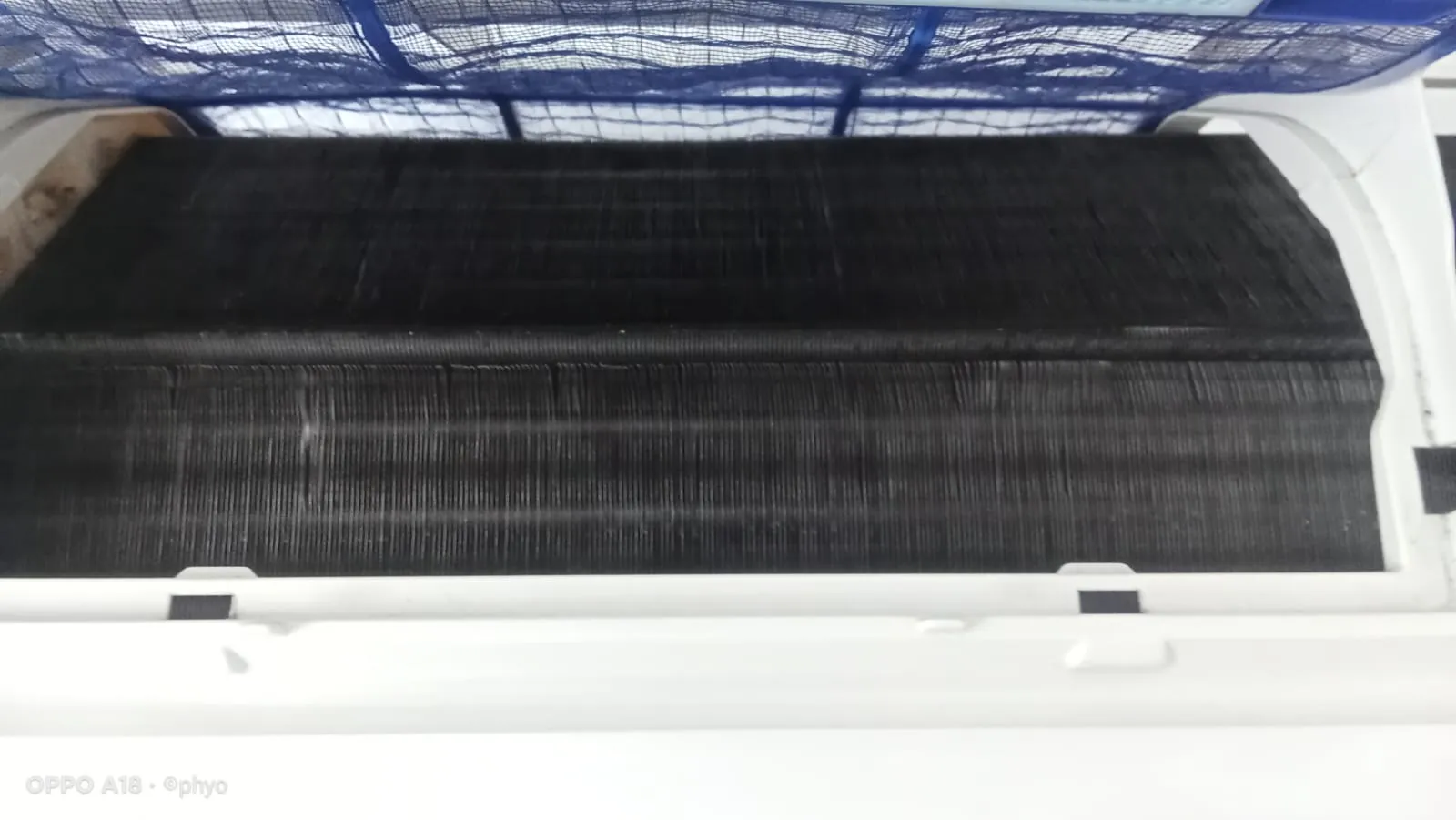
The evaporator coil. This is the block of aluminium fins the air is pulled through, and the gaps between those fins are narrow by design — that is how the heat exchange works. Fine dust that passes the filter lands on fins that are wet with condensation for most of their working life. Wet dust does not stay dust. It binds, then it grows biofilm on top of itself, and in a kitchen-adjacent room it picks up cooking oil vapour and turns tacky. After a few years the fin gaps are not dirty, they are closed. Air stops going through the coil and starts going around it.
The blower wheel. The barrel fan behind the coil is made of dozens of small cupped blades, and each cup collects a crust that eventually sets hard and grey. A caked wheel moves less air and moves it unevenly, which is why an old unit can sound busy and still not cool. We have written separately about what a general service does not reach on the blower wheel, because it is the single most-skipped part in the trade.
The drain pan and drain line. The pan sits under the coil catching condensate all day. Left alone it grows a slime layer, and slime plus loose debris is what eventually blocks the drain. This is why the first symptom of a long-neglected unit is often water rather than warmth.
Notice what is not on that list: refrigerant. A split system is a sealed circuit. It does not consume gas the way a car consumes oil, and it does not go low because you skipped services. If it is low, there is a leak somewhere, and that is a separate diagnosis with a separate fix. Be careful with anyone who proposes a top-up as the remedy for a unit that was simply never cleaned — telling a top-up from a leak repair is worth reading before you agree to it.
Why a general service will disappoint you here
Our general servicing is $55 for one unit, $90 for two, $120 for three, $160 for four, and $35 per unit from five. It covers a filter clean, a coil wipe, a drainage flush and a gas check, and for a unit that gets seen every three or four months it is exactly the right job.
Read that list again with a fouled coil in mind. A wipe is a surface action. It cleans the face of the coil, which is the part you can see and the part that looks better in a photo. It cannot get into fin gaps that are packed solid, and no amount of wiping will. So the unit comes out looking cleaner, smelling slightly better for a week, and cooling almost exactly as badly as before — because the blockage was never in the place that was cleaned.
That is not a bad service. It is the wrong service for the condition, and the honest thing is to say so before the money is spent rather than after.
The three real options, and how to tell which one you are in
A chemical wash is deep coil cleaning with the unit still on the wall: chemical applied to the coil, flushed through, drain pan and drain line cleared properly, and the wash water caught in a bag. Ours is $135 for one unit, $245 for two, $345 for three, $425 for four, and $100 per unit from five. For most units that have gone a couple of years too long, this is the job.
A chemical overhaul is a full disassembly — the unit comes off the wall, the coil, blower wheel, drain pan and casing are separated and cleaned individually, and it goes back up. Ours is $200 for one unit, $370 for two, $515 for three, $640 for four, and $150 per unit from five. We recommend it every two to three years as routine, or for severely fouled units — and a unit nobody has touched in five years is usually the second category. The reason is the blower wheel: those cupped blades genuinely cannot be cleaned in place, so if the crust is on the wheel, only the overhaul reaches it. The full comparison is in chemical wash versus chemical overhaul, and it is also worth reading what a chemical wash cannot fix, because cleaning is not a repair.
Replacement. Sometimes the honest answer. If the unit is well past ten years, the compressor is noisy, and it needs an overhaul plus an electrical part, you are spending real money on a machine near the end of its life. We would rather tell you that than take the booking. When to replace versus keep repairing sets out the arithmetic.
Every service booking with us includes a nine-point pre-check, and on a neglected unit that check is the point of the visit as much as the cleaning is. It is what tells you which of the three you are actually in, rather than guessing from the outside.
Things that break at the same time, for unrelated reasons
This catches people out and it is worth saying plainly, because it is where "the servicing broke my aircon" usually comes from.
Capacitors, contactors, fan motors and PCBs age on a clock, not on a service record. A unit that has been left alone for six years is also a six-year-old unit, and those parts were quietly getting older whether or not anyone cleaned the coil. So it is genuinely common for a first service after a long gap to be followed within weeks by an electrical fault — not because the clean caused it, but because the machine was already there and now someone is finally paying attention to it.
The other one is water. Clearing a drain that has been silting up for years dislodges what was holding the silt in place. A good technician flushes until the flow runs clean and tests it; a rushed one clears just enough for it to drain that afternoon. If water appears a week later, that is usually what happened.
What to ask for, and how to check it was done
You do not need to watch over anyone's shoulder. Ask for four things.
Photos of the coil before and after. Not the front panel — the coil, with the cover off. This is the single most useful thing you can ask for and it takes the technician ten seconds.
What came off. On an overhaul, the casing, coil and blower wheel are separated. If nothing came off the wall, you had a wash, whatever the invoice says.
Where the water went. A proper wash produces filthy water and a lot of it. If nothing was bagged and nothing was carried out, the coil was not flushed.
The smell, one hour later. Switch it on and leave it running. A sour or musty smell that returns within the hour usually means the drain pan and blower wheel were not reached — the coil face was cleaned and the source of the smell was left behind.
What happens afterwards
Once a neglected unit is properly back to baseline, it goes onto a normal rhythm: general servicing roughly every three to four months, and a deeper clean at the interval that suits how hard it works. That is genuinely all it needs. We do not sell contracts or take money upfront for future visits, so there is nothing to sign — book the next one when the time comes.
The uncomfortable part of all this is that the first visit after a long gap costs more than a routine one would have. That is the real price of the gap, and it is the argument for not repeating it, rather than an argument for having felt bad about it. Every price we charge is published on our pricing page, and the chemical wash cost is broken down further on the chemical wash page.
Not sure how bad yours is? WhatsApp us on 9107 2601 — tell us roughly how long it has been, how many units, and whether they are still cooling at all, and we will tell you which of the three jobs it is likely to need before anyone comes out.
A unit does not need years of neglect to need this kind of first-visit check — a flat left empty for a long trip or a longer vacancy creates a smaller version of the same problem: a dried-out drain trap and a coil that has had an unusually long time to collect moisture.
Related: arranging an aircon visit for your parents' flat when you cannot be there