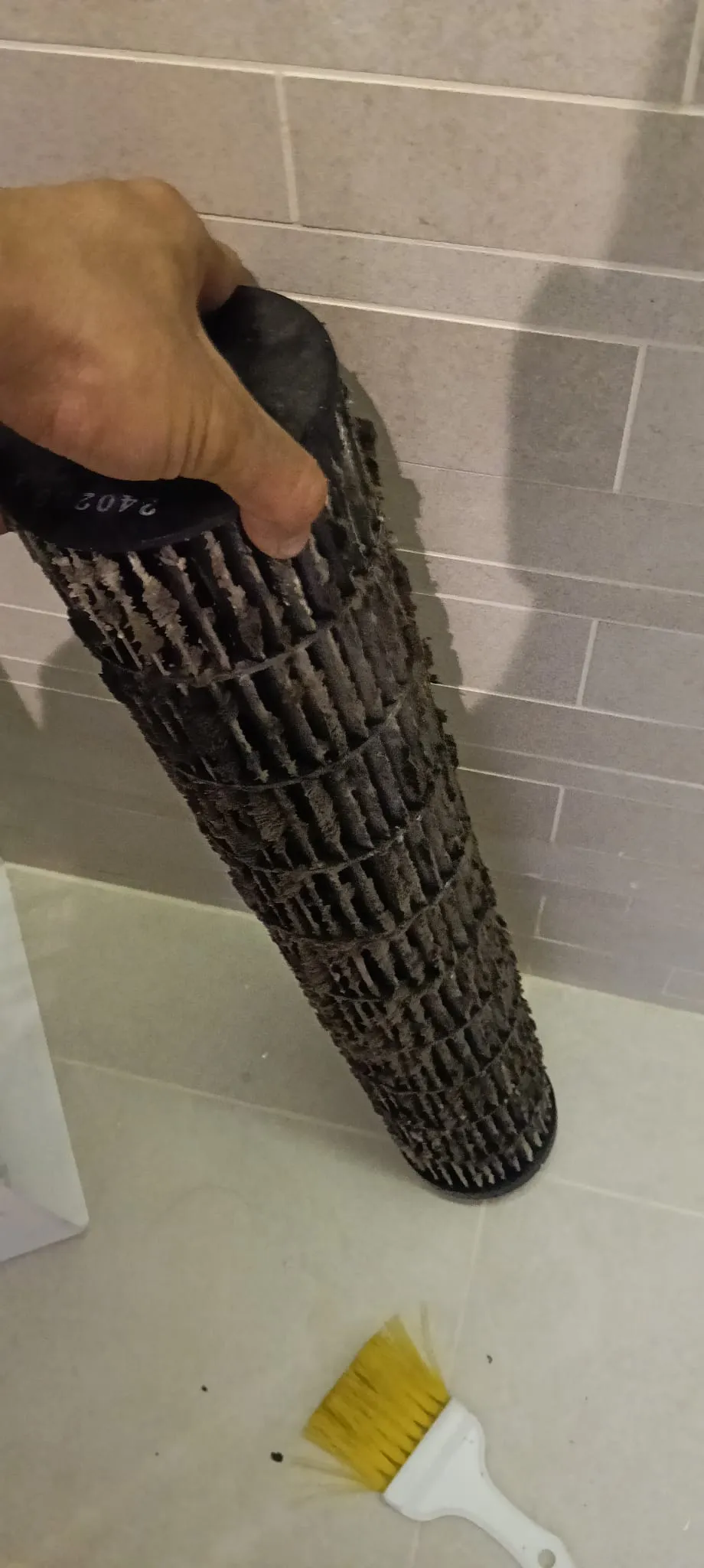
A chemical wash is the most requested job on our list, and a fair share of the time it is not the job the unit actually needs. Someone books one because the air is weak, or the room smells, or the unit is dripping, and they expect the wash to end the problem. Sometimes it does. Often it cleans a unit that was already reasonably clean and leaves the real fault exactly where it was — except the owner has now spent money and believes the matter is closed.
This is the honest version of what a chemical wash is for, what it physically cannot repair, and how to tell which situation you are in before you pay for the wrong thing.
What a chemical wash actually is
A chemical wash is a deep clean of the coil in place. The filter comes out, the casing is opened, and a chemical solution is worked through the evaporator coil to dissolve biofilm, mould and embedded dust that plain water will not shift. It runs about 60 to 90 minutes per unit and gets a fouled unit back to roughly 80–85% of as-new performance. Ours is $135 for one unit, $245 for two, $345 for three and $425 for four, with additional units at $100 each. A routine general service, by comparison, starts at the $45 minimum for one unit.
Read that description again and notice what is in it: cleaning. Nothing in a chemical wash replaces a part, seals a leak, corrects a slope or rewires anything. It is a cleaning operation performed on a coil. Every problem on the list below sits outside that boundary.
1. It cannot put refrigerant back, and it cannot seal a leak
This is the most expensive misunderstanding of the lot. A unit low on gas blows air that is only mildly cool, runs continuously without reaching the set temperature, and pushes your bill up while doing it. A dirty coil produces very similar symptoms, which is exactly why people guess wrong.
The way to separate them is to measure. A healthy split system drops the air temperature between intake and outlet by 8–12°C. Under 6°C points at gas, coil or compressor rather than dirt alone. That measurement is the second item in the 9-point pre-check we run before quoting any work, and it takes a couple of minutes.
If the reading says gas, a wash will not help. Topping up on its own is usually not the answer either — a sealed system does not consume refrigerant, so if it is low, it is leaking, and new gas put into a leaking system is gone again within weeks. Find the leak first. We have written separately about where refrigerant leaks actually happen, which is worth reading before anyone tops you up twice.
2. It cannot fix a failing blower motor or a worn bearing
Cleaning a blower wheel does change the noise a unit makes, and that catches people out. A wheel caked with set dust is out of balance, and washing it can genuinely quiet a rattle. But a dry bearing or a motor on its way out makes a different sound — a whine, a grinding note, or a hum that rises and falls with speed — and that sound survives any amount of cleaning.
The test is what happens after. If the unit is quiet for a fortnight and the noise returns unchanged, the noise was never dirt. Listening for bearing wear and checking the wheel for cracks and imbalance is the sixth check in the pre-check, before the casing goes back on rather than after.
3. It cannot correct a drain that was installed with the wrong fall
Water dripping from the front edge of an indoor unit is one of the most common calls we take, and blocked drainage is the usual cause. A wash does flush the drain line, so where the blockage is sludge, the wash fixes it, and it stays fixed.
Where it does not stay fixed is when the drain pipe was run with too little fall, or dips somewhere inside the wall, or was disturbed by another trade during renovation works. Then water sits in the line instead of running out, the pipe re-blocks, and you are back to dripping in a month or two. The clue is repetition: a drain that blocks once is dirt, a drain that blocks every few months is geometry. Geometry is a piping job, not a cleaning job.
4. It cannot undo years of neglect — that is an overhaul
There is a point where in-place cleaning simply cannot reach the deposits. Heavy scale, severe biofilm, a unit that has run daily for three years or more without attention: on those, a wash is applied to the accessible face of the coil and the rest of it stays as it was. The owner gets a modest improvement and concludes that servicing does not work.
The right job there is a chemical overhaul, where the indoor unit is dismantled and the blower, coil, fan motor and drain pan are each cleaned individually and refitted. It takes 2–3 hours a unit and gets you past 95% of as-new performance, at $200 for one unit, $370 for two, $515 for three and $640 for four. It is roughly one and a half times the price of a wash and several times the result on a badly neglected unit. Our comparison of when each of the two is worth it goes through the decision in more detail.
5. It cannot make an undersized unit cool a room
If a system was specified too small for the space it serves, it will run continuously, never quite reach the set temperature, and feel worst on hot afternoons and in rooms with west sun or a lot of glass. Every one of those symptoms also appears on a dirty unit, which is why undersized systems get washed repeatedly by owners hoping the next clean will be the one that works.
The distinguishing question is history. If the unit cooled the room properly when it was new and gradually stopped, that is fouling or gas. If it was never quite adequate from the day it went in, cleaning is not going to change the physics. Our guide to sizing by BTU for the room you actually have covers what should have been worked out at the survey.
6. It cannot fix an electrical fault, a board, or a remote
Units that will not start, that trip the breaker, that ignore the remote or run a set temperature they were never asked for are electrical or control problems. A wash touches none of that. Worse, disassembly around a unit with an intermittent electrical fault can make the fault appear to change, which sends the diagnosis off in the wrong direction.
Power, board response and remote function are checked first in the pre-check, deliberately, before anything is opened.
7. It cannot remove a smell that is not coming from the coil
Musty and sour smells usually do come from mould and biofilm on the coil, and a wash is genuinely the right answer for those. But not every smell in a room is the aircon's. Drain smells from a trap that has dried out, damp in the wall behind the unit, and odours pulled in from outside through the condensate line all present as "the aircon smells" and none of them are cured by cleaning a coil.
The check is simple and you can do it yourself: run the unit on fan only, with no cooling, for ten minutes. A coil smell fades noticeably. A smell that is unchanged, or that is present when the unit is off entirely, is coming from somewhere else.
How to avoid paying for the wrong job
Everything above comes down to one habit: diagnose before you buy. In practice that means three things.
- Do not name the service when you book. Describe the symptom instead — weak air, water dripping, a smell, a noise. Every booking of ours starts at the $45 minimum with the 9-point pre-check included, and the pre-check tells you which service you actually need. It is the cheapest way to find out.
- Ask for the temperature drop, before and after. Any technician can measure intake and outlet air. A wash on a genuinely fouled coil moves that number. If it does not move, the fault was not the coil, and you have the evidence in your hand rather than an argument.
- Ask what was found, not just what was done. A useful report names the state of the coil, the blower and the drain, and the gas pressure reading. "Chemical wash completed" tells you nothing about whether it was the right job.
When a wash is exactly right
None of this is an argument against chemical washes. On a unit that is genuinely fouled — visible grey matting between the coil fins, a musty smell that fades on fan-only, cooling that has fallen off gradually over a year or two of daily use — a wash is the correct, proportionate job and it works. For daily-use units, every 6–12 months is the sensible interval, and there are clear signs that tell you when a general service is no longer enough.
The failure is not the wash. It is booking the wash to answer a question it was never able to answer.
If you are comparing prices for a wash, read what a cheap chemical wash usually leaves out before you book. A low quote usually drops the check first or the drain treatment, and that is why the smell comes back.
Get the diagnosis first
Tell us the symptom rather than the service and we will tell you what the unit needs. Message us on WhatsApp, or read what each visit covers on chemical wash and aircon servicing.
Also worth reading: what your aircon technician should show you before they leave — the four things to look at while the panel is still off.
Related: a wash cannot reach a blower it cannot get to — see the access panel decision you only get one shot at.
Related: the parts a wash cannot reach are exactly the ones that come out on the floor during a chemical overhaul.
Also worth reading: the blower wheel - the part of your aircon a general service does not reach.
If yours has gone years rather than months without attention, what the first service actually involves covers how to tell a wash job from an overhaul job.
Related: why an aircon drain that keeps choking never stays cleared, which is one of the clearest cases where cleaning is the answer and one where it is not.
Related: when one unit in the flat needs a wash and the others do not, chemical wash every aircon or just one sets out what each booking costs.
Preparing a flat for viewings and unsure whether cleaning is enough? See service or wash the aircons before selling.