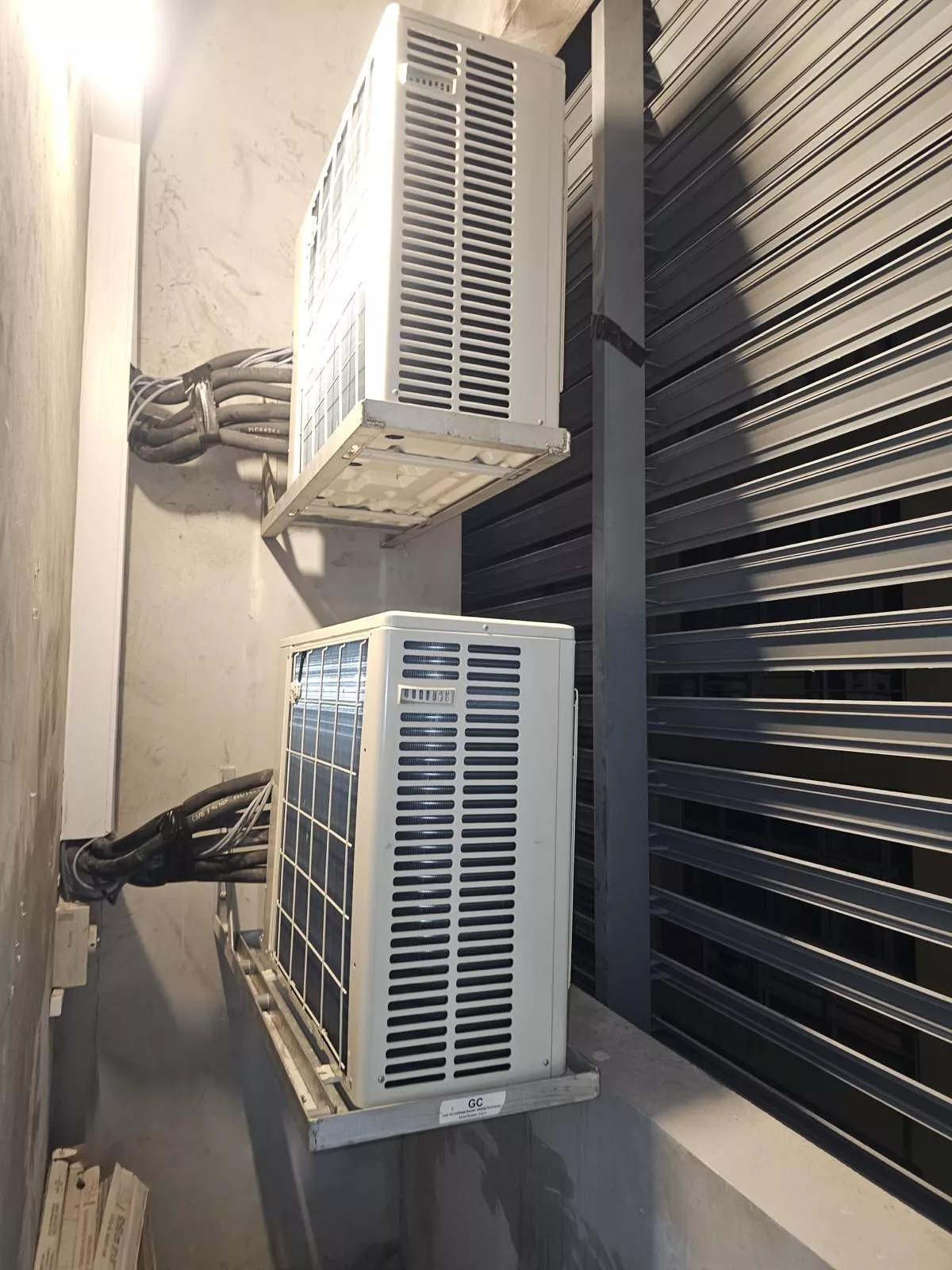
Pictured: two outdoor units on their brackets on a flat's ledge, with the pipework running back into the wall. This is the part of your aircon that sits outside, and the part most people cannot easily see, let alone clean.
"How do I clean my aircon ledge?" is a fair question, and it hides two different jobs. One is housekeeping: what you keep on the ledge, and what you can see from the window. The other is cleaning the outdoor unit itself, the box with the fan and the coil. This post separates them, says what is safe to do from inside the flat, what is not, and what we publish about the outdoor unit so that you know what a visit does and does not include.
First, what the ledge is for
On an HDB flat the outdoor unit sits on the designated aircon ledge, on proper brackets. Our published position is that roof and common-corridor installation are not allowed in most blocks, and that the work is done by a BCA-licensed contractor. The ledge exists to carry the unit and to let it throw heat outwards. That second job is the one housekeeping protects. We cover what HDB does and does not specify in our guide to the aircon ledge.
The cleaning that costs nothing: clear the ledge
On our jobs the most common thing a technician has to move before he can even reach the outdoor unit is whatever has been stored on the ledge: brooms, pots, drying racks and boxes. They sit exactly where the unit needs air to dump its heat, and they are in the way of anyone who has to work on the unit. If you do one thing before a visit, take them away. It helps whichever job you book.
Two small additions from the same habit of looking:
- Do not stack anything against the unit's sides or in front of its grille. The fan pulls air through the coil, and a blocked side makes the unit breathe its own hot air.
- Keep the drain and pipe paths free. If water is dripping outside from the aircon, that is a drainage question, and we cover it in water dripping onto a neighbour's unit.
What you can safely look at from inside
You do not need to touch the unit to learn something about it. From inside the flat, with your feet on the floor, you can look. Do not reach out, lean out or climb onto anything to get a better view. If you cannot see it without doing that, no look at all is the right answer. Then tell us what you could see.
Things worth noticing, and what each one points to:
- Fluff, leaves or debris against the grille. Airflow is being blocked. Tell the technician; do not poke at it.
- Rust on the bracket under the unit. Most rust is cosmetic, but a bracket is the one part where failure is not "the room gets warm". See when a rusting bracket has to be replaced.
- A bird's nest, ants or a gecko around the unit. Do not clear it yourself. Ants, geckos or birds in your aircon says what to do and when to call pest control first.
- Oily or damp patches on the pipes. Refrigerant oil stains are one of the things the pre-check physically looks for. Do not wipe them off before we see them.
- The fan not turning while the room is warm. Switch the aircon off and tell us. Do not try to spin the fan with anything.
What not to do to the outdoor unit
This is the part where well-meant cleaning does the damage.
- Do not hose or pressure-wash the coil. The fins are thin, and water forced into a live unit's electrical parts is a worse problem than dust.
- Do not use cleaning sprays or chemicals on the ledge. Runoff drips onto the flats below, and the unit's coil is not something to experiment on.
- Do not comb or scrape the fins. Bent fins reduce airflow, and that is hard to undo.
- Do not remove the casing. There is mains power inside, and refrigerant pipework.
- Do not lean out of a window or step onto the ledge. No cleaning job is worth the fall. This is also why the outdoor unit is a technician's job.
What a visit from us does and does not cover on the outdoor unit
This is the part to read carefully, because it is easy to assume a wash covers more than it does. These are the lines on our own pages:
| Job | What our pages say about the outdoor unit |
|---|---|
| 9-point pre-check (included with every service booking) | Point 5 is an outdoor condenser inspection: a visual check of the fan, the condenser coil and the external pipework, to catch fan failure and coil corrosion early. Point 7 is a physical check for rust, refrigerant oil stains, cracked piping and visible damage. |
| General servicing ($55 for 1 unit) | The service page lists a basic check of cooling, electrical connections and the outdoor unit. |
| Chemical wash (from $135 for 1 unit) | The published steps are on the indoor unit. The outdoor unit is not mentioned. |
| Chemical overhaul (from $200 for 1 unit) | A strip-down of the indoor unit. The outdoor unit is not mentioned. |
So the honest summary is that the outdoor unit is looked at on every visit, and that none of our published wash or overhaul steps clean it. We have not published a price for washing an outdoor unit, so we will not give you one here. If the pre-check shows the outdoor unit needs more than a look, that is a conversation after the inspection, with a quote before any work starts. For the wording question "does an overhaul include the outdoor unit", the longer version is in what the word overhaul covers.
Why a technician and not you
It is partly safety, and partly that the useful part is the diagnosis, not the rinse. A dusty coil is rarely the whole story. The reasons an outdoor unit struggles include a failed fan, a corroded coil, a restricted airflow path, or a pressure problem that you cannot see from a window. The pre-check reads the refrigerant pressure at the same visit, which is why the outdoor look and the pressure reading belong together. Higher floors add a further question of access, which we cover in why high-floor servicing can cost more; we publish no ledge-access surcharge, and we confirm any access-related charge with you on WhatsApp before the visit.
What to do this week
- Clear the ledge of anything stored there, from the inside, without leaning out.
- Note anything from the list above: fluff, rust, a nest, oily marks, a fan that is not turning.
- Book a service with the 9-point pre-check and put your notes in the booking message.
- Ask for the outdoor unit finding in writing, in the words "looked at" or "cleaned", so you know which it was.
The short version
- "Cleaning the ledge" means two things: housekeeping you can do, and cleaning the outdoor unit, which is a technician's job.
- Clearing brooms, pots, drying racks and boxes off the ledge is free and helps every job.
- Look from inside, never lean out. Do not hose, spray, scrape or open the unit.
- On our pages the outdoor unit is inspected at the pre-check and general service. The wash and overhaul steps are indoor-unit steps. We publish no price for washing an outdoor unit.
- Notes sent with the booking make the pre-check quicker.
If you would like us to look at the ledge and the outdoor unit
The message below opens in WhatsApp with the fields laid out. Fill in what you know and leave the rest blank. WhatsApp us on 9107 2601 and we will tell you what the visit covers. You can read how the inspection works on our 9-point pre-check page, and the published servicing prices are on the pricing page.