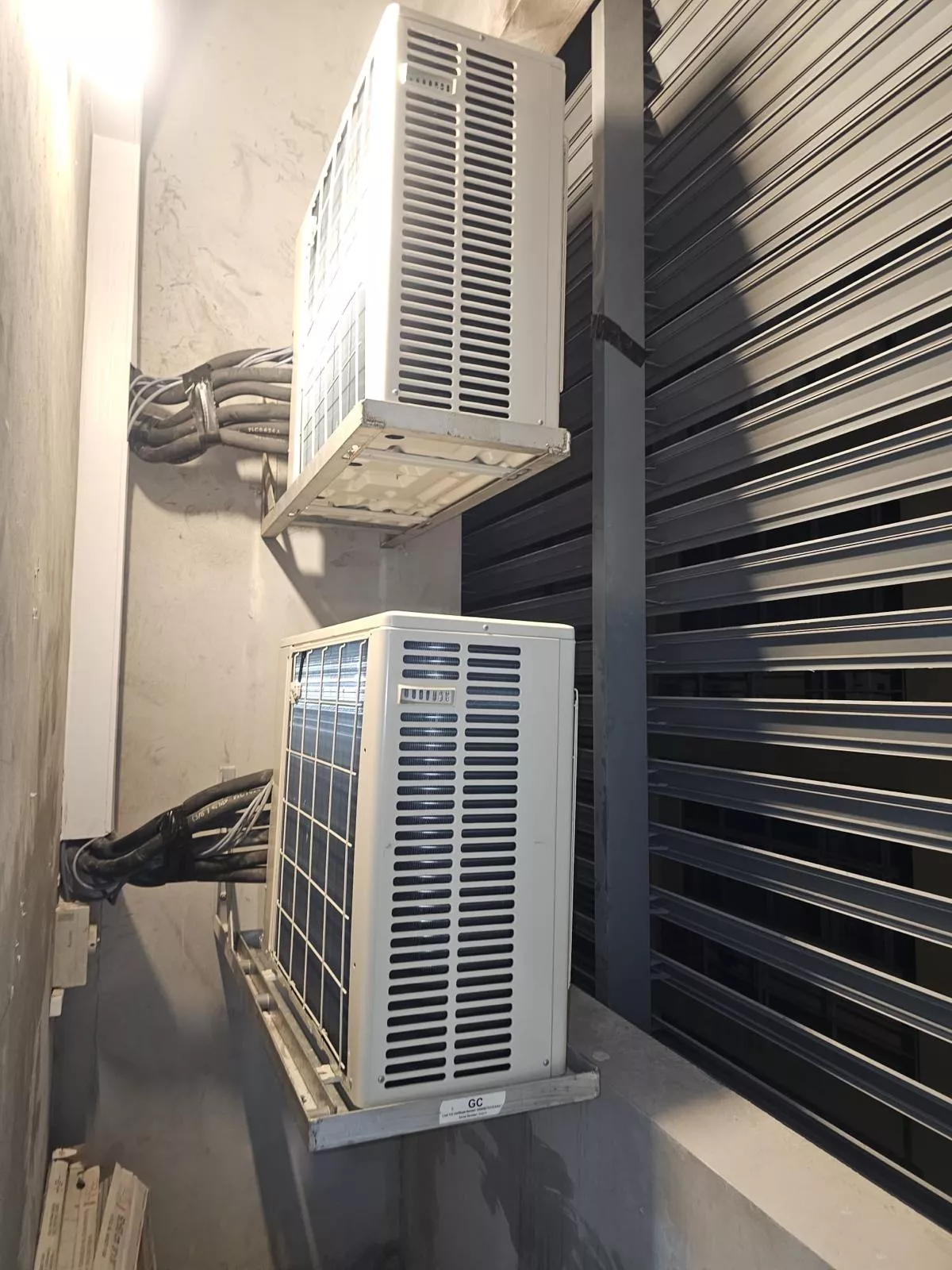
Nobody inspects the bracket. People look at the fan coil in the bedroom because that is the part they can see, and they look at the outdoor unit maybe once a year when something starts dripping. The two pieces of steel angle bolted into the wall underneath the condenser get looked at when a technician happens to be out on the ledge and thinks to mention it.
That bracket is holding somewhere in the region of 30 to 50 kilograms of compressor, permanently, in the open air, above something. In an HDB block that something is usually a walkway, a service yard, or a neighbour's ledge two floors down. It is the one part of an air-conditioning system where the failure mode is not "the room gets warm".
Here is what actually corrodes, how to tell surface rust from a bracket that has to come off, and what happens when a servicing company refuses to work on your unit.
What a bracket actually is, and where it fails
A standard condenser bracket is a pair of steel angle arms, usually powder-coated or galvanised, bolted back to the wall with expansion anchors and carrying the condenser on rubber anti-vibration mounts. It is a simple thing, and it fails in four places rather than one.
The coating. Steel in Singapore does not rust because the steel is bad. It rusts because the coating got broken and then stayed wet. The most common time for that coating to be broken is during installation — a bracket dragged across a concrete ledge, drilled through, or knocked with a spanner has a chip in it before the condenser ever sits on it. Everything after that is time.
The wet spot. A condenser produces condensate and rain lands on the ledge, and both run to the same place: the underside of the unit, straight onto the bracket arms. A bracket does not corrode evenly. It corrodes worst directly under the unit, where you cannot see it from the window.
The bolts and washers. These are the part that matters most and the part that gets checked least. The arms can look presentable while the fixings holding them to the wall are the item actually losing section. Rust bleeding downward from a bolt head in a brown streak on the wall is the sign worth knowing.
The wall around the anchor. An expansion anchor works by gripping sound concrete or masonry. If the wall around it has spalled, cracked or gone powdery, the bracket can be in perfect condition and still be unsafe, because the thing it is bolted into is not. This is more common on older blocks and on walls that have been drilled and re-drilled through several sets of aircon over the decades.
Surface rust or a real problem
Almost every bracket in Singapore over five years old has some rust on it. Most of it is cosmetic. The distinction is not how ugly it looks, it is whether the steel has lost thickness.
Usually cosmetic: a brown film you can rub and it leaves a stain on your finger; discolouration at a corner or an edge; rust staining that has run onto the bracket from something above it.
Take seriously: flaking that lifts off in layers or scales, because that is corrosion that has been going on long enough to eat into the section; pitting you can catch a fingernail in; any visible deformation — an arm that has sagged, twisted or is no longer at a right angle to the wall; a gap opening between the bracket and the wall face; rust streaks running down the wall from the fixing points; and a bracket that moves at all when the unit is running.
Stop and get it looked at properly: the wall around the bolts is cracked or crumbling; you can see daylight or a shadow line between the back of the bracket and the wall; the condenser is visibly out of level when it was not before. None of these are wait-and-see items on a high floor.
What you can check yourself, safely
You do not need to climb onto anything. From inside, at the window or the service yard door, three things are visible on most installations:
- Is the unit level? Sight along the top edge of the condenser against the horizontal line of the ledge or the window frame behind it. A tilt that was not there before is worth a call.
- Are there rust streaks on the wall? Look below the bracket arms and below the bolt heads. Streaks tell you where water sits and how long it has been sitting.
- Does it move or buzz? Run the system and put a hand flat on the window frame or wall near the bracket. A heavy vibration coming through the wall usually means the anti-vibration mounts have hardened or collapsed. That is a small job on its own — and a large one if it is left, because vibration is what works fixings loose.
What you should not do is lean out to feel the bracket, or send anyone up a ladder on a ledge. Anything that involves being outside the window is a job for people with the right access equipment.
Why a servicing company may decline to work on it
This surprises people, and it is worth explaining rather than arguing about. A technician doing a chemical wash or a gas top-up has to get onto or over that ledge and put weight and force on and around the outdoor unit. If the bracket underneath it is questionable, the technician is the person standing next to it.
So a company that says "we are not touching this until the bracket is dealt with" is not upselling you. It is the same judgement as refusing to work off a wobbly ladder. If you are told this, the useful next question is not "are you sure" but "what specifically did you see" — a straight answer will name the part: the bolts, the wall, the arm, the mounts.
When brackets actually get replaced
Almost always alongside something else, and for a practical reason: to change a bracket, the condenser has to come off it. That means the refrigerant is pumped down, the electrical connection isolated, the unit lifted clear, the old bracket unbolted, new anchors set — ideally not in the same holes — the new bracket fixed, the unit reseated, and the system vacuumed, leak-tested and recharged.
That is most of the labour of an installation. Which is why the sensible moments to deal with a bracket are:
- When the system is being replaced anyway. The condenser is coming off regardless. New brackets at that point are marginal work, and a new system on twenty-year-old brackets is a strange saving to make.
- During a relocation. Everything comes down and goes back up. If you are moving the units to a new home, the brackets at the new address are new anyway — the question is what you leave behind.
- Before a renovation seals the access. If a false ceiling, a new service yard door or new grilles are going in, get the ledge sorted first. Access is never cheaper later.
What it costs, and what we can tell you before a visit
We do not publish a price for bracket replacement, and we are not going to invent one here. It depends on how many units are on the ledge, what the wall is made of, what access is available at that floor, and whether the condenser has to be lifted clear or can be shuffled. It is quoted after a site survey, and the site survey is free.
What is published is everything around it. A service visit is $55 minimum for one unit and includes the 9-point pre-check, which is how the bracket and mounts get looked at properly in the first place. Standard repair work covering drainage and electrical is $80. Our full price list is published in full, and if the answer turns out to be a new system rather than a repair, the installation costs are published too. The displayed price is the final price.
If you are renting, or the flat is not yours
A corroded bracket is a fixture of the property, not a consumable, so it usually sits with the owner rather than the tenant — but "usually" is doing work in that sentence, and the tenancy agreement and inventory are what actually decide it. The same question comes up over servicing, and we covered how those responsibilities normally split in tenant or landlord: who pays for aircon servicing, and what tenants can and cannot change in installing aircon in a rented flat.
The practical advice either way is the same: report it in writing with a photo, and date it. A bracket problem that was raised and ignored is a very different conversation from one nobody mentioned.
Three questions worth asking your installer
- Are you reusing the existing brackets? On a system replacement this is a real question with a real cost attached, and it should be answered before the quotation is signed rather than discovered on the day.
- Are you drilling new anchor points or reusing the old holes? Re-using tired holes in tired concrete is how a bracket ends up looking fine and holding badly.
- What are the anti-vibration mounts made of, and are they new? They are cheap, they are the first thing to perish, and they are what stops vibration from loosening everything else.
The short version
Rust on a bracket is normal. Flaking, pitting, movement, a tilt, or a cracked wall around the bolts is not. You can check the level, the wall streaks and the vibration from inside your own window in about a minute, and that is enough to know whether to call someone. Brackets are cheapest to deal with at the moment the condenser is already coming off — which is a good reason to raise it when you book a service rather than when a technician raises it with you.
Not sure what you are looking at? Send us a photo from your window. WhatsApp us on 9107 2601 — tell us the block, the floor and what you can see, and we will tell you honestly whether it needs a visit or whether it is the ordinary rust that every ledge in Singapore has.
Also worth reading: aircon for a landed house: what is different
A loose or rusted bracket is also one of the more common reasons an outdoor unit gets audibly louder before it fails visually — see why a normal aircon gets louder over time, and what actually happens if a neighbour raises it.