Somewhere between a whining outdoor unit three floors up and a WhatsApp group chat about "the noisy aircon at block whatever," most people assume there is a clean legal number: a decibel limit, an NEA fine, a form to fill in. There isn't — not the way it usually gets described. What actually exists is a boundary noise guideline written for a different kind of building, and a separate, slower system for resolving neighbour disputes that was never built around aircon compressors specifically.
This is what the rules actually cover, what recourse genuinely exists if a neighbour's unit — or your own — has become a real problem, and the mechanical reasons a perfectly normal aircon gets louder over the years without anything being "broken" in an obvious sense.
Is there an actual noise limit for aircon units in Singapore?
There is a published NEA guideline with real numbers in it, and it is worth knowing exactly what it says and does not say. The Guideline on Boundary Noise Limit for Air Conditioning and Mechanical Ventilation Systems in Non-Industrial Buildings sets a maximum noise level, measured at the site boundary, of 65 dBA in the day (7am–7pm), 60 dBA in the evening (7pm–11pm) and 55 dBA at night (11pm–7am) where the noise reaches residential premises — and a stricter 60/55/50 dBA where it reaches a noise-sensitive premises such as a hospital or a home for the aged.
The detail almost every summary of this leaves out: the guideline's own scope is air conditioning and mechanical ventilation systems in non-industrial buildings — shopping complexes, offices, hotels, schools, hospitals and similar. It was written for the AC and ventilation plant on a commercial building affecting the homes around it, not for one HDB household's split-system condenser affecting the flat next door. There is no separate published NEA decibel limit that applies specifically between two residential units the way a lot of aircon-company blog posts imply. If your neighbour's condenser is loud, you cannot simply measure it, compare it to a number, and file a fine.
That does not mean an unusually loud unit has no recourse — it means the recourse runs through a different system, built for neighbour disputes generally rather than aircon noise specifically.
What to actually do if a neighbour's aircon is too loud
Singapore's process for this kind of complaint is the same one used for any neighbour noise dispute, and it is designed to escalate gradually rather than jump straight to an authority:
- Raise it directly first. A unit can get louder gradually over a few years without the owner noticing — they are not the one hearing it from the next block. A specific, polite heads-up ("your outdoor unit sounds a lot louder than it used to, especially at night") is often the fastest fix, because it points the owner toward a cause worth checking rather than a dispute worth having.
- Bring in your Residents' Committee or town council if raising it directly does not help. They can help mediate informally.
- The Community Mediation Centre (CMC) handles neighbour disputes, including noise, through mediation rather than a ruling — both sides come to an agreement rather than one side "winning."
- The Community Disputes Resolution Tribunal (CDRT) is the last resort. Under the Judiciary's own description, it hears disputes between neighbours involving "unreasonable interferences of enjoyment or use of places of residence". A mediated settlement reached at the CMC can be registered with the CDRT.
None of these steps require you to own a sound level meter or quote a dBA figure at anyone. What they do reward is being able to say something specific: since when, roughly how often, what it sounds like, and whether it changed recently — which is exactly the information that also helps a technician find the actual cause.
Why a normal aircon gets louder over time
This is the part a noise dispute usually skips past, and it is the more useful question if the loud unit is your own: when an aircon that has run for years gets louder, there is usually a specific, checkable reason. These are the ones worth checking first.
A worn or dirty blower wheel
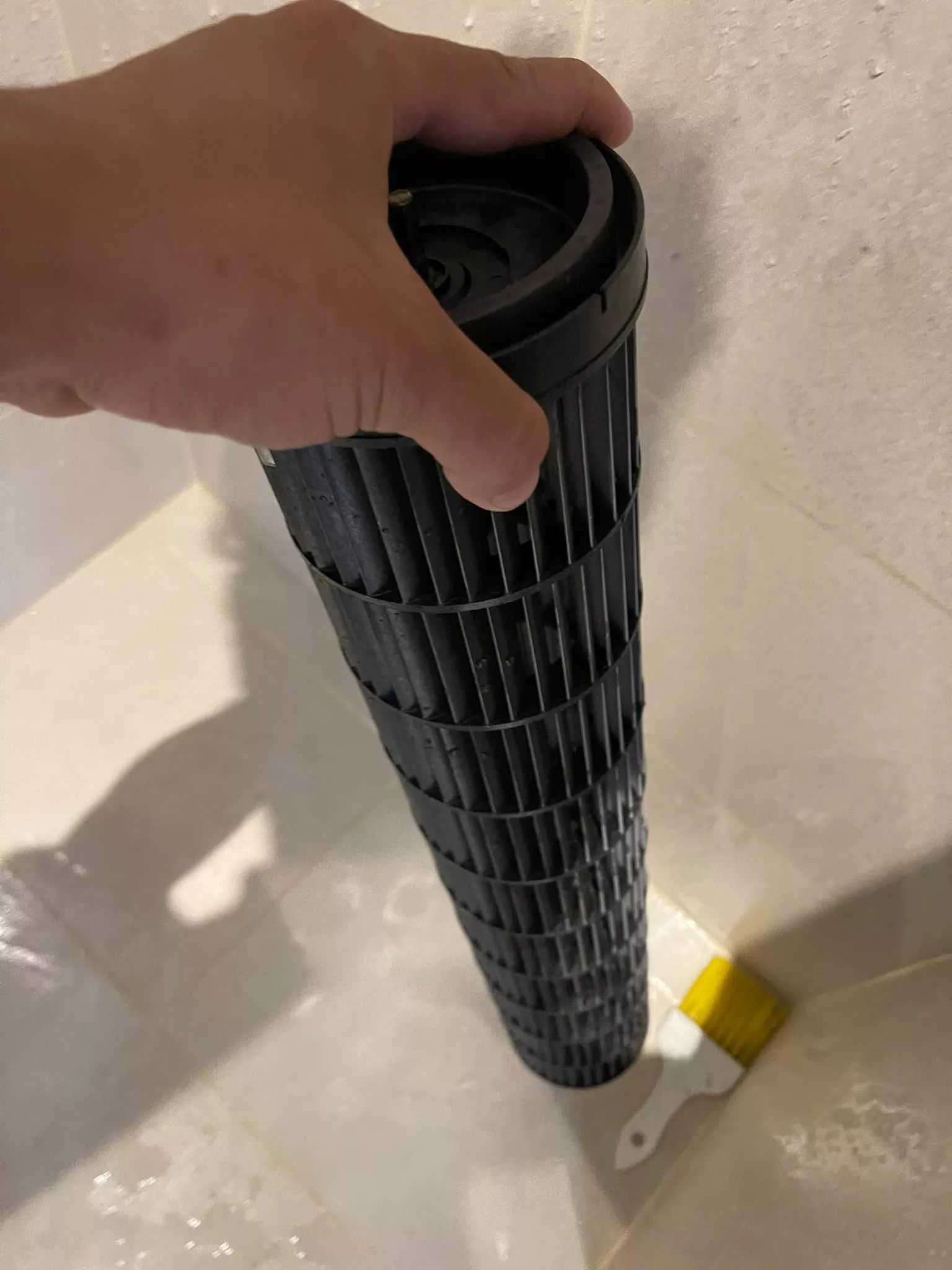
The blower wheel — the fan inside the indoor unit that pushes cooled air into the room — collects dust and grime over time, and an unevenly coated wheel spins out of balance the way an unbalanced washing machine drum does. This shows up as a new humming, whirring or rattling sound rather than a change in cooling. A general service or chemical wash inspects and cleans this; a chemical overhaul goes further and removes the blower wheel entirely for individual cleaning and rebalancing, which is the step that actually fixes a wheel that a wash alone has not quietened.
A loose or corroded outdoor bracket
The outdoor unit's mounting brackets take years of rain, heat and vibration on an HDB ledge, and a bracket that has rusted or loosened lets the whole condenser vibrate against the wall or the ledge itself — which reads as a new buzz or rattle that gets worse, not better, and is often more audible to the neighbour below than to the owner. What to look for on a rusted or loose bracket covers how to tell from your own window whether this is what you are hearing.
Low refrigerant or a strained compressor
A system running low on gas makes the compressor work harder to reach the same temperature, and a compressor under that kind of strain is often audibly louder before it fails outright. Signs a compressor is failing, and whether to repair or replace it goes through what that actually sounds like and what decides whether it is worth fixing. Gas top-up pricing depends on refrigerant type — from $115 for R22, $130 for R410A, $170 for R32 per outdoor circuit — and is only the right fix if a leak, not old age, is the actual cause.
An aging unit nearing end of life
Compressors and fan motors tend to get noisier as they wear, gradually rather than suddenly, which is why "it has always been a bit loud" is a different problem from "it just got loud this month." A unit in this category is a candidate for the same overhaul-or-replace decision covered elsewhere on this site, not a quick fix.
New noise versus baseline noise — the distinction that matters
Before assuming a fault, work out which situation you are actually in:
- It just got louder. Something changed — a bracket loosened, a gas leak developed, a blower wheel picked up enough grime to go out of balance. This is worth a proper check relatively soon, both for your own comfort and because it is the version a neighbour is most likely to notice and raise.
- It has always sounded roughly like this. Non-inverter systems and older units are simply louder by design than a newer inverter system, and that is a like-for-like comparison problem rather than a fault. If a neighbour raises this kind of noise, the honest answer may be that nothing is actually broken — the unit is just old, and replacement rather than repair is the real fix if it needs to change.
Either way, the unit's age, when it was last serviced, and whether the bracket or blower wheel has ever been checked are the three facts worth having ready before you book anything — they are the same three facts that tell a technician where to start.
Getting it checked
General servicing starts from $25/unit (minimum $45 for one unit) and includes the 9-point pre-check, which covers power and thermostat, drainage, a fan blower spin test for bearing noise and imbalance, and an operating noise diagnostic as part of the same visit — with a 90-day workmanship warranty on the work done. If the pre-check points to something specific, such as a bracket needing replacement or the compressor itself, that gets quoted transparently before any further work, never guessed at over WhatsApp.
If you are dealing with your own unit getting louder, or you have been asked by a neighbour to look into it, WhatsApp us on 9107 2601 and tell us since when and what it sounds like — it helps the technician know where to start.