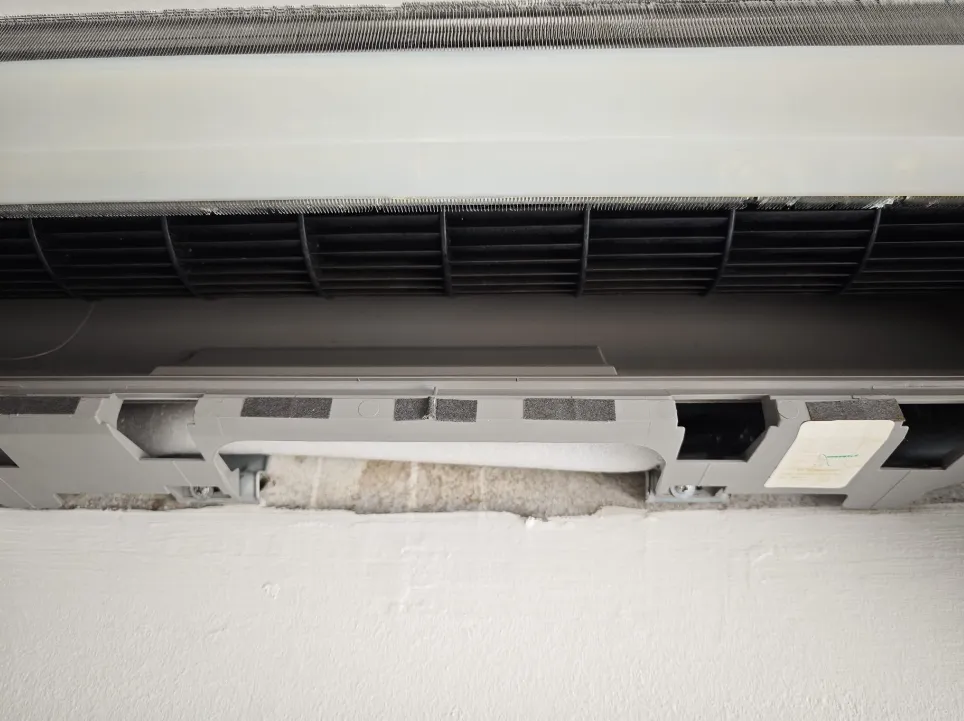
Pictured: the inside of an indoor unit on one of our jobs, front panel open. The coil fins run along the top edge of the picture and the dark blower barrel sits below them. This is the part of the unit the self-clean button is trying to look after.
Many aircons sold in Singapore today have a button or a remote setting with a name like self-clean, auto-clean, clean mode or mould guard. It is a fair question to ask: if the unit cleans itself, why would I still pay for a wash? We get asked this when we send the 9-point pre-check results, usually by someone who bought a newer unit and was told it looks after itself. The honest answer is that the function is useful, but it is not a chemical wash, and the way to know what it does for your unit is to read the manual, not the marketing line. This post sets out what these functions usually do, three checks you can make yourself, and how the service rhythm stays the same.
What these functions usually do
The names are the brand's, and the behaviour is the maker's choice, so it differs between brands and between models. From what the manuals describe, they fall into three kinds. Your unit may have one, two or none.
1. Drying the coil after you switch off. The unit keeps the fan running, and on some models warms the coil slightly, for a few minutes after the cooling stops. The aim is to leave the coil drier, because a coil that stays wet between cycles is where mould and biofilm like to grow.
2. A rinse cycle that uses the coil's own water. Some models freeze the coil and then let it thaw, so the water runs down and carries some of the loose dust out through the drain. This is described by the makers as a light clean, not a replacement for a service.
3. Automatic removal of dust from the filter. A few models brush the dust off the filter and into a box that you empty. This protects the filter. It does not touch the coil or the blower behind it.
We do not test these functions, and we do not publish a figure for how much any of them cleans. Be wary of any article that gives one without naming the model. The reliable source is the manual for your own unit, which says which of the three your button does and how often it expects you to use it.
Why none of them replaces a chemical wash
Our chemical wash is a set of steps, and it is worth setting them next to the functions above. We dismantle the roller, fit a water tray and cover, put chemical on the coil and the blower, rinse, flush the drainage and test the cooling before we leave. The chemical is what dissolves the mould, the biofilm and the sticky layer that dust forms on a coil that has been wet for months. Singapore's humidity, around 84% through the year, is why coils foul faster here than in a drier country, and a drying cycle that runs for a few minutes after each use is working against that. It does not take the layer off.
The same goes for the blower wheel, the barrel fan behind the coil. It is permanently damp while the unit runs and sits in the dust path, so it holds a felt-like layer once the unit has been used for a while. We explain why a normal service does not reach it in our post on the blower wheel. A self-clean function does not remove the barrel or wash it, and neither does a filter-dust brush. If you want that barrel clean, the job is a chemical wash or, when the unit is badly fouled or has not been stripped for years, a chemical overhaul.
So the function and the wash do different jobs. Think of the function as keeping the unit from getting worse between visits, and the visit as what actually cleans it.
Three checks you can make with a torch
You need your phone light and a chair you can stand on safely. Switch the unit off at the remote and let any after-run cycle finish. Do not touch the coil: the fins bend and cut easily.
- Take the filter out and hold it up to the light. If you cannot see the light through it, it is choked, and the function cannot help with that. Our filter washing guide sets out how often to wash it and where do-it-yourself stops. Put it back dry and fully seated.
- Shine the light along the coil. With the filter out, the coil is the finned surface behind it. A clean coil shows metal fins with gaps between them. A grey layer that fills the gaps, or black spots and slime on the fins, is more than a drying cycle will deal with.
- Look at the blower barrel through the opening. If the blades carry a grey felt, or the barrel looks furry, the airflow is already reduced. This is the case where a normal service will not be enough.
Then switch the unit on and smell the first minute. A clean unit blows air with almost no smell. A sour, musty or wet-cloth smell that appears at start-up and fades is coming from the unit, and our guide to why an aircon smells musty goes through the causes. If the room is damp as well, the dry mode guide explains what that setting can and cannot do. It is a different setting from the clean function, and the two are easily mixed up on a remote.
The rhythm does not change
This is what we work to on every job, and it is the same whether or not your unit has a clean function:
- General servicing about every 3 months for a unit in daily use. The roller and blower are dismantled and the filter, coil and drainage are cleaned and flushed.
- A chemical wash every 6 to 12 months, on top of the routine servicing. Go every 6 months if anyone at home has allergies or asthma, if the unit runs 8 or more hours a day, or if you have pets. A lightly used guest-room unit can stretch closer to 12 months.
- A chemical overhaul every 2 to 3 years for most homes, or sooner for a unit that runs heavily, sits in a dusty room or is already 5 or more years old.
Where the function helps is at the edges of those ranges. A unit that dries itself after each use may be a candidate for the longer end of the wash range, and a guest-room unit that is used rarely may not need a wash at all in a year. That is a judgement for the pre-check, which looks at drainage flow, the fan blower spin and the coil and filter dirt, and not something we will promise from the model name. We cover the other side of this in our post on a rarely used spare-room aircon.
What it costs, from our published prices
Everything below is on our pricing page, and the price shown is the price you pay.
- Normal servicing (wall unit): $55 for 1 unit, $90 for 2, $120 for 3, $160 for 4, then $35 per unit from 5. The $55 for 1 unit covers the visit, the 9-point pre-check and the service.
- Chemical wash: $135 for 1 unit, $245 for 2, $345 for 3, $425 for 4, then $100 per unit from 5. More on what it includes on our chemical wash page.
- Chemical overhaul: $200 for 1 unit, $370 for 2, $515 for 3, $640 for 4, then $150 per unit from 5. See the chemical overhaul page.
The 9-point pre-check is included with any service booking and tells you which of the three your unit needs. We will not strip a unit that only needs a wash, and we will not sell a wash to a unit that only needs a service. If a wash alone did not bring a unit back, our post on what a chemical wash cannot fix sets out the other causes.
What not to do
- Do not skip a booked visit because the unit has a clean function. The visit is the cleaning. The function is the upkeep between visits.
- Do not use the function as a way to cover a smell. If the smell is there at start-up and has been for weeks, the unit needs a look. Running the cycle more often will not change that.
- Do not spray anything into the vent. It does not clean the coil, and the unit blows whatever you used into the room.
- Do not pick the cheapest wash because the unit is new. Ask what is actually being done to the coil and blower. Our post on what a cheap chemical wash leaves out gives the questions to ask.
What to tell us when you WhatsApp
- The brand and model, if you can read them off the sticker on the indoor unit, and whether the remote has a clean or self-clean setting.
- Whether the function runs after you switch off, and how long it runs for.
- The number of indoor units, and when each was last washed or serviced.
- What the torch check showed: a clear coil, a grey layer or black spots, and whether the blower barrel looks furry.
- Whether there is a smell at start-up, weaker cooling than before or any dripping.
The short version
- A self-clean or auto-clean function is the maker's upkeep feature. It dries the coil, lightly rinses it or removes dust from the filter, depending on the model. Read your manual to see which.
- It does not apply chemical to the coil and blower, and it does not take the barrel out. That is what the wash and the overhaul are for.
- The 3-monthly service and the 6 to 12-monthly wash stay as they are. The pre-check is how you decide whether yours can stretch.
If you would like us to look
The message below opens in WhatsApp with the fields laid out. Fill in what you know and leave the rest blank. WhatsApp us on 9107 2601 and we will tell you which job fits and the price on our published table.