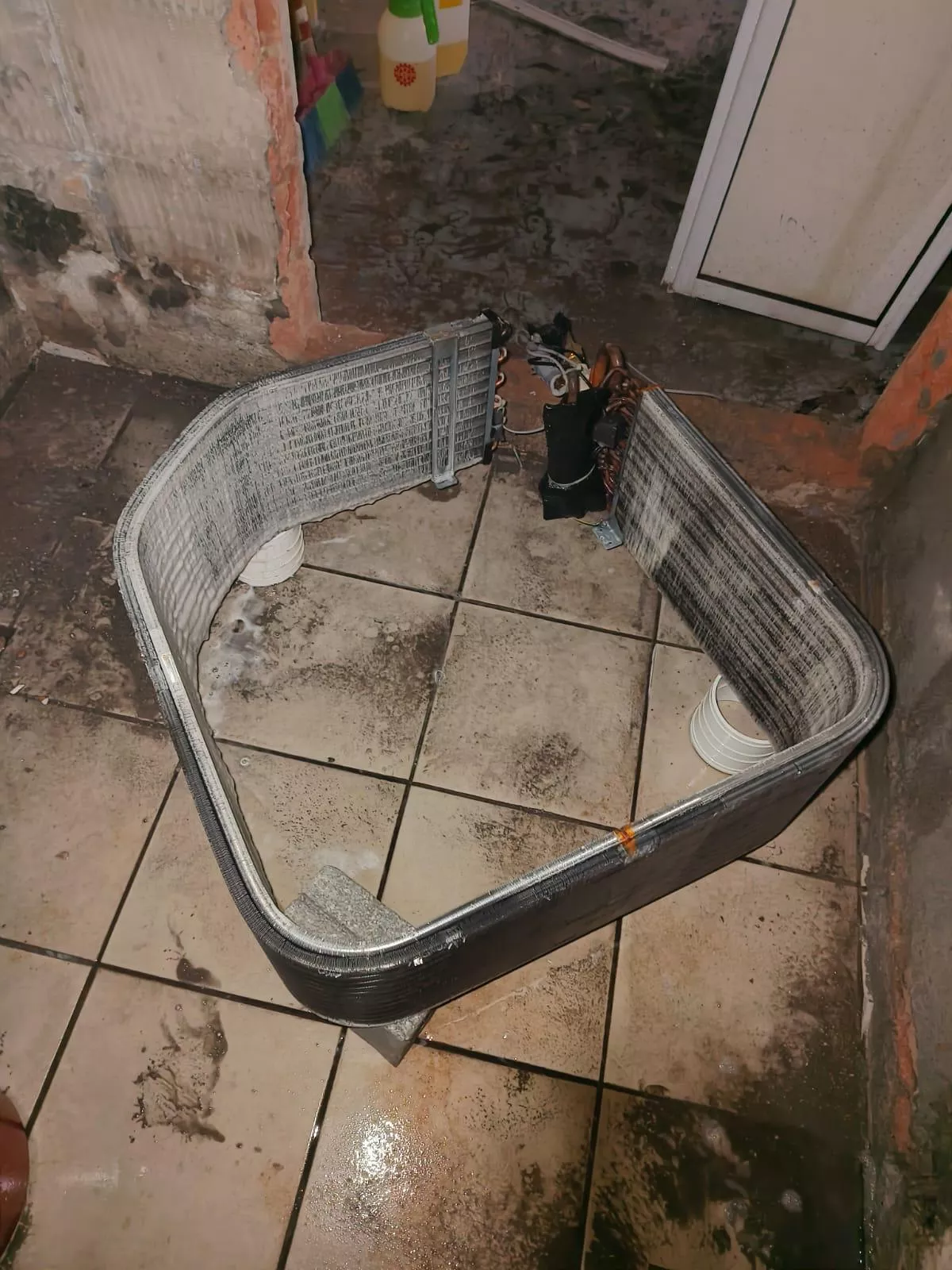
Pictured: a coil taken out of a unit on one of our jobs, with a grey layer of grime coating the fins. You cannot see this from the room, but it helps decide whether the air coming out of your aircon is dry or carries water.
You switch the aircon on and, for a few seconds, a thin white haze rolls out of the vent. Or you notice fine beads on the louvre that grow and drip onto the bedsheet. Or, worse, a light spray lands on the floor or on the person under the unit. People describe all three as "my aircon is blowing water", and they are not the same thing. One of them is the air behaving the way cold air behaves in a Singapore room. The other two usually mean the unit needs a look. This post is about telling them apart in five minutes, before you book anything, and about what we check when we do come.
Three things people call "mist"
1. A short haze at the vent, right after start-up, on a humid day. Air leaving the indoor unit is much colder than the room. In a damp room, that cold air can cool the moisture around the vent below its dew point and show up as a faint haze, for the same reason a cold drink sweats on a hot day. It appears in the first minute or so and fades as the room cools and the air dries. Nothing gets wet. This is not usually a fault.
2. Beads of water on the louvre or the outlet edge that grow and drip. The vent is cold, and the room air touching it is humid, so water collects on it. A little is normal on a very humid day. If it keeps forming, runs down the wall or drips on the bed, something is making the vent colder or the airflow weaker than it should be.
3. Droplets or spray that actually leave the unit and land on things. This is the one that needs a visit. Water that travels through the air is water that has not gone down the drain. It can come from a coil that has iced up and is melting, from a blower that is throwing off water it has collected, or from a drain that has backed up.
The five-minute test you can do yourself
You need a dry tissue, a torch or your phone light, and a chair you can stand on safely. Do not open the casing or touch the coil. Switch the unit to cool, run it for ten minutes, then:
- The tissue test. Hold a dry tissue about 30 cm below the vent for a full minute, away from the wall. If it stays dry, whatever you saw was haze. If it gets spotted or damp, water is leaving the unit.
- Look at the louvre. Shine the light along the vane. A film of tiny beads that stays put is condensation. Beads that join up and drip are a reason to book.
- Look for ice. White frost on the louvre, on the pipe or on the coil behind the front panel means the coil is running too cold. Stop cooling and switch to fan-only to thaw it, and do not chip at it. Our guide to a frozen indoor unit covers the first ten minutes.
- Check the filter. With the unit off, lift the front panel, take out the filter and hold it up to the light. If you cannot see the light through it, it is choked. How often to wash it and where do-it-yourself stops is in our filter washing guide. Put it back dry and fully seated.
- Look at the drain outlet outside. With the unit running, the pipe that carries the water away should drip or run. If it is dry on a humid day while the vent is wet, the water has gone somewhere else.
Then write down when it started. "Since the rainy weeks began" points one way. "Since the wash last month" points another, and our post on dripping right after a wash or service sets out what can be normal in the first days and what to report.
Why a unit starts throwing water
These are the usual reasons, from the commonest. A technician has to confirm which one it is. You cannot tell from the room, and neither can we from a photo.
Not enough air across the coil. The indoor coil is meant to be cold, but not so cold that the moisture on it freezes. A choked filter, a fouled coil or a slow fan cuts the airflow, the coil runs colder than it should, and ice builds up. When the ice melts, or when chunks of it are caught in the airflow, you get water in the air. If the ice keeps coming back after the filter is clean, the cause is further in, and the same ice guide above explains why.
A dirty blower wheel. The blower wheel is the barrel fan that pushes the air out. Air leaving the coil is wet as well as cold, and some of that moisture lands on the blades as fine droplets. When the barrel is clogged with grime, the blades hold more of it and the air that leaves is wetter. We explain why a normal service does not reach it in our post on the blower wheel, because it decides which job you actually need.
A drain that has backed up. The coil makes water on purpose; it is meant to run into the pan and down the drain pipe. When the drain is slimed up or has lost its fall, the pan fills and the water has to go somewhere. Most of the time it drips from the front lip of the casing, but a blocked drain can also leave water sitting inside the unit where the airflow can pick it up. A drain that keeps choking needs more than another flush. We cover what produces the blockage in why a drain keeps choking.
A very humid room. Doors left open, wet laundry drying indoors and the damp end-of-year weeks all push more water into the air the unit has to handle. A unit in good condition copes. A tired one shows it first. If the room itself feels clammy, the dry mode guide explains what that setting can and cannot do.
What we check when we come
Every service booking starts with our 9-point pre-check, and for a unit throwing water four of the nine points do most of the work:
- Drainage flow check. We verify the drainage pipe is clear. Blocked drains are the number one cause of aircon water leaks in HDB and condo units, so this is where we start.
- Temperature drop measurement. We measure the difference between the air going into the unit and the air coming out. It tells us whether the problem leans towards gas or towards dirt.
- Fan blower spin test. We check the blower wheel for cracks, imbalance and bearing noise.
- Filter and coil dirt assessment. We tell you whether the unit needs a general service or a chemical wash, and we do not sell the wrong one.
The pre-check is included with any service booking. There is no check-only visit, because the inspection and the service are done together by the same technician. After it you hear one of three things: a normal service is enough, something extra is needed and here is the quote, or you decide not to go ahead and the $55 covers the visit and the diagnosis.
What it costs, from our published prices
Everything below is on our pricing page, and the price shown is the price you pay.
- Normal servicing (wall unit): $55 for 1 unit, $90 for 2, $120 for 3, $160 for 4, then $35 per unit from 5. The $55 for 1 unit covers the visit, the 9-point pre-check and the service. The roller and blower are dismantled, and the filter, coil and drainage are cleaned and flushed.
- Chemical wash: $135 for 1 unit, $245 for 2, $345 for 3, $425 for 4, then $100 per unit from 5. This is the deeper clean when the coil and blower are heavily fouled. More on it on our chemical wash page.
- Chemical overhaul: $200 for 1 unit, $370 for 2, $515 for 3, $640 for 4, then $150 per unit from 5.
- Standard repair (drainage, electrical): $80. Compressor and PCB replacement are quoted on site.
Which of these your unit needs is the pre-check's job. If the coil is only lightly dirty and the drain is the problem, a normal service with a proper flush may be all it takes. If the coil and blower are caked, a normal service will not clear it, and we will say so before any work starts. If the readings point to gas, that is a separate job with its own steps on the pricing page, and we tell you before anything is done.
What not to do
- Do not spray anything into the vent. It does not clean the coil. The unit then blows whatever you sprayed into the room.
- Do not keep restarting a unit that ices up. If the frost returns within a few hours, stop and book a check instead of experimenting.
What to tell us when you WhatsApp
- Which room, and where the water shows: the vent, the louvre, the wall below, or the floor.
- Whether the tissue test came back dry or wet.
- Whether you saw ice, and whether it came back after the filter was clean.
- When it started and what changed just before: a wash, a service, a new installation or the weather.
- The number of indoor units, and when the unit was last washed or serviced.
- A 20-second video of the vent with the unit running. It shows more than a description.
The short version
- A short haze at the vent in the first minute on a humid day, with a dry tissue underneath, is usually just the air. Keep an eye on it.
- Beads that drip, spray that lands on things, or a wet tissue mean water is leaving the unit and it should be checked.
- The cause is one of four or five. The pre-check separates them: drain flow, temperature drop, blower spin and coil dirt.
If you would like us to look
The message below opens in WhatsApp with the fields laid out. Fill in what you know and leave the rest blank. WhatsApp us on 9107 2601 and we will tell you which job fits and the price on our published table.