There is a particular kind of aircon problem that does not feel like a problem, because every time it happens somebody fixes it. The unit drips. Someone comes, clears the drain, the dripping stops, everyone is satisfied. Three months later it drips again.
After the third round of that, the useful question stops being "how do I clear it?" and becomes "why does clearing it not hold?" Those are different questions with different answers, and almost nobody is asked the second one.
Here is what actually blocks a condensate drain, why the quick clear buys you a season rather than a fix, and what to ask for so the next visit is the last one.
What is actually in the pipe
Start with what your aircon is doing all day. Warm room air is pulled across a cold coil, moisture condenses out of it, and that water runs off the fins into a drain pan under the coil. From the pan it leaves through a pipe, and in most Singapore homes that pipe runs inside the trunking on the wall.
Now add what else is in that air. Dust, lint, skin and hair get past the filter — a filter is a coarse screen, not a fine one. In a flat where the kitchen is not far from the living room, cooking oil vapour goes the same way. All of it lands on a coil that is wet for most of its working life, and wet dust does not behave like dust. It binds. Then it grows a biofilm on top of itself, which is the soft grey-brown slime you find in the pan of a neglected unit.
That slime is the blockage. Not a lump of debris that arrived one day, but a living layer that grows steadily in a warm, permanently damp pipe. Which is why the clog is never really "cleared" — it is removed from one section of a system that is still producing more of it.
Why the quick clear buys a season
The fast method is to put a vacuum or a pressure line on the drain outlet, pull or push the plug out, watch water run, and pack up. It works. Water flows again that afternoon and the customer is happy.
What it does not do is remove the source. The pan still has its slime layer, the coil is still shedding into it, and the walls of the pipe still carry a film that new debris sticks to. So the pipe re-narrows from the inside, at roughly the rate it did before, and you are back where you started on a schedule.
This is the same reason a general service will not fix a recurring choke. Our general servicing is $55 for one unit, $90 for two, $120 for three, $160 for four, and $35 per unit from five, and it covers a filter clean, a coil wipe, a drainage flush and a gas check. For a unit seen every three or four months that is exactly the right job. But a wipe is a surface action and a flush on a pan that is already coated mostly runs over the top of the coating. If the drain is choking repeatedly, the unit has moved past what routine maintenance is for.
The four reasons it keeps coming back
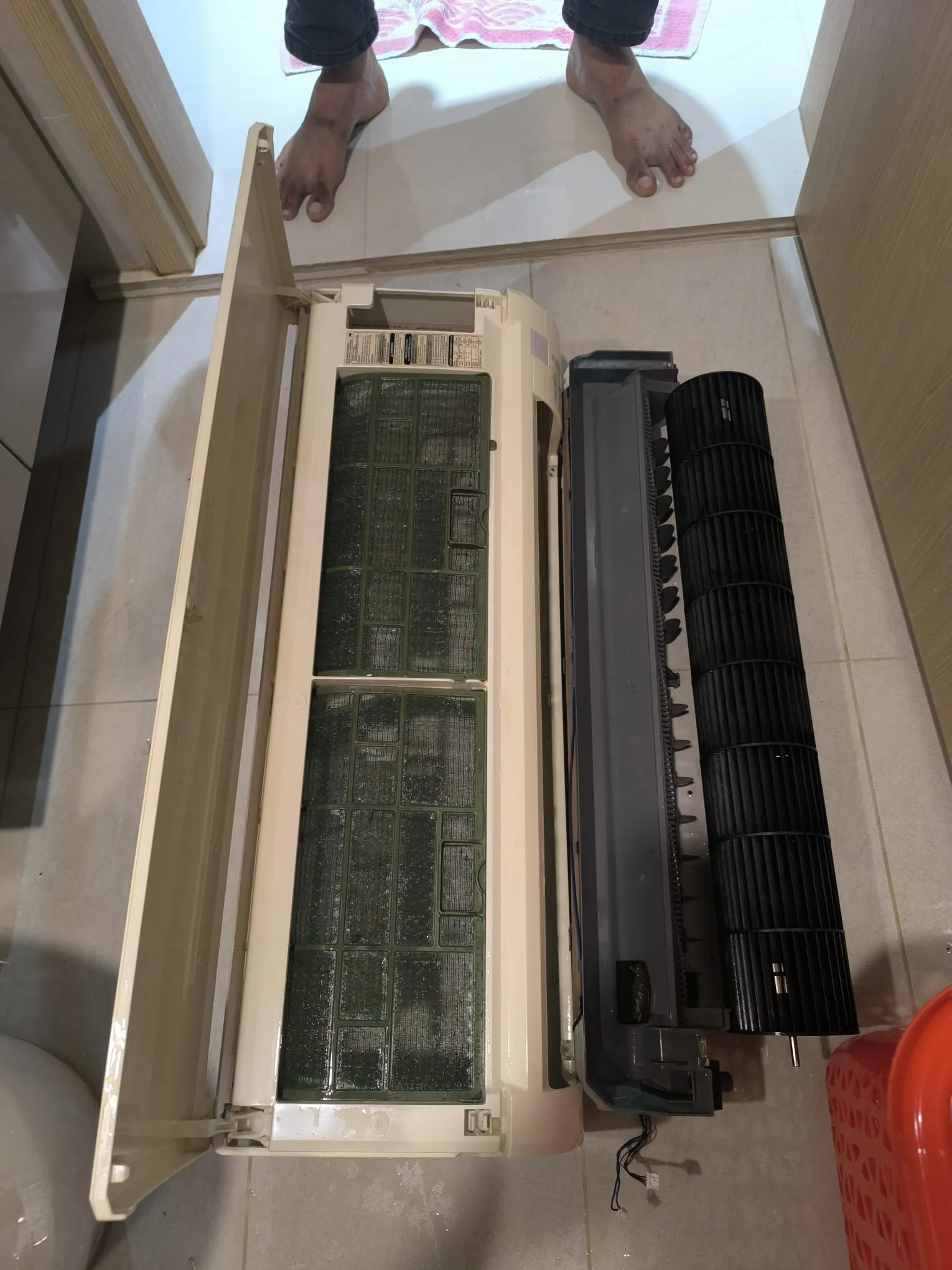
1. The pan and blower were never cleaned. This is the most common one by a distance. The drain pan sits under the coil and is awkward to reach with the unit on the wall; the blower wheel behind the coil is a barrel of small cupped blades, and each cup holds a crust that sets hard. Both shed continuously into the drain. Cleaning the pipe while leaving those two alone is bailing without finding the leak. We have written separately about what a general service does not reach on the blower wheel, because it is the single most-skipped part in the trade.
2. The drain line does not fall properly the whole way. A condensate drain in a home has no pump in most cases — it works on gravity, so it needs a continuous downward fall from the pan to the outlet. What it often gets instead is a flexible hose inside trunking with a dip in it, usually where the trunking turned a corner or was routed around something. Water sits in that dip permanently. Standing water grows biofilm far faster than moving water, so the low spot becomes the factory for the next blockage. Clear the pipe all you like — the dip is still there, and it will do it again.
3. Something changed and nobody connected it. If the choking started after renovation, after new trunking, after the unit was taken down and put back, or after a shelf or false ceiling went in around it, that is a strong hint. Re-routed drain runs are where dips get introduced. Worth reading alongside when in the renovation sequence aircon work should happen, which is the stage where these things get decided.
4. There is a drain pump and it is struggling. Where the unit sits low, or in a bulkhead or false ceiling with nowhere to fall to, a small condensate pump lifts the water instead. Pumps have a float switch that tells them when to run, and that float sits in the same slime as everything else. A gummed float means the pump runs late, runs constantly, or does not run — and the overflow arrives as water on your floor with a drain pipe that is perfectly clear. If your unit is in a false ceiling, whether there is a proper access panel decides how easily any of this can be reached at all.
When it is not the drain at all
Two things look exactly like a choked drain and are not.
A coil so fouled that it ices up. When airflow across the coil collapses, part of the coil drops below freezing and builds ice. When the unit stops, that ice melts all at once — far faster than the pan and pipe were designed to carry — and the overflow goes over the front lip of the pan rather than down the drain. The tell is that it drips heavily in bursts rather than steadily, often shortly after switching off. That is an airflow problem wearing a drainage costume.
Condensation on the outside of the pipe. If cold pipework in the trunking lost its insulation, the trunking itself sweats and water tracks along it and out at a joint. It looks like a leak and the drain is fine. We covered that separately in trunking condensation and ceiling stains, because the fix is completely different — insulation, not clearing.
There is also the honest boundary: cleaning is not repair. A cracked or warped drain pan, a failed pump, or a drain run built with no fall are things you replace or re-do. What a chemical wash cannot fix sets out that line, and it is worth knowing before you buy another wash hoping it does something a wash cannot do.
What actually breaks the cycle
For most repeat chokers, the job is a proper deep clean rather than another clearing — because the point is to remove the material that keeps producing the blockage, not the blockage.
A chemical wash is deep coil cleaning with the unit still on the wall: chemical applied to the coil, flushed through, the drain pan and line cleared properly, and the wash water caught in a bag. Ours is $135 for one unit, $245 for two, $345 for three, $425 for four, and $100 per unit from five.
A chemical overhaul is full disassembly — the unit comes off the wall and the coil, blower wheel, drain pan and casing are separated and cleaned individually. Ours is $200 for one unit, $370 for two, $515 for three, $640 for four, and $150 per unit from five. If the crust is on the blower wheel, this is the only thing that reaches it, and a unit that has choked three times usually has crust on the blower wheel. The full comparison is in chemical wash versus chemical overhaul.
If the problem turns out to be the pipe run rather than the fouling — a dip, a missing fall, a pump — that is a repair, not a clean. Standard repair work covering drainage and electrical is $80, and anything larger is quoted after diagnosis rather than guessed at over the phone. Every service booking includes a nine-point pre-check, and on a recurring drain problem that check is most of the value of the visit: it is what separates "the pan is filthy" from "the pipe has no fall", which are the same symptom and two different bills.
Four things to ask for, and one to do yourself
Ask what came out. Slime and dark water means fouling, and fouling has a source you can clean. Almost nothing coming out, on a unit that was definitely blocked, points at the pipe run or the pump instead.
Ask for a photo of the drain pan with the cover off. Ten seconds of the technician's time, and it tells you immediately whether the pan was actually cleaned or only the pipe.
Ask them to pour water through and watch it. A proper test is a jug of water into the pan and someone looking at the outlet — not just "the drip stopped". If it runs slow, or takes a moment to start, something is still restricting it.
Ask whether the drain has fall the whole way. Anyone who has just worked on it can tell you, and if the honest answer is "there is a dip in the trunking near the corner", you have finally found the reason it keeps happening.
And the one to do yourself: after the next clean, look at the trunking on a hot afternoon with the unit running hard. That is when condensate production is highest and a marginal drain shows itself. A drain that copes in the evening can be at its limit at 3pm, and that is the hour a real fix has to survive.
What happens after
A unit that has been properly deep-cleaned goes back onto a normal rhythm — general servicing every three to four months, a deeper clean at whatever interval matches how hard it works. If the drain still chokes after a genuine overhaul, the fouling was never the cause and the pipe run is, and that is worth establishing rather than paying for a third wash to prove it.
Every price we charge is published on our pricing page, and the deep-clean options are broken down further on the chemical wash page. We do not sell contracts or take money upfront for future visits, so there is nothing to sign either way.
Drain choking for the second or third time? WhatsApp us on 9107 2601 — tell us how many times it has been cleared, whether the water comes from the unit or the trunking, and whether anything was renovated around it since, and we will tell you which of the four causes it most likely is before anyone comes out.
If the drip starts late at night, switch the unit off at the isolator and contain the water first. Aircon stopped working at night: call now or wait? explains when a night call-out is worth it and when it can wait for a daytime visit.
Also read: getting the aircon ready before a baby arrives, on timing the work so it is finished before the due date.
If the unit does start but then switches itself off after a few minutes, read aircon switches itself off after a few minutes: what short-cycling means.