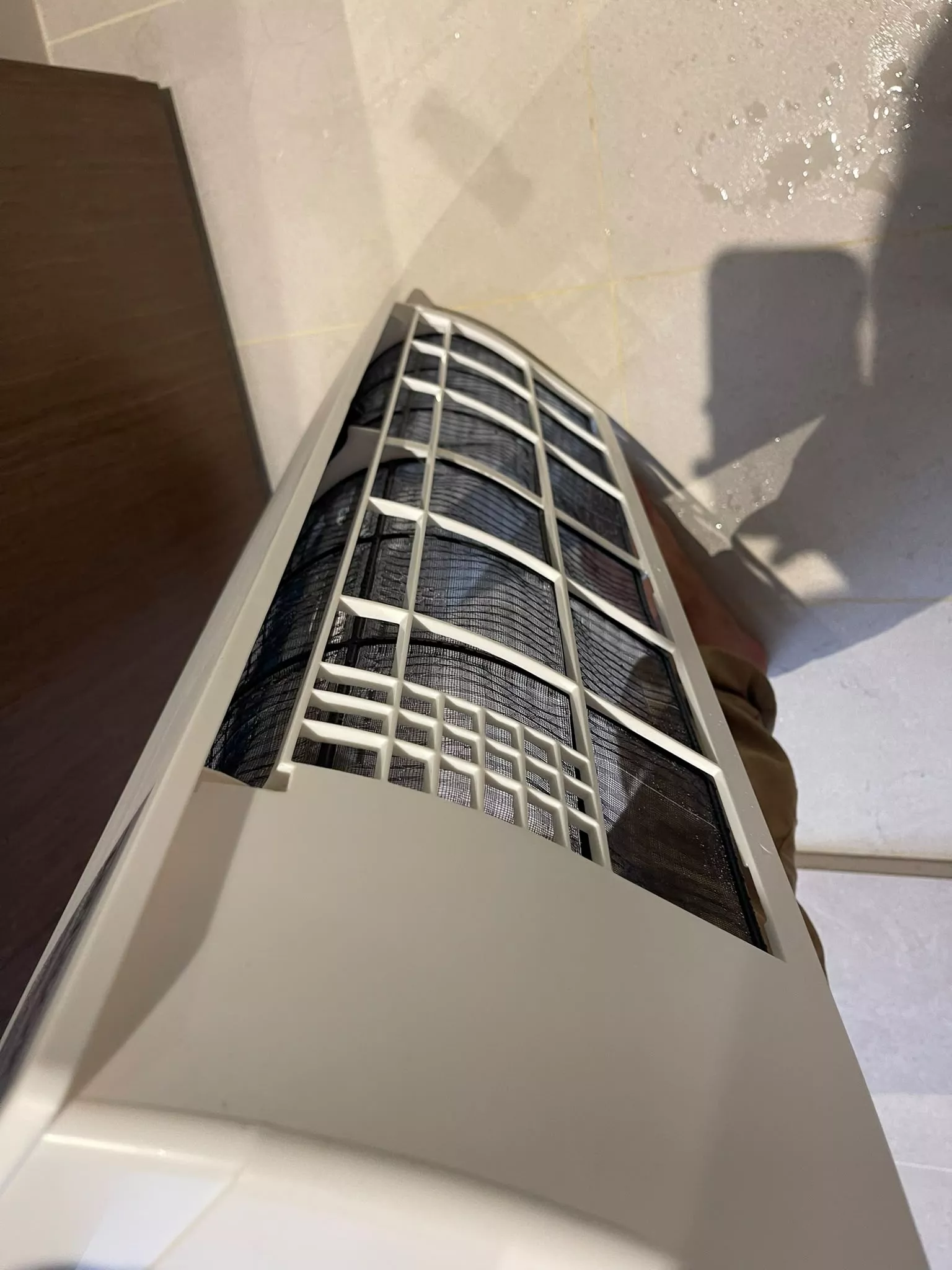
When the haze comes back, the same questions arrive in the same order. Should the aircon be on or off? Does it clean the air? Is it bringing the smoke in? And a week later, why does the filter look like that?
Most of the confusion comes from one mix-up. People treat an aircon as an air cleaner, and it is not one. This post sets out what a standard home aircon does and does not do on a hazy day, what to do with the filters, and how to tell afterwards whether the unit needs more than a rinse. It is about the machine only. For what the haze means for your health, go to the official sources, not an aircon company.
What a standard wall-mounted aircon actually does with the air
A normal split unit takes air from the room, passes it over a cold coil, and blows it back into the same room. It does not pull air in from outside. The pipe that runs to the outdoor unit carries refrigerant, not air.
That has two consequences on a hazy day, and they pull in opposite directions.
- It does not bring the haze in. With the windows and doors shut, running the aircon does not draw outdoor air into the room. If anything, it is what lets you keep the windows closed and still be comfortable.
- It does not take the haze out either. The only thing between the room air and the coil is a coarse mesh filter. It is there to protect the coil from dust, not to clean the air you breathe. Fine smoke particles are far smaller than that mesh, so treat the aircon as a way to stay cool with the windows shut, not as protection.
One exception is worth knowing about. Some ducted and building-ventilation setups do bring in outside air through a separate intake. A standard wall-mounted split does not. If you are not sure what you have, look at the indoor unit: if it is a box on the wall with a front panel that lifts, it recirculates.
Aircon on or windows open?
On a clearly hazy day, the practical answer for most homes is windows and doors shut, aircon or fan on. Open windows are the route by which the haze gets into the room, and a unit that recirculates does not add to it.
Two small things make a difference:
- Close the gaps you can control. A balcony door left ajar for a pet, or a bathroom window, defeats the point.
- Do not take the filters out to get more airflow. It feels logical on a stuffy day and it is the one thing that makes the coil worse. Everything the filter would have caught goes straight onto the coil, and one dusty night undoes months of care. We say the same in our guide to washing aircon filters yourself and where DIY stops.
To decide whether the day is hazy enough to matter, use the official readings. The National Environment Agency publishes the current PSI at haze.gov.sg, and that is also where the health advice for each band lives. We are not going to paraphrase those bands here, because they are the NEA's to state and they can change.
The filter: look at it, do not guess
After several hazy days, one thing is worth doing: look at the filter. Switch the unit off at the wall isolator or the breaker, not just with the remote, open the front panel, lift the filter out and hold it up to a light.
- Light comes through evenly. Leave it. Check again in a couple of weeks.
- It looks grey and furry, like felt. Wash it. Rinse from the clean side in cool or lukewarm water, no brush, dry it fully in the shade, and refit it so it sits flat with no gap at the edge. The full method, step by step, is in the filter guide linked above.
The interval we normally give is monthly for a bedroom unit that runs most nights, and every two weeks if there is a main road or building works nearby. A hazy fortnight is a fair reason to move to the shorter interval for a while. That is a rule of thumb for the filter, not a measurement of the air.
If you only look at one thing, look at how fast the filter gets dirty compared with normal. A filter that looks the same as it did last month is telling you something. So is one that has gone grey in a week.
Running longer hours is its own cost
Haze usually means the aircon runs for more hours, because the windows stay shut and the room has nowhere else to go. More running hours means more water through the drain, more dust through the filter and a heavier load on the unit, which is the same pattern we describe in our post on an aircon used all day when you work from home. If you are about to run a unit for far more hours than usual, it is worth checking the service history first. Our general-service interval is roughly every three months, and a unit that is already overdue is the one most likely to show a problem under extra load.
When a filter rinse is not enough
Washing the filter keeps things from getting worse. It cannot clean what is behind it. After a long run of hazy days, these are the signs that the dirt has moved somewhere your hands do not reach:
- A musty or sour smell that comes back within days of a clean filter. The smell is not on the filter. It is on the blower barrel or the coil.
- Weak airflow even with a clean filter fitted. The coil face or the barrel is partly blocked.
- Water dripping from the indoor unit. That points to the drain pan or a partial choke in the drain line, not to the filter.
- The room cools but takes much longer than it used to. Clean filter, slow cooling: check the coil, and read what to check when an aircon is still not cold before you call anyone.
If none of those apply, you do not need a bigger job. A tidy filter and the normal service cycle are enough. We would rather tell you that than sell you a chemical wash you did not need.
What the work costs at aircons.sg
These are the published prices on our pricing page, and the price you see is what you pay:
- General servicing: $55 for 1 unit, $90 for 2, $120 for 3, $160 for 4, and $35 per unit from 5. Every service booking includes the 9-point pre-check. See aircon servicing for what the visit covers.
- Chemical wash: $135 for 1 unit, $245 for 2, $345 for 3, $425 for 4, and $100 per unit from 5. This is the job for a smell that keeps returning or a coil that has gone solid, not a routine one after haze.
If you are not sure which one applies, say what you are seeing. The pre-check is there to tell the two apart before anyone commits you to the dearer job. Our note on how cooking grease changes your service interval makes the same point about another source of extra dirt: the room decides the interval, not the calendar.
What to check before the next hazy spell
- Pull one filter and look at it. Note how dirty it is.
- Check when the unit was last serviced. If it was months ago, book before the unit has to run long hours, not during.
- Confirm the drain is running freely: no drips from the indoor unit, no pooling under the outdoor pipe.
- Know where the isolator and the breaker are, so you can switch off properly when you wash the filters.
- Keep the remote batteries fresh, so a flat battery is not mistaken for a fault on a bad-air day.
If you would like us to check it
Tell us how many indoor units you have, when they were last serviced and what you have noticed: smell, weak airflow, drips, or slow cooling. WhatsApp us on 9107 2601 and we will tell you whether a general service is enough or whether the unit needs the deeper job, before we come out.