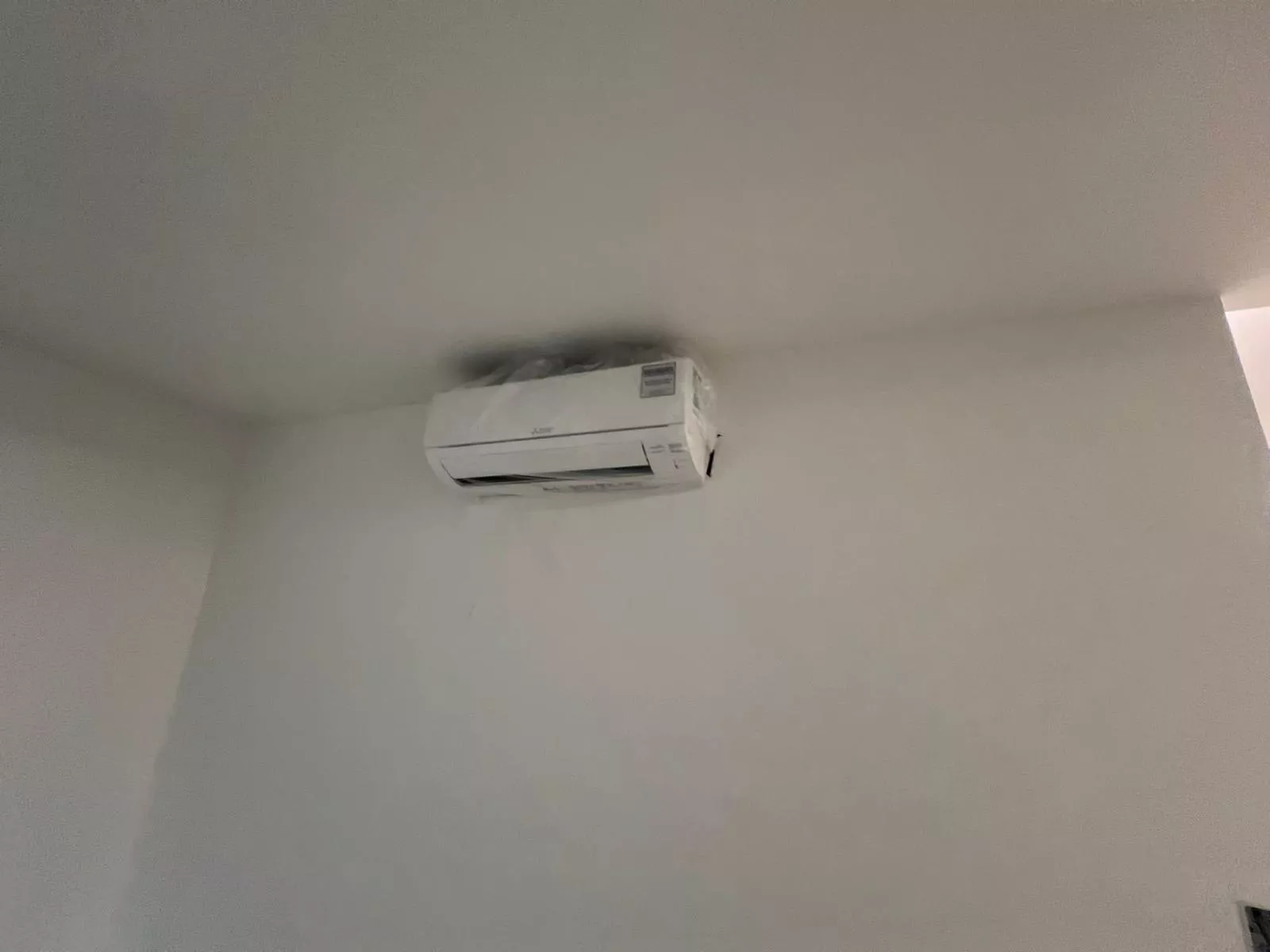
It rains hard, the lights flicker, and an hour later the aircon will not start. Or it starts and blinks. Or the whole system is warm and nobody can say why. The instinct is to keep pressing the remote, flip the breaker again and again, and hope. That instinct is the one thing worth resisting, because a unit that has just been through a power event is easier to damage by repeated restarts than it was by the event itself.
This post is about the first hour: what to leave alone, what to check, how to tell a supply problem from an aircon problem, and what to have ready so one visit sorts it out.
First, is it the aircon or the flat's power?
Before anything else, look at what else is affected. Do the lights, the fridge, the router and the other sockets all work normally? Is the distribution board showing a tripped switch?
- Other things in the flat are also off or flickering. The cause is the supply, not the aircon. A tripped main switch or a supply fault is not aircon work, and waiting on an aircon technician will not bring it back.
- Everything else is fine, only the aircon is dead. The supply to the flat is working, so the question is narrower: the aircon's own breaker, its isolator, or something inside the system.
- Some indoor units work and others do not. On a System 2, 3 or 4, the indoor units share one outdoor unit. If one unit ignores the remote while its neighbours cool normally, the supply is clearly there, and the fault is local to that indoor unit. Our post on what to check when an aircon will not turn on sets out how to tell these patterns apart.
Safety first: smell, marks or heat
If you smell burning, see brown or black marks around the isolator, or find a switch plate that has gone soft or yellow, stop. Leave the isolator and the aircon breaker off, do not reset anything, and read what to do first when an aircon smells of burning. Nothing about restoring cooling is worth a hot switch.
What to leave alone
- Do not reset the breaker over and over. If it has tripped, you may reset it once. If it trips again straight away, or trips the moment the aircon starts, leave it off. A breaker that keeps tripping is protecting you from a fault, and each reset sends current back through that fault.
- Do not keep switching the unit on and off from the remote. After power returns, many units hold the outdoor side back for a few minutes before it starts. That delay exists to protect the compressor. Pressing the button again and again does not shorten it, and a unit that is being switched on and off repeatedly is under more strain, not less.
- Do not open the panels or reach into the outdoor unit. Lifting the front panel as far as it opens by hand to find a button is fine. Unscrewing anything, or leaning out over a ledge to look at the outdoor unit, is not.
- Do not run an extension cord to get a dead unit going. If the aircon is meant to be on a proper point, a socket and adaptor is a workaround for a problem, not a fix.
The five-minute checks
- The isolator. The isolator is the local switch, usually near the indoor unit or at the service yard, that makes the aircon electrically dead without switching off the whole circuit. A storm is a reason some households switch it off on purpose, so confirm it is where you expect. Our post on the power point and isolator a new install needs explains what it is and where it normally sits.
- The aircon's own breaker. Find it on the distribution board. If it has tripped, reset it once, as above.
- The remote. A power event can leave the remote on a different mode or a different timer setting. Check the screen is clear, change the batteries if it is faint, and confirm Cool mode and a low set temperature.
- Time. If power has just come back, wait five minutes before deciding the outdoor side has failed. The indoor fan blowing without cold air in the first few minutes is normal after a restart.
- The display and the lights. If a light is blinking, do not keep restarting to watch it again. Take a short video of the blinking pattern and photograph the label on the indoor unit. What a blinking light means and what to tell the technician is covered in the error-code post.
What a power event can leave behind
We cannot tell you what failed from a description, and neither can anyone else honestly. What we can say is what the usual candidates are, and which of them our published price list covers.
- The breaker or isolator. The simplest outcome: it tripped, you reset it once, and the unit comes back. Nothing needs repair.
- The control board (PCB). This is the part that takes the instructions from the remote and runs the system. A board that no longer responds looks like a dead unit with lights that may or may not come on. PCB replacement is quoted on site, after the pre-check has confirmed what failed. There is no published price for it, so we do not give one here.
- The capacitor. Our repair page lists a unit that will not turn on against three usual causes: the capacitor, the PCB or the remote signal. Which one it is gets confirmed at the pre-check, not guessed over the phone.
- The compressor. If the outdoor unit is silent or hums without starting, a failed compressor is possible, but so are cheaper causes that look similar. Compressor replacement is quoted on site, and you get the figure before any work starts.
What a visit costs, and what it covers
These are the figures on our published price list, and they are final.
- The visit: $55 for 1 unit. It covers the technician visit and the 9-point pre-check, whose first point is a power and thermostat test: it confirms the electrical supply, the board's response and the remote before anything is taken apart.
- If more work is needed and you go ahead, the pre-check page says the $55 minimum is part of the total, so you are not charged for the diagnosis twice. If you decide not to proceed, the $55 covers the visit and diagnosis only.
- Standard repair (drainage, electrical): $80.
- PCB and compressor replacement: quoted on site, price varies by site.
- Warranty: repairs carry 90 days on workmanship, and parts carry the manufacturer's warranty. Details are on the repair and gas top-up page.
- If it fails late at night: an after-hours emergency call between 10pm and 7am carries a $50 surcharge. A unit that simply will not start, with no burning smell, no marks and no breaker that keeps tripping, is not dangerous left off overnight. The surcharge is worth paying only if someone at home genuinely cannot get through the night without cooling.
If the aircon is still under warranty
Find the installation invoice and the model and serial numbers before anyone opens the unit. Then read what the manufacturer's warranty says about electrical events. Do not assume a power event is covered, and do not assume it is not: it depends on the wording and on the brand. Having the paperwork in front of you before a technician quotes is what lets the warranty question be answered first.
What to have ready when you call
- Roughly when it stopped, and whether it followed a storm, a power cut or a breaker trip.
- Whether other things in the flat were affected.
- Whether the aircon's own breaker tripped, and whether it tripped again after one reset.
- Which indoor units are affected, and whether the others on the same outdoor unit are fine.
- Any blinking light, noise, smell or ice, and a short video of the blinking if there is one.
- Whether the indoor fan runs and whether the outdoor unit makes any sound.
One more habit is worth keeping: write down the time and take photos of anything you see. If you later want to talk to a landlord, a manufacturer or an insurer, a note made at the time is stronger than a memory.
Switching off ahead of a storm
If you are leaving the flat and a heavy storm is forecast, or you are going away for a while, switching the aircon off at the isolator takes the unit out of the picture entirely. That is the same advice we give for a flat left empty on a long trip, covered in what your aircon needs before, during and after a long absence. It is a precaution, not a guarantee, and it is not something to do while a storm is directly overhead and you are standing at a wet switch.
If you would like us to look at it
Tell us how many indoor units you have, which ones are affected and what you found with the checks above. WhatsApp us on 9107 2601 and the pre-check will show whether it is a supply problem, a board or capacitor fault, or something else. Every booking is confirmed on WhatsApp, and the prices on the pricing page are the prices you pay.