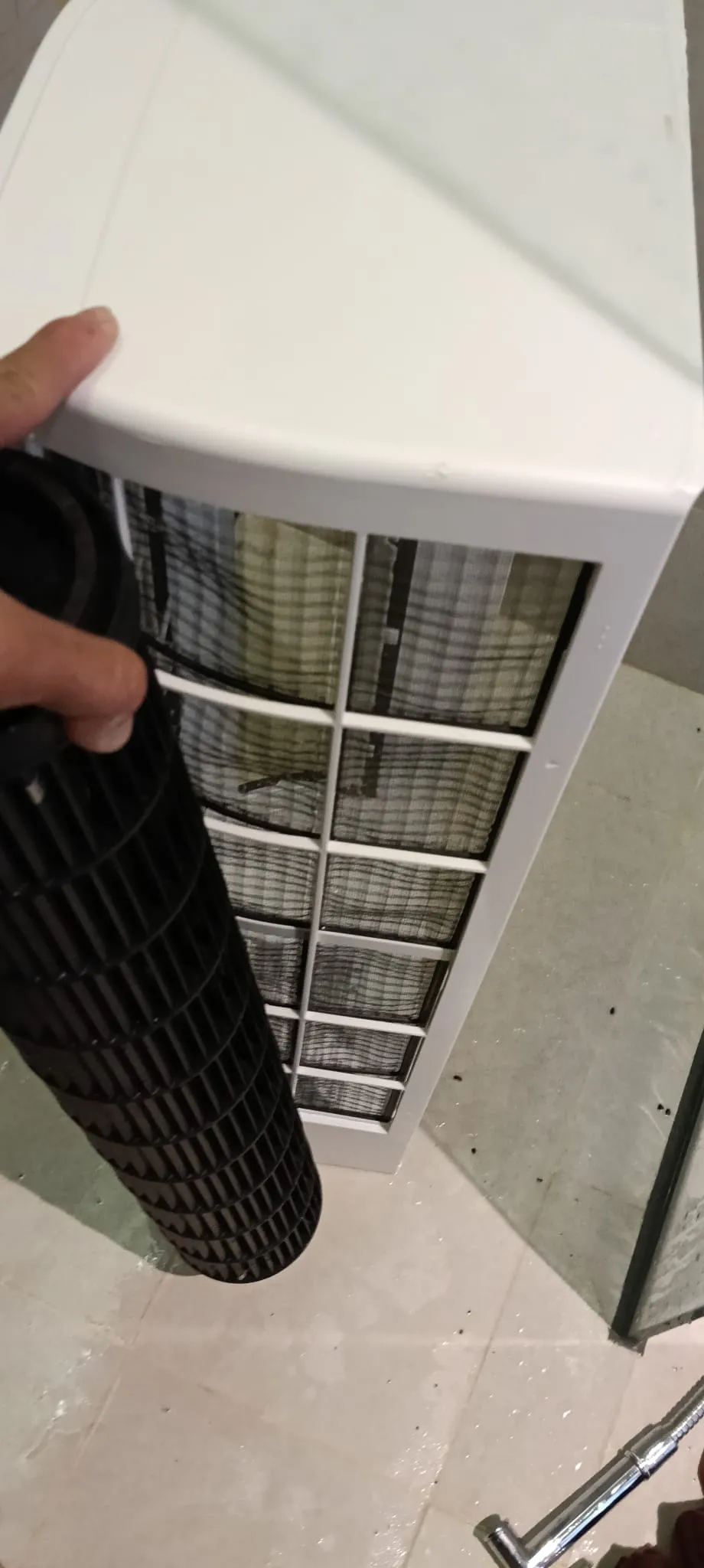
The technician came, the unit was cleaned, you paid, and that evening the room still will not cool. It is a frustrating moment, because it feels like the service did nothing. Sometimes the service did exactly what it was meant to do, and the real problem is a different job that a service was never going to reach.
This post helps you work out which of those you are in before you call back, what each possible cause costs on our published price list, and what to say so that one visit settles it.
First, what a normal service does and does not do
A normal service on a wall-mounted unit is the minimum we offer. The roller and blower are dismantled, the filter, coil and drainage are cleaned, the drain is flushed, and there is a basic check of cooling, electrical connections and the outdoor unit. The published time is 30 to 45 minutes per unit. Prices are $55 for 1 unit, $90 for 2, $120 for 3, $160 for 4, and $35 per unit from 5. The full list is on the aircon servicing page.
Read that list for what is missing. It does not top up gas. It does not find or repair a leak. It does not take the indoor unit apart piece by piece the way a chemical overhaul does. And our own servicing page says that a unit that is not cooling effectively may need a chemical wash or a leak check instead of a general service. So a unit that was weak before the visit can still be weak after it, for a reason the service was not designed to fix.
Five checks you can do tonight, for free
Work through these before you call anyone. They take a few minutes and they rule out the simple causes.
- Is it set to Cool? After the unit is powered down for work, the remote can come back on a different mode or a different set temperature. Confirm Cool mode, a low set temperature and the fan on auto or high.
- Are the filters seated properly? They were taken out and refitted. A filter that sits crooked or a front panel that is not fully clicked shut changes how air moves through the unit.
- Is only one room the problem? On a System 2, 3 or 4, several indoor units share one outdoor unit. If one room is weak and the others are fine, switch off the other indoor units and test the weak one on its own, as described in why one room never gets cold. If it cools alone, you are dealing with shared capacity, not a failed service.
- Is the air cold but the room warm? Close doors and windows, and give the unit a proper run rather than judging it after a few minutes. A hot room takes time to pull down.
- Is the air itself weak, or is there any water? Weak airflow points to the indoor unit. Water dripping points to the drain, and a drain that keeps choking has its own explanation in why a drain choke keeps coming back.
If all five check out and the air coming out of the unit is still not properly cold, the cause is probably inside the system, and that is where the cost starts to matter.
The four usual causes, and what each one costs
These are the published figures. Each is a separate job, charged on a different basis, which is why one price over WhatsApp can hide which of them you are being quoted.
1. The coil is too dirty for a general service to clear
A general service cleans the coil, but a heavily fouled coil needs the deeper job. A chemical wash is $135 for 1 unit, $245 for 2, $345 for 3, $425 for 4, and $100 per unit from 5. If the unit has gone a long time without any service, this is the likeliest answer, and our chemical wash page explains what it adds. If you have just been through a wash and it is still warm, you can rule dirt out as the main cause.
2. The gas is low
Aircons do not use up refrigerant. A unit that is low has lost it somewhere, so a top-up is the visible fix and the leak is the question behind it. A top-up is priced per outdoor circuit, not per indoor unit: R22 $115, R410A $130, R32 $170. Indoor units that share one outdoor unit share one circuit, so a System 3 is one top-up, not three.
3. There is a leak
If a top-up is only a short-term answer, the leak has to be found. The published steps are a leak detector check at $180 flat (one price, System 3 included), then a nitrogen pressure test at $180 per fan coil unit (a System 3 is $540, and the aircon cannot be used for 2 to 3 days). If a pipe is leaking, the pipe change is $520 per fan coil unit in an HDB flat and $700 per fan coil unit in a condo. The price list says that if a repair is approved on the same visit, the test fee is offset against that repair. The cost breakdown is on the gas leak repair cost page, and the questions worth asking before you approve anything are in how to check a gas leak quote.
4. A part or an electrical fault
A standard repair for drainage or electrical faults is $80. Compressor and PCB replacement are quoted on site, and there is no published price, so we do not give one here. If a technician names a figure for either over the phone without seeing the unit, ask what it is based on.
Was it the service, or was it already there?
This is the question people actually care about, and the honest answer is that it depends on what the problem is.
- A fault that was there before the visit, such as low gas or a slow leak, was not caused by cleaning. A service does not create a leak. It may have been hidden until the unit was running properly again.
- Something that went back wrong, such as a cover not seated, a drain not refitted properly, or a connection not tightened, is workmanship. Our workmanship warranty on servicing is 90 days, and a problem like this is exactly what it is for. If you are within those 90 days and the symptom started right after the visit, say so clearly.
The pre-check is what makes this easier to judge. Every visit begins with the 9-point pre-check, and one of the points measures the temperature drop between the air going in and the air coming out. That measurement is how the visit tells a gas problem from a cleaning problem. So the useful thing to ask any company that serviced your unit is: what was the temperature drop at the start, and what was it at the end? If nobody measured it, you cannot say whether the unit improved. This is one of the things in what your technician should show you before they leave.
What to tell the technician when you call back
One visit is more likely to settle it if the technician arrives knowing the history. Have these ready:
- The date of the last service, and which service it was (normal, chemical wash or overhaul).
- Whether the unit was cooling badly before that visit as well, or only afterwards.
- Which indoor units are affected, and whether the others on the same outdoor unit are fine.
- Whether there is any water, noise, smell, ice on the pipe or a blinking light.
- Whether the air is weak, or strong but not cold.
Questions to ask before you approve any extra work
- What did you measure, and what did it show? A diagnosis should come from a reading, not a guess.
- Is this a top-up or a leak repair? They are different jobs with different prices.
- Is it priced per outdoor circuit or per indoor unit? On a multi-system the total depends on the answer.
- What does the warranty cover, and for how long? Ask for it in writing.
If you would like us to look at it
Tell us how many indoor units you have, when the unit was last serviced and what it did before and after. WhatsApp us on 9107 2601 and the pre-check will show whether it is a dirty coil, low gas or something else. The prices on the pricing page are the prices you pay.