The aircon starts. The louvre opens, the fan runs, the room begins to cool. Four or five minutes later it clicks off. A little while after that it starts again, and does the same thing. Or it runs for ten minutes, stops, and will not restart until you give it half an hour. You are not looking at a unit that is dead, so the "not turning on" checklist does not quite fit, and you are not looking at one that simply does not cool. It is something in between, and the pattern is itself the best clue you have.
Technicians call this short-cycling: the system keeps switching itself off before it has finished a normal run. It is almost always the unit protecting itself or reacting to a bad reading, not a random fault. This post is about reading the pattern, the free checks that are safe to do yourself, and what it usually costs to have it looked at, using only the prices already on our published price list.
First, describe the pattern properly
Before you check anything, spend one cooling cycle noting what actually happens. It takes ten minutes and it changes the conversation with whoever you call.
- How long does it run before it stops? A few minutes, or most of an hour? A unit that stops within a few minutes is behaving very differently from one that switches off every so often once the room is cool, which is normal.
- Does the indoor fan keep blowing after the cooling stops? If the fan carries on but the air turns warm, the outdoor side has stopped. If everything stops together, the indoor unit or its controls cut it.
- Is there a blinking light or a code on the display? Note exactly what it does. Do not reset anything repeatedly to make it go away.
- One unit or all of them? On a System 2, 3 or 4, if only one indoor unit does this, the fault is probably at that unit or its piping. If every unit stops at once, think of the shared outdoor unit or the power supply.
- Did something change recently? A service, renovation dust, a power cut, a new heavy cooking habit, or the weather turning hotter.
Also check that the room is actually warm enough for the unit to keep running. If you set the remote to 16 or 17 degrees in a small, cool bedroom late at night, the unit reaches its target and stops by design. That is the thermostat doing its job, not a fault. The stop that matters is the one that happens while the room is still hot.
Why a unit switches itself off early
Most causes fall into a few groups. We list them from the most common and cheapest to the least common and dearest, because that is the order to check them in.
1. Restricted airflow at the indoor unit
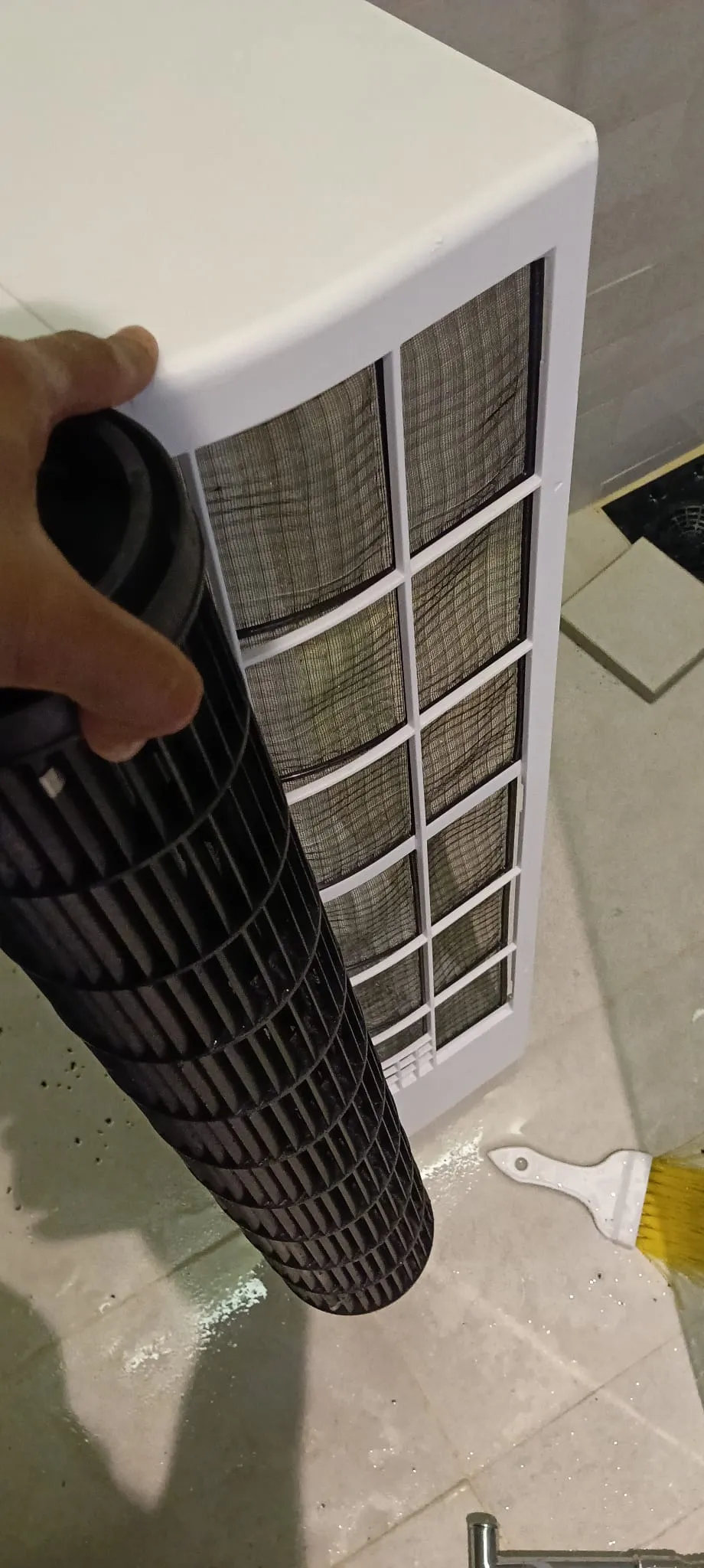
A coil that cannot pass air gets very cold very quickly, and the unit's sensors react to it. Clogged filters, a coil coated with the grey film that builds up between services, and a blower wheel packed with dust all do this. The unit senses the problem and shuts the compressor down to protect itself, then tries again when things recover. That gives you exactly the on, off, on, off pattern.
The photo on this post is a blower wheel lifted out of an indoor unit during a service, with the dust-matted mesh of the unit behind it. A wheel like that moves far less air than it should. We cover why a general service does not always reach it in the blower wheel post. Filters you can wash yourself: pull them, rinse them, let them dry fully, and put them back. If that changes nothing, the dirt is deeper than a filter.
2. A drain that is backing up
Some units are built to stop when the water they are removing from the air cannot get out. If the condensate pipe is choked, water collects in the indoor unit and the unit can cut out, often after it has run long enough to produce a lot of water. You may also see dripping, or a damp patch below the unit. If this keeps coming back, read the recurring drain choke post. Our repair page lists drainage blockage clearance as part of what a repair visit covers.
3. Low refrigerant
When the gas level is low, the coil can ice over and the unit will stop and thaw before it tries again. The sign is cooling that gets weaker over weeks, ice on the indoor coil or the thin copper pipe, and a unit that works better on a cool day. A gas top-up treats the symptom, not a leak. If the gas is low, it went somewhere, which is why our pre-check measures pressure first and tells you whether a top-up will hold.
4. Outdoor unit that cannot get rid of heat
Look at the outdoor unit if you can reach it safely, from where you are standing and without leaning out over a ledge. A condenser coil that is clogged with dust, a fan that is slow or not turning, or an outdoor unit boxed in so that hot air blows back into itself, will all push the system to shut down on a hot afternoon and run fine at night. Do not climb onto a ledge or lean out of a window to check. If the outdoor unit sits on a ledge, that is a job for a technician. Our ledge access post explains why those visits are priced the way they are.
5. Electrical and control faults
A failing capacitor, a loose connection, a faulty sensor or a failing circuit board can all make a unit cut out. These are the faults you cannot see from the outside, and they are the reason to be careful about "just reset it". If the breaker trips as well, stop and read why your aircon trips the breaker.
6. A compressor that is struggling
The compressor is the part nobody wants to hear about. A compressor that overheats and trips its own protection will start, run briefly, stop, and refuse to restart for a while. It is the least common cause on this list, and it should be the last one a technician reaches, after the cheaper explanations have been tested and ruled out. If someone tells you the compressor has gone before checking airflow, drainage, gas and the outdoor coil, ask what they tested. We wrote about how to check that call in the compressor failure post.
What you can safely do yourself
- Wash the filters and let them dry completely before refitting them.
- Look for ice on the indoor coil or the pipe, and for water below the unit. Note it down, and take a photo if you can.
- Switch the unit off at the remote and leave it for about half an hour if it has been cutting out repeatedly, so any ice can melt. Then run it again and note how long it lasts.
- Check that nothing blocks the outdoor unit, but only from a safe position.
- Do not keep resetting the breaker. Once is a reasonable test. If it trips again, leave it off.
What you should not do: open the indoor unit, spray anything onto the coil, add gas, or run the aircon continuously for hours to "see if it clears". A system that is cycling because of ice or a blocked drain can be damaged by being forced to keep running.
What it usually costs to have it looked at
Every figure below is already on our pricing page and our repair page. Nothing here is an estimate for your unit.
- The $45 minimum for 1 unit covers the visit and the 9-point pre-check, which is included with any service booking. If you decline the recommended fix, that $45 covers the visit and diagnosis only.
- A standard repair for drainage or electrical faults is $80.
- Gas top-up is priced per outdoor circuit, not per indoor unit: R22 $115, R410A $130, R32 $170.
- A dedicated pressure or leak test on the piping set is $180 per FCU, and if a repair is approved on the same visit, the test fee is offset against that repair. Piping replacement is $450 per FCU, and concealed pipe work is quoted after the test.
- Compressor or PCB replacement is quoted on site, because it depends on the unit.
- If the cause turns out to be a coil and blower that are simply dirty, a chemical wash is $135 for 1 unit and a chemical overhaul is $200 for 1 unit; the price per unit comes down as you add units. Which one fits depends on what the unit shows when it is opened up.
Quoted prices are final, and anything beyond the pre-check is quoted before work starts. We do not sell prepaid plans or contracts, so there is no commitment attached to asking.
When to stop and call
- It cuts out again within minutes after you have washed the filters and let any ice melt.
- You see ice on the coil or the pipe more than once.
- Water is dripping from the indoor unit.
- The breaker trips, or you notice a burning smell or a warm switch plate. In that case leave it off.
- Only one unit on a multi-unit system does it, or the outdoor unit is on a ledge.
When you message us, the details from the first section are what we need: how long it runs, whether the fan carries on, whether there is a blinking light, one unit or all, and what changed recently. WhatsApp us on 9107 2601 and we will tell you what we need to look at and when we can come.
Frequently asked questions
Is it normal for an aircon to switch off by itself?
Yes, once the room reaches the temperature you set, a unit slows down or pauses. What is not normal is stopping within a few minutes while the room is still hot, or repeatedly starting and stopping.
Can a dirty aircon cause it to turn off after a few minutes?
Yes. A clogged filter, a coil coated with grime or a blower wheel full of dust restricts airflow, and the unit can shut itself down to protect itself. Washing the filters is a safe first step.
Is short-cycling a sign the compressor is dying?
It can be, but it is the least common cause. Airflow, drainage, gas level and the outdoor coil should all be checked first.
Should I top up the gas if it keeps stopping?
Only after the pressure has been measured. Low gas means there is a leak, and topping up without checking for it only delays the problem.
What does it cost to get it diagnosed?
The $45 minimum for 1 unit covers the visit and the 9-point pre-check. Any repair beyond that is quoted before work starts.