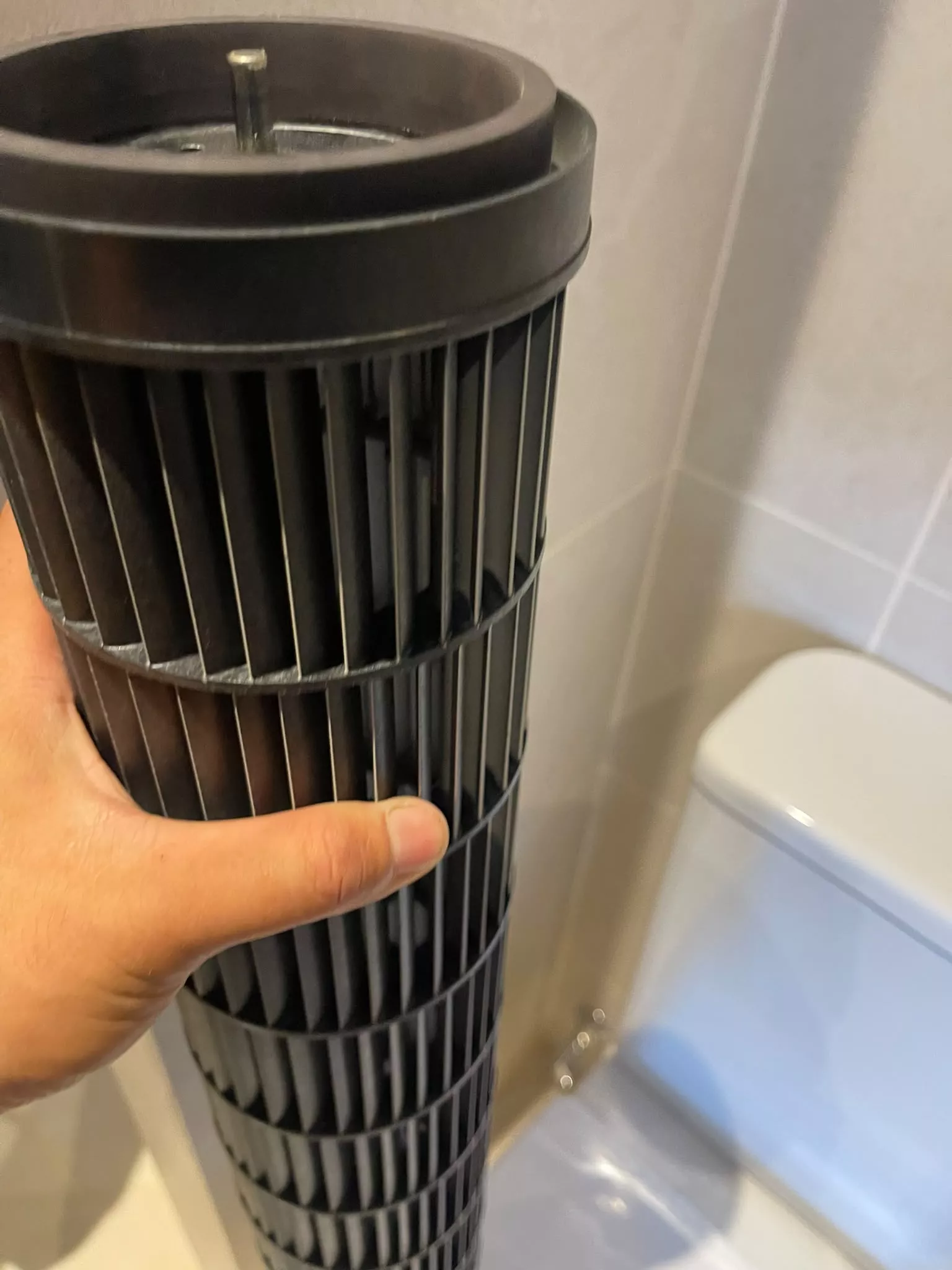
There is a part inside every wall-mounted aircon that almost nobody has seen, that holds more dirt than anything else in the unit, and that a standard service does not touch. It is a black plastic barrel about the length of your forearm, sitting behind the coil, covered in hundreds of small angled blades. It is called the blower wheel, or the barrel fan, and it is the single most useful thing to understand if you want to know why your aircon still is not right after servicing.
Most complaints we are called out for — the smell that comes back, the airflow that never quite recovered, the fine black specks on the wall below the unit — trace back to it. And most of the confusion about aircon pricing traces back to it too, because the difference between a $55 job and a $200 one is largely a question of whether that barrel comes out.
What it actually does
The evaporator coil gets cold. It does not move air. The blower wheel is what pulls room air in through the filter, across the cold coil, and pushes it back out through the vanes at the bottom of the unit. Every cubic metre of air your aircon delivers has passed through that barrel.
It is a cross-flow design, which matters: instead of a few large propeller blades, it has dozens of thin blades running the full length of the barrel. That geometry is what makes it quiet and what makes it move a lot of air in a shallow casing. It is also what makes it a near-perfect dirt trap.
Why the dirt goes there and stays there
Here is the part that is not obvious. The air leaving the coil is not just cold, it is wet. The coil condenses moisture out of the room, and some of that moisture carries over as fine droplets onto the blades immediately downstream.
So the blower wheel is a surface that is permanently damp while the unit is running, sitting directly in the path of whatever dust got past the filter. Dust arrives, lands on a wet blade, and does not blow off. It builds into a grey-black felt that follows the shape of each blade. Once there is a film, it holds moisture between cycles, and once it holds moisture between cycles, it grows biofilm — which is what you are smelling when a unit smells musty within minutes of switching on.
Two consequences follow, and they arrive in this order.
Airflow drops before anything else does. Each blade is a small aerofoil. Coat it and it stops behaving like one — the barrel spins at exactly the same speed and moves noticeably less air. Nothing has broken. There is no fault code. The room simply takes longer to cool and never quite gets there, so the thermostat never satisfies and the compressor runs longer than it should. Most people read that as "the aircon is getting old" or "it needs gas". Very often it is neither.
Then it starts throwing things at you. When the build-up gets thick enough, pieces let go. Black specks on the wall or bedsheet below the unit, and occasional fine spitting of water droplets, are both classic late-stage blower wheel symptoms. If you are seeing either, the barrel is not slightly dirty — it is loaded.
Why a general service does not clean it
This is the part worth being straight about, because it is where most of the disappointment comes from.
A general service is routine maintenance. Filters washed, the accessible face of the coil wiped, drain pan and drainage line flushed, gas pressure and electricals checked, casing cleaned. It is the right job to do every three to four months and it keeps a healthy unit healthy. At our published rate that is $55 for one unit, $90 for two, $120 for three, $160 for four, and $35 per unit from five.
What it does not include is removing the blower wheel. The barrel sits behind the coil, held on a shaft with a set screw at one end and a bearing at the other. Getting it out means dropping the drain pan, disconnecting the drainage, releasing the coil, and in most models unclipping the electrical box first. That is a strip-down, not a wipe-down. It cannot be done in the time or at the price of a general service, and any technician who tells you otherwise has not done it.
You can sometimes see a little of the barrel through the outlet if you angle the vanes open and shine a torch upward. What you see there is the cleanest part of it. The face pointing into the coil is worse.
So which job actually cleans it
Two of ours do, to different depths.
A chemical wash applies cleaning agent to the coil and the accessible surfaces and flushes them through the drainage. It reaches the coil properly and it will improve a moderately dirty barrel, because the chemical and the rinse pass across it. It does not remove the barrel. Published rate: $135 for one unit, $245 for two, $345 for three, $425 for four, $100 per unit from five.
A chemical overhaul is the one where the unit comes apart. The blower wheel and the coil come out and are cleaned individually, off the wall, on both faces, and the drain pan is cleaned rather than flushed. Published rate: $200 for one unit, $370 for two, $515 for three, $640 for four, $150 per unit from five.
The gap between $135 and $200 per unit is, almost entirely, the labour of removing and refitting that barrel. That is the honest answer to "why is the overhaul so much more". Nothing else in the job changes that much.
How to tell which one you need, before anyone quotes you
You do not need to open anything. Four questions settle it most of the time.
Does the smell come back within a day or two of a clean filter? If yes, the smell is not on the filter. It is on the barrel and the coil, and washing filters more often will not touch it.
Is there black speckling on the wall, curtain or bed below the unit? That is material leaving the blower wheel. Go straight to the overhaul conversation.
Did a chemical wash help, but only for a few weeks? A wash that gives you a month and then fades usually means the chemical cleaned what it could reach and the reservoir behind it re-seeded the coil. The reservoir is the barrel.
Is the airflow weak even with a freshly washed filter and a clean-looking coil? Then the restriction is downstream of both.
If none of those apply and the unit simply has not been serviced in a while, start with the general service. We would rather put you on the cheaper job and be right.
Two things that quietly wreck a barrel early
Running without filters. People take filters out to wash them, the aircon gets switched on that night, and everything the filter would have caught goes onto a wet coil and a wet barrel. One night undoes months.
Renovation and construction dust. Fine cement and sanding dust is far worse than household dust because the particles are small enough to pass the mesh and sharp enough to key into a damp surface. If there has been work in your flat or in the block, the barrel takes the hit. It is the reason we treat a post-renovation unit as an overhaul candidate rather than a service candidate, regardless of how recently it was serviced.
What to ask a technician
Three questions, and they are fair to ask anyone.
"Does this job include removing the blower wheel?" — a yes or no, not a description of chemicals.
"Can you show me the barrel before you put it back?" — anybody who has genuinely taken it out can, and it is the only real proof the work was done. Photograph it. Next time you will have a comparison.
"Is the quoted price the final price?" — ours is; every rate on the pricing page is what you pay, and the 9-point pre-check is included with a service booking so the diagnosis happens before any money is committed to the wrong job.
The short version
The blower wheel is where the dirt that matters actually lives, because it is the only surface in the unit that is both wet and directly in the dust path. A general service does not remove it, a chemical wash cleans around it, and an overhaul takes it out. If the smell returns fast, if there are black specks below the unit, or if a wash keeps fading, stop paying for the shallow job repeatedly and do the deep one once.
Related reading: washing your aircon filters yourself, and where DIY stops, what a chemical wash cannot fix, and why your aircon smells musty and how to fix it for good. The full cleaning options are on the chemical wash page.
Not sure which job yours needs? WhatsApp us on 9107 2601 — describe the smell, the airflow and when it was last serviced, and we will tell you whether it is the $55 job, the $135 one or the $200 one.
If the unit has not been serviced for a long time, the wheel is usually the part that decides which job it needs — see what the first service on a neglected aircon actually involves.
The blower wheel is also why drains block repeatedly — see why clearing a choked aircon drain never holds.
If the symptom you are chasing is one room that never gets as cold as the others, the blower wheel is one of six things worth checking - the full set is in why one room never gets cold.
If only one of your units is showing these signs, you may not need to clean them all - see chemical wash every aircon or just one for how to decide unit by unit.
Also read: aircon near an open kitchen: how cooking grease changes your service interval
If the unit does start but then switches itself off after a few minutes, read aircon switches itself off after a few minutes: what short-cycling means.
Related: what is included in a general aircon service, line by line, which lines are work and which are only a look.