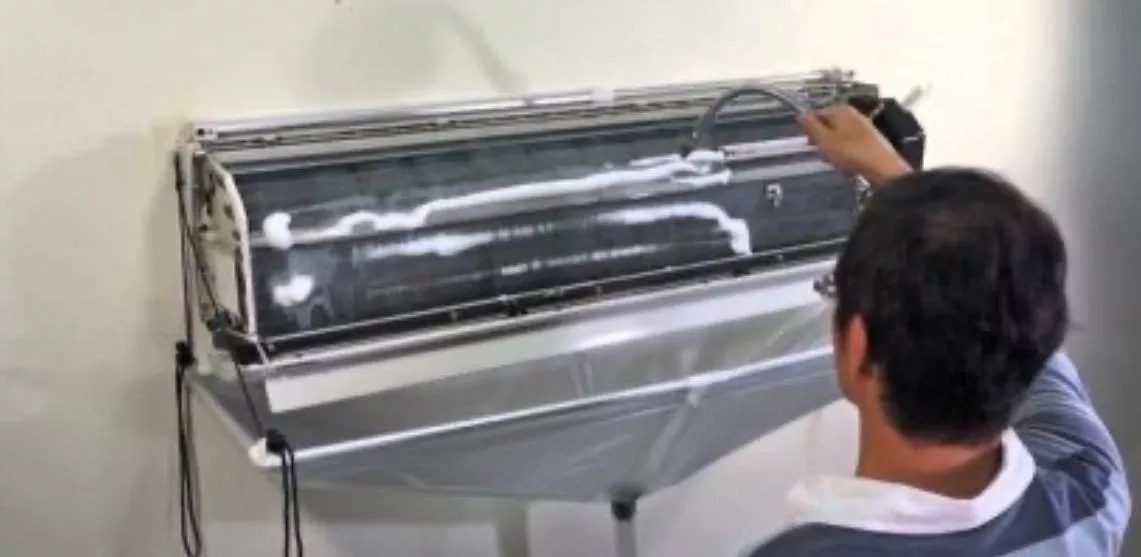
The false ceiling is one of the last things drawn and one of the first things built. By the time the carpenter is on site, the aircon is already installed, the trunking is already run, and the ceiling goes up around all of it in an afternoon. Nobody stops to ask where the servicing hatch should be, because on the day it does not feel like a question — the aircon is working.
It becomes a question about eight months later, the first time somebody has to open that unit up. And by then the answer costs money, because the only way to reach anything is to cut the ceiling.
What actually has to be reached, and how often
A fan coil is not sealed for life. Over a normal ten-year run, somebody needs to get at six things:
- The filters — every few weeks if you rinse them yourself, every visit if we do.
- The blower wheel — the barrel fan behind the coil. This is what a chemical wash is actually for, and it cannot be cleaned properly through the front grille alone.
- The drain pan and its outlet — the single most common source of a leak, and the part that has to be flushed.
- The drain pipe run itself — including every joint and every change of direction between the unit and the discharge point.
- The electrical connection — the isolator and the control board, whenever a unit stops responding.
- The refrigerant joints at the unit — the flare connections, which are where a slow gas loss usually starts.
Five of those six sit at the fan coil. The sixth — the drain run — is the one that gets buried, and it is the one that causes the most trouble.
The drain line is the reason this matters
Water leaking out of an indoor unit is the complaint we attend most often, and the cause is nearly always the drain: a partial choke, a sagging section that holds water, or a fall that was never quite right and only fails once there is enough slime in the pipe to slow the flow. We have written separately about why aircon water leaks happen and how to stop them.
Clearing a choke is straightforward work when the pipe can be reached. When the run is concealed above a sealed ceiling, the same job turns into a demolition question: where exactly is the blockage, and how much ceiling has to come down to get to it? A technician can flush from the drain pan and hope it clears. If it does not, somebody is opening the plasterboard.
That is the asymmetry. Access costs almost nothing to provide while the ceiling is open. It costs a carpenter, a re-skim and a repaint to provide afterwards — and the repaint never quite matches, which is why people put up with a leaking unit for months instead.
Where the panel has to be
An access panel in the wrong place is decoration. To be useful it has to sit:
- Directly under the drain pan outlet and the first section of drain pipe. This is the non-negotiable one. If you get only one panel, put it here.
- At the body of the unit, if the fan coil is boxed in rather than wall-mounted below the ceiling line — big enough to remove the cover and drop the blower, not just to look at it.
- At any joint or bend in the concealed pipe run, and at any point where the pipe crosses from one boxed-up section to another.
- At the isolator, if the electrical connection was taken up into the ceiling rather than left on the wall.
Practical sizing: a panel you can get a head, a torch and two hands into is useful; a 200mm inspection hole is not. Hinged panels with a proper frame are worth the small extra over a friction-fit lift-out tile, because a lift-out panel that has been painted over three times stops being removable.
Concealed and ducted units are a different problem
A wall-mounted fan coil hanging below the ceiling line is the easy case — the unit is in the room and only the pipework is hidden. A concealed or ducted unit is entirely above the ceiling, and everything on the list above is up there with it, including the filter.
If you are going ducted, the access provision is not a detail to be settled on site. It needs a panel at the return-air side for the filter, a panel large enough at the unit to drop the blower assembly for cleaning, and clear space above the ceiling to actually work in. A ducted unit installed with 150mm of clearance above it is a unit nobody will ever clean properly, no matter what panel you cut.
What this does to the price of routine work
With sensible access, servicing a wall-mounted unit in a concealed installation is ordinary work at ordinary prices. Our published rates are $45 for a general service on one wall-mounted unit and $135 for a chemical wash on one unit, and those are the prices whether the unit is on a bare wall or tucked above a bulkhead with a proper hatch. A ducted unit is a different line on the price list: $60 per unit for normal servicing, and from $500 for chemical servicing, depending on site conditions. How to tell which you have, and what access does to a ducted job, is set out in ducted aircon cleaning: what it costs and what decides the price.
Without access, two things happen. The honest technician tells you a full chemical wash is not possible, cleans what can be reached, and you pay for a partial job — which is exactly the situation we described in what a chemical wash cannot fix. The less honest one does the same thing and does not mention it. Either way the blower stays dirty, and a dirty blower is what brings the musty smell back six weeks after a wash you paid for.
Get the sequence right and none of this arises
This is really a sequencing problem, and it has a clean solution: the aircon goes in, somebody stands under it and marks where the panels go, and then the ceiling closes. That is the order set out in when to install aircon during a renovation, and the access marking is the step most often skipped inside it.
If the ceiling is already up, it is not a disaster — it is simply a decision to make now rather than later. Cutting one clean panel in a finished ceiling while the flat is still empty is far cheaper than cutting it after you have moved in and the leak is running down a wardrobe.
The questions to ask before the ceiling closes
- Where does the drain pipe run, and where are its joints? Ask for it to be pointed out, not described.
- Which of those points will still be reachable after the ceiling is closed?
- Who is cutting the access panels — the aircon installer or the carpenter — and is it written down anywhere?
- Is the panel hinged and framed, or a loose tile that will be painted shut?
- For a ducted unit: how much working clearance is there above it, and can the blower actually come out?
- Is the electrical isolator staying accessible?
None of those cost anything to ask. All of them cost money to answer later.
The honest summary
A false ceiling is a ten-year decision made in an afternoon by whoever happens to be on site. The aircon works either way on handover day, which is why the question never gets asked — and why the cost of getting it wrong lands on somebody who was not in the room when it was decided.
If your ceiling is going up soon, or is already up and you are not sure what is behind it, send us a photograph of the ceiling line and where the unit sits. We will tell you where a panel needs to be, and whether you need one at all — some layouts genuinely do not. WhatsApp us on 9107 2601 — usually a reply within five minutes.
Related: access matters most on the day a unit has to come off the wall — see what actually happens during a chemical overhaul.
Related: Washing your aircon filters yourself — and why a ducted unit with no access panel changes the answer.
If the unit behind your ceiling is a cassette, the published servicing rates are in ceiling cassette aircon cleaning in Singapore.