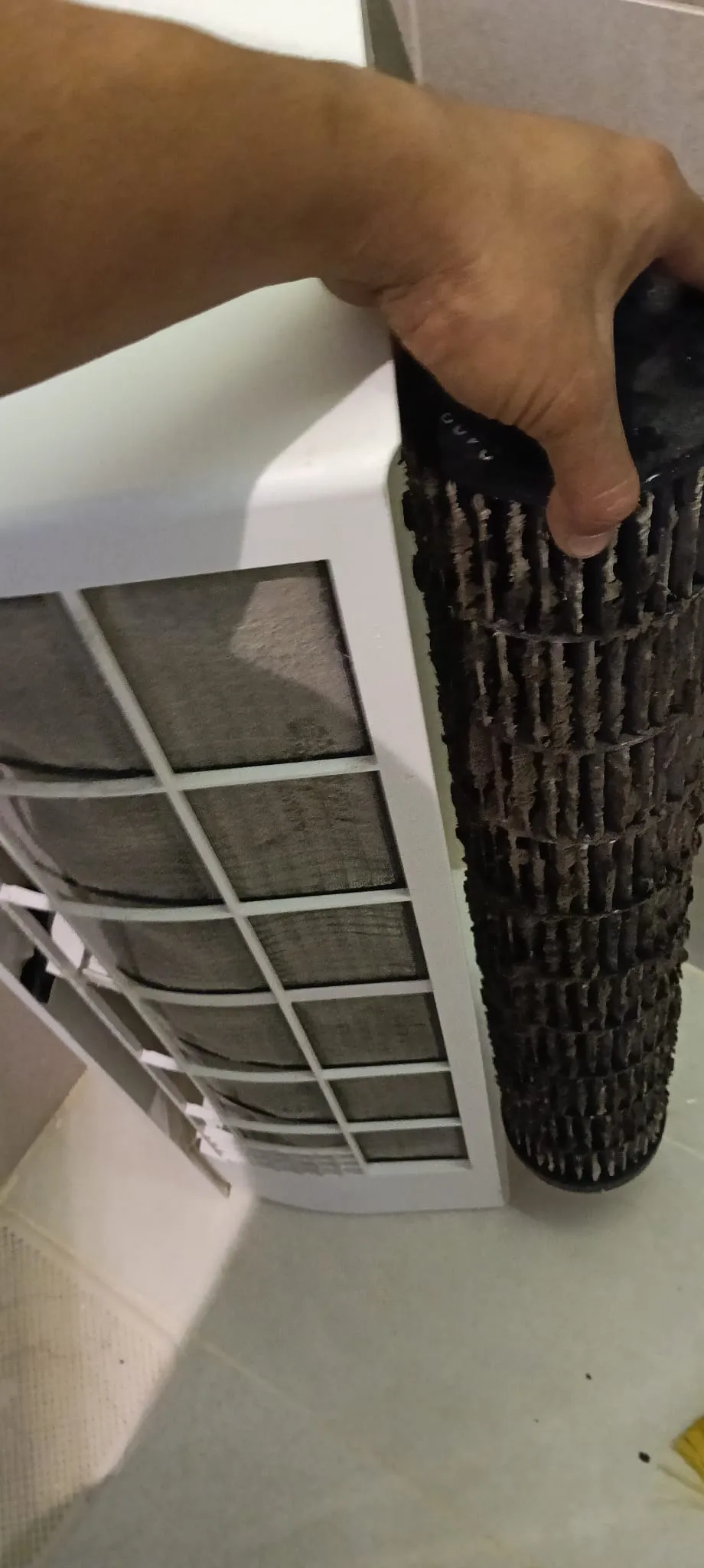
Most people book a chemical overhaul picturing a longer version of the service they have had before: someone arrives, opens the front cover, sprays something, wipes it down, leaves. Then the fan coil comes off the wall, gets carried into the bathroom in pieces, and there is water running for the next couple of hours.
Nothing has gone wrong. That is what an overhaul is. But it is a different kind of afternoon in your flat from a general service, and hardly anyone is told that before the day. This is what actually happens, and the handful of things you can do beforehand that make it go smoothly.
An overhaul is not a longer wash — it is a different job
Our published price list describes a chemical overhaul as full disassembly, recommended every two to three years or for a severely fouled unit. "Full disassembly" is meant literally. The unit comes off its bracket, the casing comes apart, the drain pan comes out, the blower wheel comes out, and each part is cleaned separately before the whole thing is rebuilt and put back up.
A chemical wash is deep coil cleaning done with the unit still on the wall, on a six to twelve month cycle. A general service is routine three-monthly maintenance — filter clean, coil wipe, drainage flush, gas check. The three are not degrees of the same thing; they reach different parts of the machine. We have set out where each one stops in chemical wash versus chemical overhaul.
The reason a unit has to come down at all is that three of the dirtiest parts cannot be reached properly while it is up there:
- The back face of the coil. The side you can see is the clean side. The dust that matters is packed into the fins from behind, where the air comes through.
- The blower wheel. The barrel fan behind the coil, whose blades hold a felt of dust and biofilm. This is the part that carries the smell, and it is the reason we wrote what a chemical wash cannot fix.
- The drain pan and its outlet. The slime that eventually blocks a drain sits in a tray that is bolted under the coil, at an angle, above your ceiling line.
The sequence, start to finish
An overhaul on one unit runs roughly like this:
- Power is isolated at the breaker or the unit's own isolator, and confirmed dead.
- The room is protected — floor sheeting under the unit, and the wall below it covered.
- The front cover, filters and body panels come off in the room.
- The unit is unclipped from its wall bracket and lifted down. Refrigerant piping is not disconnected for a standard overhaul; the unit is lowered and supported so the pipes are not strained.
- The drain pan and blower wheel are removed. This is the point at which most people look at what comes out and stop asking why it costs more than a wash.
- The parts go to a wet area — usually your bathroom or service yard — and are cleaned individually with chemical and water pressure.
- The coil is treated and rinsed, then flushed until the run-off comes back clear.
- The drain line is flushed through from the pan and checked to the discharge point.
- Everything dries, is reassembled, remounted, powered up and run — and the drain is watched under load, because a drain that flows on a bucket test does not always flow on a running unit.
Where the work happens in your home
This is the part that surprises people, and it is worth settling before the technician arrives.
The washing has to happen somewhere with a tap and a floor drain. In an HDB flat that is nearly always a bathroom or the service yard. Parts get carried there and back along whatever route exists, which usually means through a bedroom and a corridor with wet components in hand.
So three questions are worth answering the moment the technician walks in, not halfway through: which bathroom are we using, what is the route from the unit to it, and is anything on that route that should be moved. A five-second conversation at the door prevents a wet patch on a rug that was there when the parts came past.
How long it takes
An overhaul takes considerably longer per unit than a general service, because every component is removed, washed and dried individually rather than cleaned in place. Multiple units multiply that, and a high wall position, an awkward bracket or a unit that has never been stripped before all add time.
Rather than work to a number you read online, ask for the expected finish time when you book, and say how many units are involved. Any honest company will give you a window, and will tell you if your job is one that needs a morning rather than a slot. What you should not do is book an overhaul for a day you also need the flat back by a fixed hour.
What it costs
Our prices are published in full and the displayed price is the final price. A chemical overhaul is $200 for one unit, $370 for two, $515 for three, $640 for four, and $150 per unit from five units. For comparison on the same page, a chemical wash is $135 for one unit and $345 for three, and a general service is $45 for one unit and $95 for three.
Two things follow from that spread. First, the per-unit price of an overhaul drops as you add units, so if two units in the flat are both due, doing them together is materially cheaper than doing them a month apart. Second, an overhaul costs roughly four times a general service on one unit — which is why it belongs on a two to three year cycle or on a unit that is genuinely fouled, not as a default.
What to do the night before
None of this is difficult, and all of it saves time on the day:
- Clear the floor under each unit, about a body's width out from the wall. Not tidied — cleared.
- Move anything valuable or absorbent off that wall. Framed pictures, a headboard, a rug, a wardrobe with an open top shelf.
- Empty one bathroom. Toiletries off the floor, mats out, the shower area free. That is the workshop for the next couple of hours.
- Find your breaker box and know which switch is the aircon. If your units are on a shared circuit with something else, say so.
- Know where your bedroom units drain to. If a drain has ever leaked before, mention it before the work starts, not after.
- Plan for pets. Doors will be open, parts will be on the floor, and there will be a stranger moving between rooms with both hands full.
- Decide who is home. Somebody should be there at the end to see the units running, not only at the start to open the door.
- Note anything the unit has been doing — a smell, a rattle, a drip, a room that will not get cold. Say it at the start. Parts are only off once.
The things that actually go wrong
The bracket underneath. On an older installation, the wall bracket only gets seen when the unit comes off. Rust, a loose plug or a bracket that has been carrying more weight than it should are all findable at that moment and at no other. If it needs replacing, that is a separate piece of work — but you would far rather know.
Brittle plastic on very old units. A casing that has been on a wall in Singapore heat for twelve or fifteen years does not always come apart cleanly. Clips break. On an old unit, ask about part availability before committing to an overhaul, because a broken cover on a discontinued model is a real problem and not an unlikely one.
Spending overhaul money on a unit at the end of its life. If the compressor is tired or the unit is old enough to be near replacement anyway, an overhaul buys you a clean machine with the same underlying problem. That decision is worth making before the money is spent, and we set out the arithmetic in when to replace your aircon versus keep repairing it.
Expecting an overhaul to fix a cooling problem. Cleaning restores airflow and removes smells. It does not put refrigerant back. If your complaint is that the room will not get cold, the question is a different one — see whether you need a gas top-up or a leak repair — and a pre-check should be settling that before anybody books an overhaul.
A unit that cannot physically come down. If the fan coil is boxed into a false ceiling with no usable access, a full overhaul may not be possible at all without opening the ceiling. That is a construction problem rather than a servicing one, and it is exactly the situation described in the access panel decision.
What to look at before the technician leaves
Ask to see the blower wheel and the drain pan while they are still out and still clean. It takes ten seconds, it is the only moment they will ever be visible to you, and it is the difference between paying for an overhaul and knowing you received one. Then watch the unit run for a few minutes before anyone packs up: cold air at the vents, no new noise, and nothing dripping at the pipe.
The short version
An overhaul is a strip-down, not a spray-down. It uses one of your bathrooms, it takes real time, and it costs about four times a general service — for a reason you can see when the parts come out. Clear the floor, empty a bathroom, know your breaker, and be home at the end. Everything else is our problem.
If your units are two or three years past their last deep clean, or you are unsure whether you need an overhaul at all rather than a wash, tell us what the unit is doing and how old it is. We would rather talk you into the cheaper job than sell you the bigger one. WhatsApp us on 9107 2601 — usually a reply within five minutes.
Related: once the overhaul is done, what is normal in the first week after an aircon overhaul, and what should go back to the technician covers drips, new noises, weak cooling and error lights, and how to report them.
Related: if you're weighing whether to overhaul the unit or replace it outright, see our aircon overhaul or replace comparison.
Wondering how long the visit will run? We set out the published time per unit for every job in how long aircon servicing takes, by number of units.