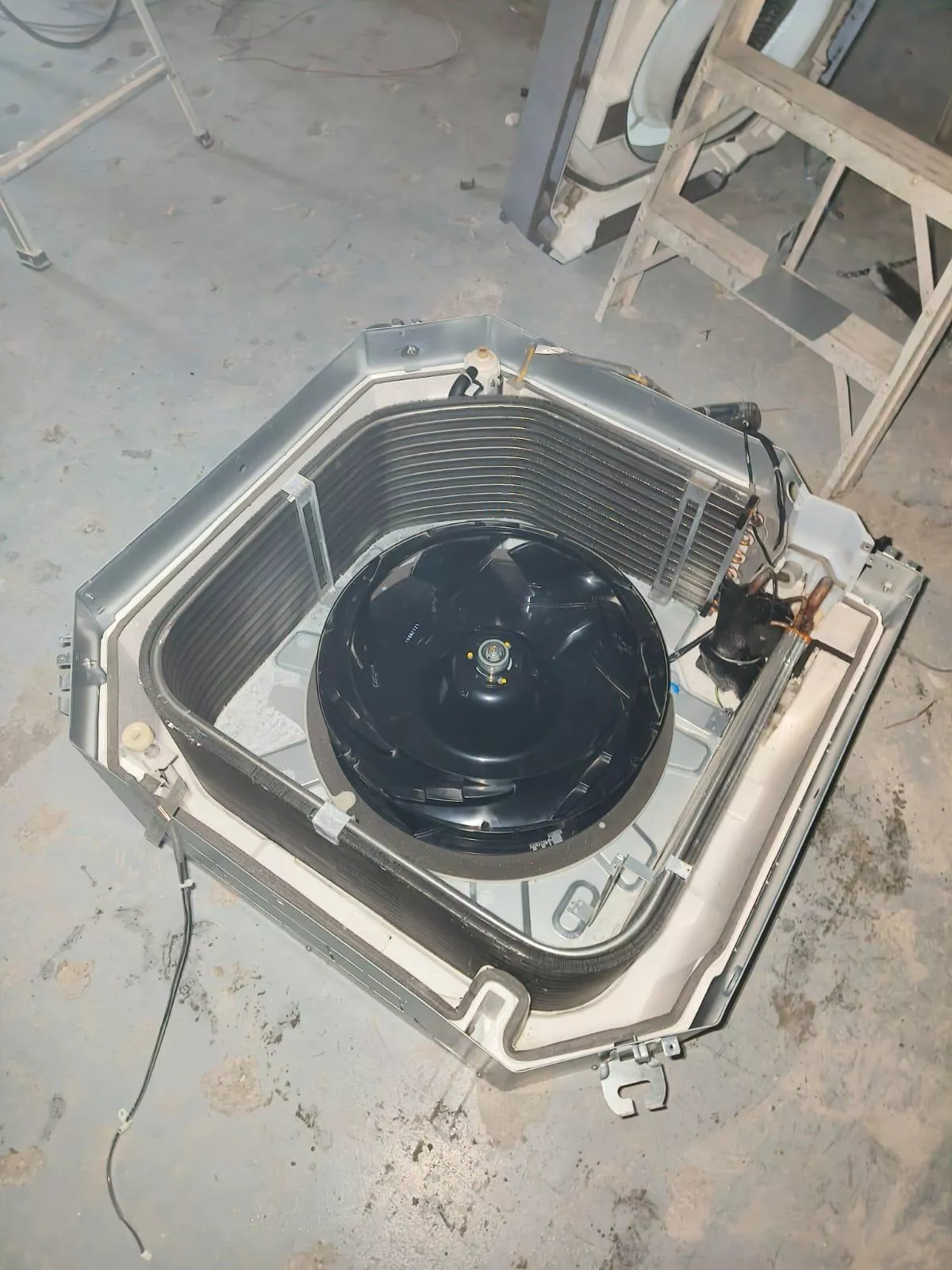
Most aircon advice in Singapore is written for the wall-mounted unit, the white box above the bedroom door. Plenty of condos and landed homes do not have those in every room. They have a long slot in the ceiling where the cold air comes out, a grille somewhere else where it goes back in, and no machine in sight. That is a ducted aircon, and looking after it is a different job, with a different line on the price list.
This guide covers how to tell whether you have one, what our published rates are for servicing it, what makes one ducted unit harder to clean than another, and what to send us so the job is confirmed correctly the first time.
First, check what you actually have
Three kinds of indoor unit get mixed up all the time:
- Wall-mounted. The unit hangs on the wall below the ceiling line, with a louvre that swings. Even when its piping is hidden in a bulkhead, the unit itself is in the room. The general servicing and chemical wash tables on our price list are for these.
- Ceiling cassette. A square panel set flush into the ceiling, blowing air out on several sides. The unit body sits directly behind that panel.
- Ducted. The fan coil is hidden entirely above the false ceiling. Cold air travels through ducting to one or more supply grilles, often long, narrow slots along a bulkhead, and comes back through a separate, larger return-air grille. It is usually run from a wall controller rather than a remote pointed at a unit.
The quickest test: stand in the room and look for the machine. If you can see a unit, it is not ducted. If all you can see are slots and grilles, it almost certainly is.
The photo above is not a ducted unit, and we would rather say so. It is a ceiling cassette taken down to the floor during an 8-unit chemical overhaul we did at a landed house in Bedok. It is here because it shows what a ceiling hides: a coil wrapped around a large blower, with the drain pan underneath. A ducted unit carries the same kinds of parts in a different box, and further out of reach.
Count indoor units, not grilles
Our ducted rates are priced per indoor unit. That catches people out, because one ducted unit can feed two or three supply grilles, sometimes across more than one room. A living and dining area with four slots in the ceiling may be served by a single unit. A condo with ducting in the living room and wall-mounted units in the bedrooms has one ducted unit plus several wall units, and those sit on different lines of the price list.
If you are not sure how many units are up there, do not guess from the grilles. Photographs of every grille, every wall controller and the outdoor unit make the count much easier to settle before anyone comes out.
What it costs: the published rates
These are the rates on our price list for ducted indoor units:
| Ducted / duct servicing | Published price |
|---|---|
| Normal servicing | $60 per unit |
| Chemical servicing | from $500 (a $500 minimum, depending on site conditions) |
Three things to take from that table.
The wall-mounted tables do not apply. General servicing is $45 for 1 unit, $70 for 2, $95 for 3 and $115 for 4, and the chemical wash is $135 for 1 unit falling to $100 per unit from 5. Those multi-unit prices are not the ducted rates. Normal servicing on a ducted unit is $60 per unit, so three ducted units come to $180.
The chemical figure is a floor, not a quote. "From $500" is the minimum. What moves it is the site, which is why photos are worth sending before you book rather than after. When you message us, ask for the figure for your number of units.
This is the residential rate. Office, shop and other commercial ducted systems are quoted separately from the residential price list. Everything in this article is about ducted units in homes.
What makes a ducted unit a different job
On a wall-mounted unit, the technician stands in front of the machine. On a ducted unit, nothing is in front of anyone. Everything that needs attention is overhead, above a finished ceiling:
- The filter usually sits behind the return-air grille, not on the unit.
- The coil and the blower are inside the unit body, and can only be reached through an access panel below it.
- The drain pan and drain pipe are above the ceiling too, so a choke tends to show up as a water mark on your ceiling before you see it anywhere else.
- The work is done from a ladder, under your ceiling finish, and whatever is directly below has to be protected.
None of that is exotic. It is simply more reaching, more protecting, and more that depends on how the unit was installed in the first place.
What makes one ducted unit harder than another
"Depending on site conditions" can sound vague. Nobody can price your unit without seeing it, but these are the things that make one ducted unit harder to reach and clean than another, and you can check every one of them yourself in five minutes:
- Is there an access panel under the unit, and how big is it? A framed, hinged panel that someone can get a head, a torch and two hands into is workable. A small inspection hole is not, and no panel at all means the ceiling has to be opened first. Where panels need to be is covered in the false ceiling access panel guide.
- How much space is there above the unit? A unit squeezed tight under the slab is hard to open up and clean properly, however good the panel is.
- How high is the ceiling? A standard ceiling and a double-volume living room in a landed house are not the same job.
- What is directly underneath? A bare floor is easy to protect. A built-in wardrobe, a TV wall or a feature ceiling right below the panel takes more care.
- When was it last cleaned, and how? A unit nobody has opened since handover is a different job from one that had a chemical clean last year.
Signs a ducted unit needs attention
Because you never see the machine, the signs turn up somewhere else:
- A musty or damp smell from the grilles when the aircon starts
- Weak airflow from one grille, or from all of them, even with the fan turned up
- A room that takes much longer to cool than it used to
- A water stain spreading on the ceiling near the unit or the access panel, or drips from a grille
- Dark marks building up around the supply slots
The ceiling stain is the one not to sit on. Water above a ceiling does not stay where it started, and the longer it runs, the more of the ceiling it spoils.
What you can do yourself, and where to stop
The filter is the one part of a ducted unit most homeowners can reach. On many installations it sits behind the return-air grille, which hinges or lifts down. If yours does, and you can reach it safely from a stable ladder, it can be rinsed the same way as a wall-mounted filter: switch off the power at the isolator first, rinse from the clean side, let it dry fully in the shade, and refit it so it sits flat. The full method is in washing aircon filters yourself.
Stop there. Do not open the access panel to spray the coil, and do not push anything into the drain. Above a ceiling, cleaning water and loosened dirt have nowhere to go except down through the ceiling you are standing under.
Do not book the wrong line
An easy mistake is booking a chemical wash from the wall-mounted table for a ducted unit, because $135 looks like the right sort of number. It is the wrong line. That table is for wall-mounted units; chemical servicing on a ducted unit is from $500 and depends on the site. Telling us the unit type up front is how you get the right price line from the start.
If your home has wall-mounted units as well, deciding which of those actually need a wash is a separate question, covered in chemical wash every aircon or just one.
What to send before booking
- Property type: condo, landed or HDB
- Photos of every supply grille and return-air grille, and the wall controller
- A photo of the access panel if you can find one, and roughly how big it is
- The ceiling height, and what sits directly under the panel
- How many wall-mounted units you have as well, if any
- What the unit is doing: smell, weak airflow, dripping, a ceiling stain, or nothing
- When it was last serviced, and what was done
The short version
If you cannot see the machine, it is probably ducted, and it is not on the wall-mounted price tables. Count indoor units, not grilles. Normal servicing is $60 per unit; chemical servicing is from $500, depending on site conditions. Access decides most of what happens next, so photograph the grilles and the panel before you book, rinse the filter yourself if you can reach it safely, and leave everything above the ceiling alone.
Not sure what you have up there? WhatsApp us on 9107 2601 with your unit type and photos of the grilles and the access panel, and we will confirm the job. The full price list is on the pricing page.