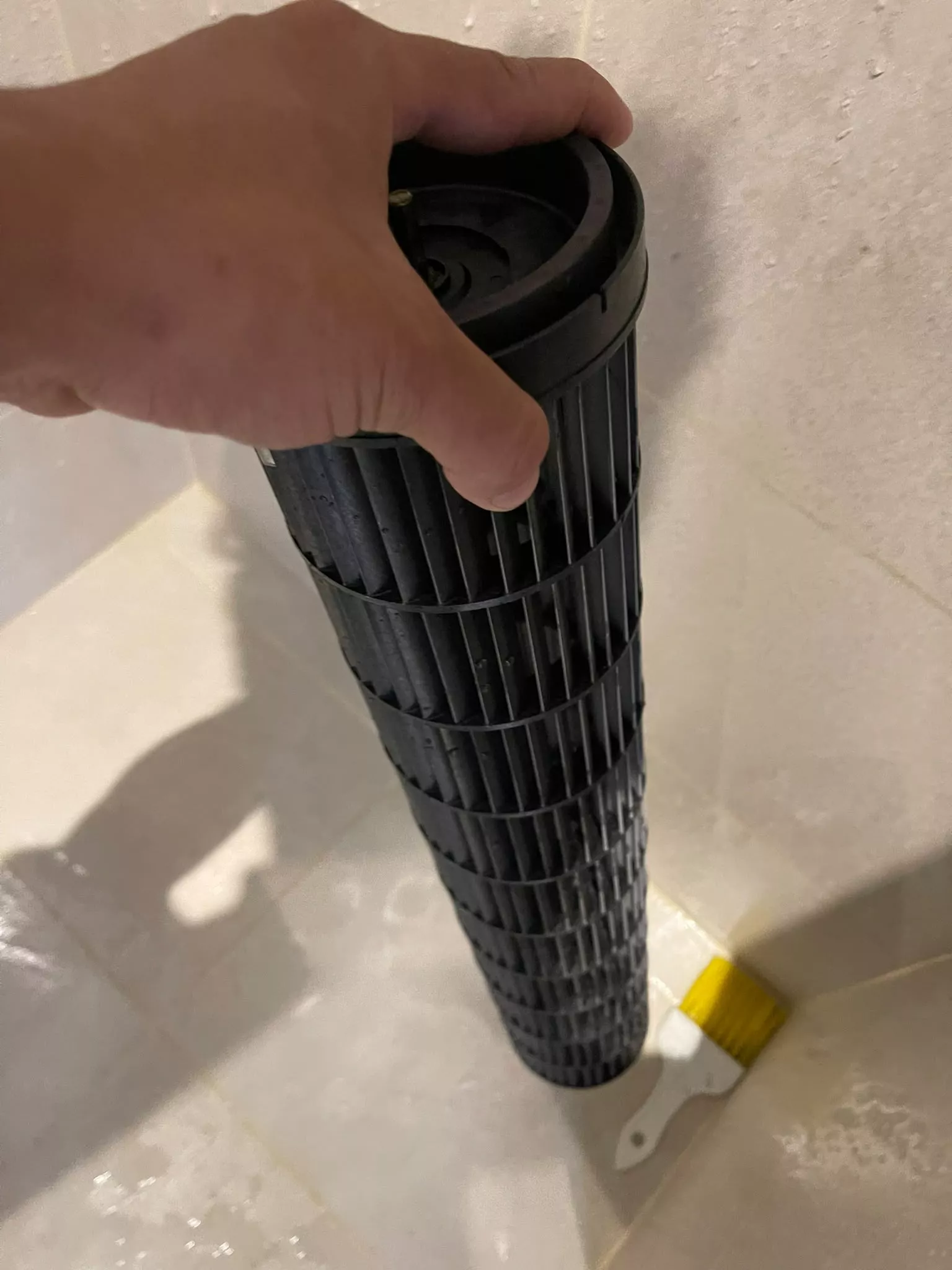
Pictured above: the blower roller taken out of a wall unit during one of our servicing jobs. It is the part behind the coil that moves the air, and it collects dust whether the room is used every night or once a month.
Most flats have one. The guest room, the study that became a storeroom, the helper's room, the bedroom of a child who is now overseas. The aircon in it works, you switch it on for a few nights a month, and every time you book a service you wonder whether that unit really needs the same attention as the master bedroom.
The honest answer is: not the same schedule, but not nothing either. This post sets out what we publish about lightly used units, what we do not publish, what the spare unit adds to a visit on the price list, and a five-minute test that tells you whether it needs a wash before the next guest arrives.
What our published schedule says, and what it does not say
The schedule on our service pages is written for a unit that runs daily. For those, normal servicing is about every 3 months, and a chemical wash every 6 to 12 months on top of that. A chemical overhaul is, for most homes, every 2 to 3 years.
For the lightly used unit, we publish one thing: on the chemical wash, a lightly used guest-room unit can stretch closer to 12 months. We also say that if you can already smell mustiness or cooling has dropped, you should not wait, because that is the coil telling you it is overdue.
What we do not publish is a separate interval for general servicing of a rarely used unit. We are not going to invent one here. So the plan below is built from the published numbers, and where it is our own judgement, it says so.
Why a unit nobody uses still gets dirty
Singapore averages around 84% humidity all year. A unit that is switched off in a closed room sits in that air, with a coil and drain pan that were wet the last time it ran. We have written about what happens inside an indoor unit that sits idle in a shut room, in leaving your flat empty for a while: a drain trap that dries out, and a coil that stays damp in a box with no airflow. A guest-room unit that runs three nights a month is not an empty flat, but it spends most of its life in that condition.
The other half of the problem is that nobody is watching it. A daily-use unit tells you quickly when something is wrong, because you live with it. A guest-room unit tells your guest, on the first night, at 11pm.
What the spare unit adds to a visit
This is the part people do not expect. Our prices fall per unit as the number of units in one booking goes up, so the spare-room unit is cheaper to add to a visit you are already booking than to book on its own. Everything in this table comes from the pricing page; the "adds" column is simple subtraction of those prices.
| Job | Daily units only (2) | Plus the spare unit (3) | Spare unit adds | Booked alone (1 unit) |
|---|---|---|---|---|
| Normal servicing | $90 | $120 | $30 | $55 |
| Chemical wash | $245 | $345 | $100 | $135 |
| Chemical overhaul | $370 | $515 | $145 | $200 |
If you have one daily unit and one spare, the spare is the second unit: it adds $35 to servicing ($90 for two against $55 for one), $110 to a wash ($245 against $135) and $170 to an overhaul ($370 against $200). In a four-unit flat where the spare is the fourth unit, it adds $40 to servicing ($160 against $120), $80 to a wash ($425 against $345) and $125 to an overhaul ($640 against $515). The displayed price is the final price.
So the cheap way to look after a rarely used unit is not to book it separately. It is to put it on a visit you are already having, when it is due.
A plan for a System 3 with one rarely used room
This is our own arrangement of the published prices, not a package. We do not sell annual packages.
- Quarterly: the two daily units get normal servicing every 3 months, at $90 for two units.
- Once a year: on one of those visits, book a chemical wash for all three units, at $345 for three. Against washing only the two daily units ($245), the spare unit adds $100, and that matches the 12-month stretch we publish for a lightly used guest-room unit.
- Before guests: run the five-minute test below. If it fails, do not wait for the yearly wash.
That is a judgement, not a rule. If the spare room is used more than a few nights a month, or someone in the household has allergies or asthma, move the spare unit onto the same schedule as the others. We say every 6 months for allergies or asthma, for 8 or more hours a day of running, and for pets.
The five-minute test before guests arrive
Do this a few days before, not the afternoon they land. If something is wrong you want time to book a visit.
- Switch it on and stay near it for the first two minutes. A musty or sour smell that does not clear is mould and bacteria on the coil and in the drain. That is what a chemical wash is for. Our FAQ says it plainly: in most cases a persistent smell calls for a wash, not another general service.
- Check the cooling. Put your hand in front of the vent after ten minutes. If the room has not clearly cooled, the coil may be blocked, or there may be a gas problem. The pre-check tells which; do not guess.
- Look for water. A drip from the front of the unit or a wet patch below it is a drainage question. The 9-point pre-check includes a drainage flow check, and a standard repair for drainage is from $80.
- Look for the obvious. A remote that does nothing, a blinking light or a rattle all show up now rather than in front of a guest.
- Leave it running for ten more minutes. Some faults only show once the unit has been on for a while.
Filters are the one part you can wash yourself. We covered where that stops in washing aircon filters yourself.
Why not leave the spare unit out completely
It is tempting, and the visit costs less without it. Two reasons we would not, beyond the smell.
First, the refrigerant is shared. Gas top-up is priced per outdoor circuit, not per indoor unit, so indoor units on the same outdoor unit share one circuit. The spare room's unit is part of the same refrigerant system as the other rooms, and the pre-check on each visit includes a compressor pressure reading, which is where a gas problem would first show.
Second, a unit found to be fouled only when the guest arrives has to be dealt with at that moment, and booked alone it is the single-unit price ($135 for a wash, $200 for an overhaul), not the in-visit price ($100 or $145 added to a three-unit booking). The cheaper time to deal with it is when the other units are already being done.
When the next regular visit is too far away
If the spare unit has not been touched in years, or the room has just been renovated and the unit is full of dust, do not wait for the next regular visit. Aircon not serviced for years explains what that first visit involves. If you are deciding which units to do first on a tight budget, four aircons, tight budget works through the same trade-off with the published prices.
The short version
- A rarely used unit still collects dust and damp. It is just quieter about it.
- Published: a lightly used guest-room unit can stretch its chemical wash closer to 12 months. We do not publish a separate general-service interval for it.
- Add the spare unit to a visit you already have: as the third unit it adds $30 to servicing, $100 to a wash or $145 to an overhaul.
- Run the five-minute test before guests arrive. A musty smell or weak cooling means do not wait.
- The spare room is on the same refrigerant circuit as the rest, so leaving it out leaves part of the system unchecked.
Normal servicing is the minimum we offer, and our work carries a 90-day workmanship warranty. The full price list is on our pricing page.
Tell us which room it is
If you have a spare-room unit and want to know whether it is due, tell us how often it runs and when it was last washed. We will give you the price before we come, and the pre-check on the day tells you what it actually needs. WhatsApp us on 9107 2601 and we will tell you what to expect before we come.