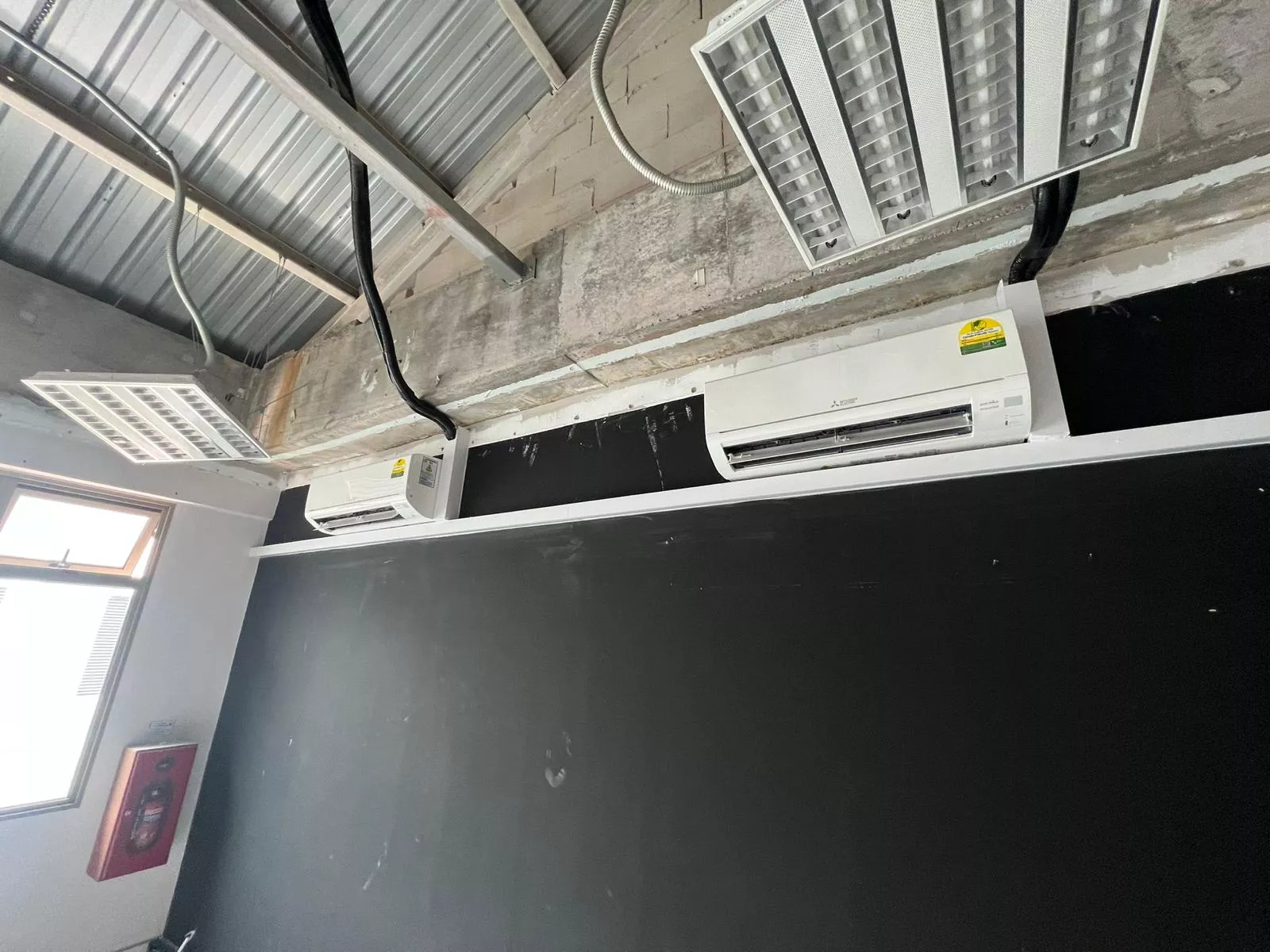
The indoor unit is running. You can hear the fan, the louvre moves, the display is lit. But the air coming out is room-temperature or warm. This is a different problem from a unit that will not turn on at all, and it points at a different part of the system: the fan inside is doing its job, and the cooling side is not.
Before you call anyone, there are a few checks you can do from inside the flat in about ten minutes. None of them needs a screwdriver, and none needs you to lean out over a ledge. What they give you is a clear description to pass on, which is what saves a technician's time and yours.
What "fan running, air warm" usually means
Cold air needs three things at once: the indoor fan, refrigerant moving through the coil, and the outdoor unit doing its part (the compressor and the outdoor fan). The indoor fan is the only one you can easily confirm from the room. So the useful question is whether the outdoor side has started.
Possible causes, from the harmless to the serious:
- The unit is still starting. After a power cut, or after the unit has just been switched on, the outdoor side may hold back for a few minutes. The indoor fan blowing before the cold arrives is normal for that short period.
- The wrong mode or setpoint. Fan mode, dry mode, or a set temperature at or above the room temperature all give air that does not feel cold.
- A choked filter or a frozen coil. Airflow collapses and the room never cools. Our guide on what to do when the indoor unit ices up covers that case.
- Low refrigerant. The cooling is weak because there is not enough refrigerant circulating, and the usual reason is a leak.
- An outdoor unit that is not starting. The compressor or the outdoor fan is not running. That can be a part, a board or a supply problem on the outdoor side.
The ten-minute checks, in order
- Read the remote. Confirm Cool mode, a set temperature several degrees below the room, and a fan speed that is not on the lowest setting. Change the batteries if the screen is faint.
- Wait five minutes. Do not keep pressing the button. Repeated on-off switching does not shorten any start-up delay and is not kind to the unit.
- Look at the filter. Switch off at the isolator or breaker first. If the filter is grey and furry, wash it and refit it fully dry. The method is in our post on washing the filters yourself and where DIY stops.
- Check the other units. If you have a System 2, 3 or 4, the indoor units share one outdoor unit. If the neighbouring unit cools normally, the outdoor side is running and the fault is local to this indoor unit. If every unit blows warm, the shared outdoor side is the first suspect.
- Look for ice or water. Ice on the indoor coil or the pipe, or water dripping, belongs to a different fault. Switch the unit off and note what you saw.
- Listen from a safe place. If you can hear the outdoor unit from a window, a service yard or a balcony without leaning out, note whether you hear a steady hum with the fan whirring, a click and then silence, or nothing at all. Do not open the outdoor unit, and do not climb or lean out over a ledge to look.
If the outdoor unit stays silent after all of the above, switch the aircon off at the isolator rather than leaving it calling for cooling that never comes.
What to tell the technician
These details let a visit get to the cause quickly:
- Roughly when it began, and whether it followed a power cut, a storm or a breaker trip. If it did, read what to check after a thunderstorm or power trip first.
- Whether the room cools slowly or not at all, and whether it ever cooled properly after a service. Still not cold after servicing sets out what to check if a recent service is part of the story.
- How many indoor units are on the system, and whether the others are cooling.
- Any blinking light, noise, smell or ice. A short phone video of a blinking light helps.
- The brand, and the refrigerant type if it is on the label.
What the visit and the likely fixes cost at aircons.sg
These are the published figures on our pricing page, and the price you see is what you pay:
- The visit: $55 for 1 unit, with the 9-point pre-check included. The pre-check is there to find out which of the causes above you actually have before any work is agreed.
- Standard repair (drainage, electrical): $80.
- Gas top-up: priced per outdoor circuit, not per indoor unit. R22 is $115, R410A is $130 and R32 is $170. Indoor units that share one outdoor unit share one circuit.
- Leak detector check: $180 flat. If the refrigerant keeps going down, a top-up alone is not the answer, and the full breakdown is in our aircon gas leak repair cost guide.
- Compressor or PCB replacement: quoted on site, and the price varies by site. We do not give a figure for it here because none is published.
A top-up is only worth buying if the pre-check shows low refrigerant, and a compressor job is only worth discussing once the cheaper causes have been ruled out. If you are weighing an old unit, our post on compressor failure: replace or repair sets out how to think about that.
If it is an old unit
Age does not decide the answer by itself, but it changes the sums. A unit that has had a warm-air fault, an earlier gas top-up and a noisy outdoor fan is telling you a story. Ask for the findings as photos or in writing, and get the figure for any major part before you agree to it.
If you would like us to check it
Tell us how many indoor units you have, what the remote is set to, whether the other units are cooling, and what you can hear from the outdoor side. WhatsApp us on 9107 2601 and we will tell you what the visit is likely to cover before we come.