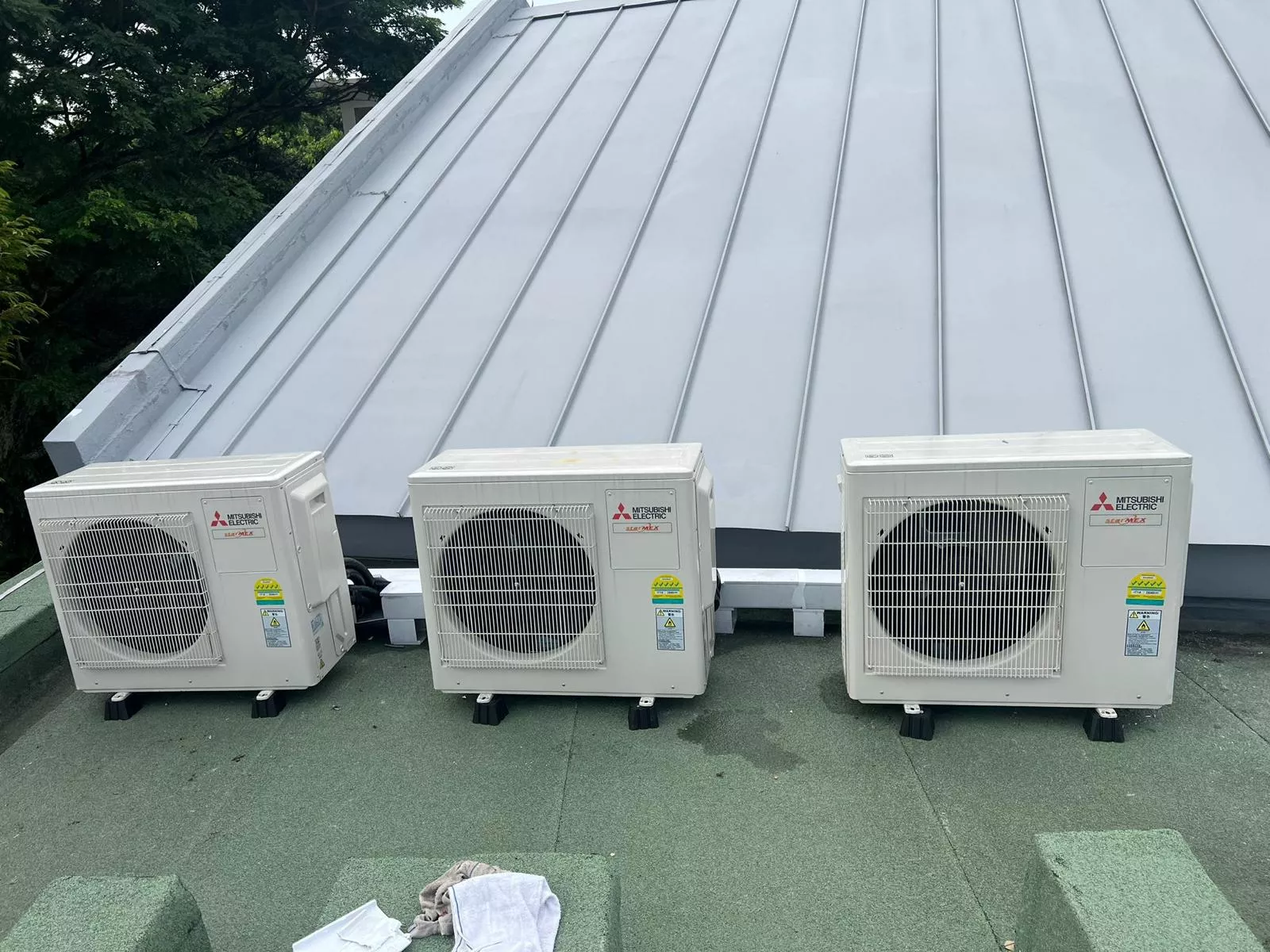
Pictured above: three condensers set out on a flat roof beside a pitched metal roof on one of our landed jobs. Where these sit, and how you reach them again in two years, is most of what makes landed aircon different.
Most aircon advice in Singapore is written for flats. That is fair enough, since most homes are flats, but it means landed owners keep reading guidance built around rules and constraints that do not apply to them, and missing the ones that do.
A landed house is not simply a bigger flat with more units. The things that decide whether the system works, what it costs to run and whether servicing is straightforward are different, and several of them are settled on the day of installation and very hard to change later.
You have freedom, and that is the problem
In an HDB flat, a great many decisions are made for you. There is a designated aircon ledge. There is a limit on how many units go on it. The pipe route is more or less fixed. Those rules are restrictive, but they also prevent most bad decisions.
A landed house has none of that. The condensers can go on the ground, on a flat roof, on a pitched roof, on a bracket on a wall, in a side corridor, behind a screen. The indoor units can go almost anywhere. Nobody is going to stop you, which means the quality of the result depends entirely on whether anyone thought it through — and on a house with three storeys and a dozen rooms, there is a lot to think through.
That is the whole difference in one sentence. On landed work, the design decisions are yours, and they are the expensive ones.
Where the condensers go decides more than you think
This is the single biggest landed decision and it gets made far too casually — usually by whoever is holding the drawing at the time. Four things ride on it:
- Heat rejection. A condenser rejects heat and needs air to do it. Put several close together in a tight corner, or box them behind a solid screen with no airflow, and they are fighting each other and the wall. That shows up as poor cooling and higher bills, not as a fault anyone will find.
- Noise, and specifically your neighbour's bedroom. On a landed plot, the condenser is often nearer to the neighbour's window than to yours. A unit that is inaudible inside your house can be the thing your neighbour hears every night. This is a much bigger issue on landed than in a flat and it is one of the few aircon decisions that can sour a relationship for years.
- Servicing access. Somebody has to reach every one of those units two or three times a year, with equipment. A condenser on a pitched roof with no safe access is a unit that will be serviced badly, or late, or not at all. When you are choosing the position, ask how the technician gets there. If the honest answer is a ladder against a gutter, choose somewhere else.
- Weather and rust. Fully exposed positions on a roof take sun and driving rain year-round. Brackets and fixings in exposed positions are worth checking periodically, because the bracket usually fails before the unit does.
Long pipe runs are a landed problem
In a flat, the distance from the ledge to the furthest bedroom is short. In a three-storey house with condensers on the roof and bedrooms on the first storey, the refrigerant pipe run can be many times that, and vertical as well as horizontal.
Long runs are normal and perfectly workable, but they are not free. They affect how the system performs and they mean there is simply more pipe, more insulation and more joints in your house — and joints are where refrigerant leaks start. It is worth asking at quotation stage where the pipes run, how they are insulated and how many indoor units are being asked to sit at the end of a long run.
The related decision is one big system or several smaller ones. A house split across several systems, by floor or by zone, means a failure takes out part of the house rather than all of it, and each system serves units closer to its own condenser. It usually costs more up front. Whether that trade is worth it depends on the house, and it is worth asking the question rather than accepting the first configuration offered.
Condensate drainage: more pipe, more gravity, more choke points
Every indoor unit produces water, and that water has to run away by gravity to somewhere sensible. In a flat that is a short run. In a landed house it can be a long one, sometimes through a ceiling void, across a floor and down.
The failure mode is the same everywhere but the consequences are worse: a choke in a long concealed drain line does not drip onto a ledge, it drips into a ceiling. If you have concealed units with long drain routes, knowing where the drain points are before there is a stain on the plaster is genuinely useful.
Servicing a landed house is a different job
Owners are often surprised that servicing a house takes considerably longer than servicing a flat. It is not only the number of units. It is the distance between them, getting to the condensers, and a technician working across three storeys instead of one room.
Two practical points:
- Block out enough time. A house with many units is not a one-hour visit, and rushing it is how the parts that need doing get skipped.
- Keep a list of units and where they are. On a big house it is easy to lose track of which unit was last washed and which was only wiped. A simple written record per unit is worth more than it sounds, and it is the only way to notice that one particular unit keeps needing attention.
If the house is being renovated or rebuilt
If the aircon is going in as part of building works, the single most valuable thing you can do is settle the sequence early. Pipe routes, drain routes and the electrical supply for the aircon all get buried behind ceilings and walls. Getting those right while the ceiling is open costs very little. Discovering them afterwards means opening the ceiling.
The electrical side deserves its own mention: a new installation needs the right power point and isolator arrangement, and on a house adding a number of units at once, the load has to be accounted for rather than assumed.
What to ask before you accept a landed quote
- Where exactly is each condenser going, and how does a technician reach it safely?
- How close is the nearest condenser to a neighbour's window?
- Is there real airflow around every condenser, including if a screen is being built?
- How long are the pipe runs, and how many indoor units sit at the end of the longest one?
- One system or several? What is the reasoning?
- Where does the condensate from each concealed unit drain to?
- Is the electrical supply, power point and isolator arrangement part of this quote?
- If building works are involved, when does the pipework need to be in?
The short version
- Landed aircon has no rulebook deciding things for you, so the design decisions are yours and they matter more.
- Condenser position is the big one: airflow, your neighbour's sleep, safe servicing access and weather exposure all ride on it.
- Long pipe runs are normal but not free. Ask how many units are at the end of the longest one.
- Long concealed drain runs fail into ceilings rather than onto ledges. Know where they go.
- Servicing a house takes real time. Give it time, and keep a record per unit.
- During renovation, pipe, drain and electrical routes must be settled before the ceiling closes.
Planning aircon for a landed house, or unhappy with the one you have? WhatsApp us on 9107 2601. Tell us the house, how many units and where the condensers are or could go, and we will tell you what we would do and confirm the price before anyone comes out. Our published prices are on the price list, and installation is covered on the installation cost page.
Related reading: BTU sizing for a room · the electrical work a new install needs · condenser brackets and rust