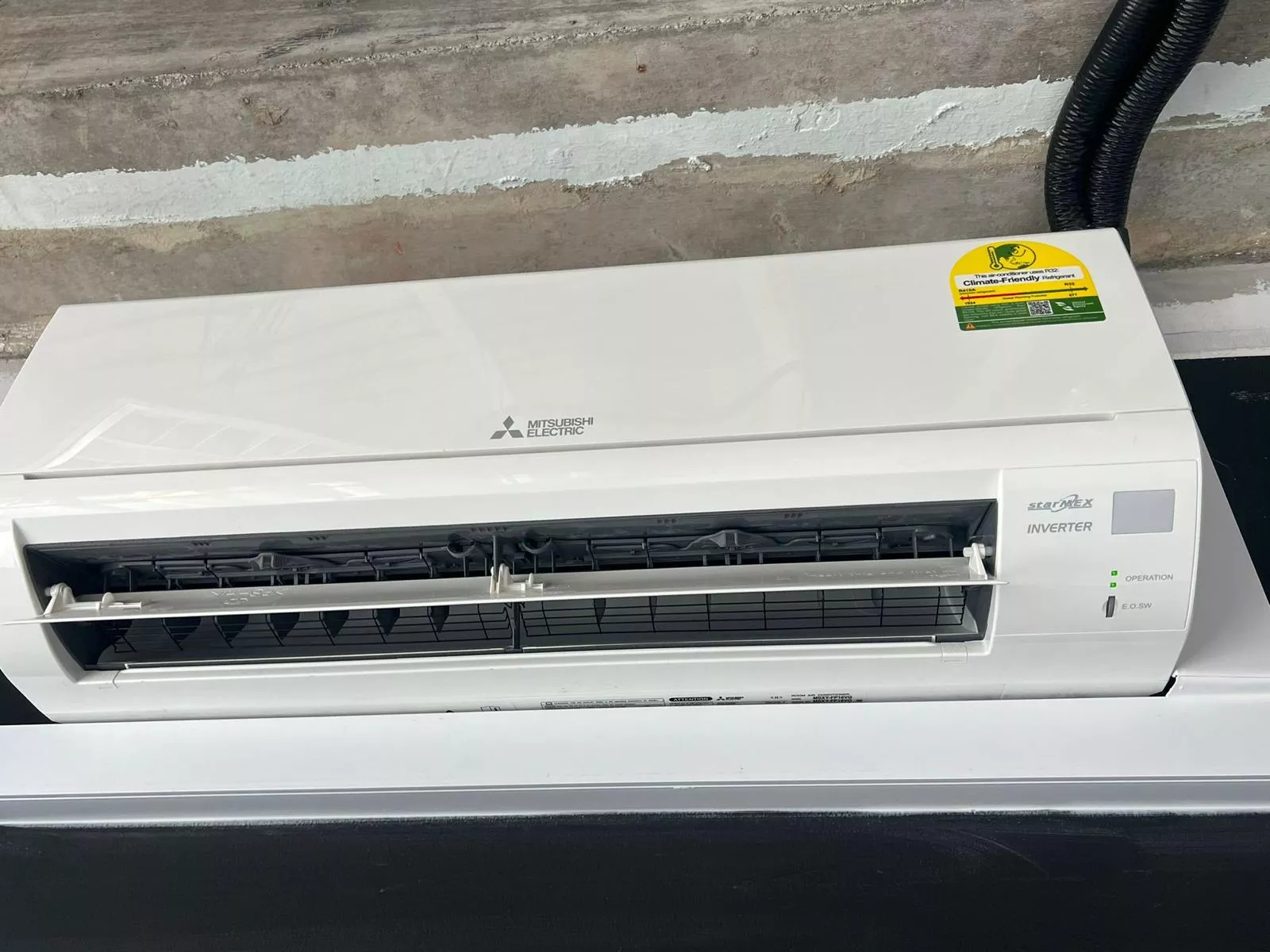
Pictured above: a wall-mounted unit on one of our repair jobs. Whether a repair starts with a check that takes minutes or a test that takes days is something most people only learn once the quote is already in their hands.
Almost everything written about an aircon gas leak is about money: what the top-up costs, what a pipe change costs. Less is said about the other cost, which is the stretch of days the unit may be out of use while the leak is found. Our price list says it in one short line beside the nitrogen pressure test: the aircon cannot be used for 2 to 3 days. If you work from home, have a baby in the flat, or have parents who sleep badly in the heat, that line matters as much as the dollar figure. This post is about planning around it, using only what we publish.
Three checks that get called "the pressure test"
People say "the technician did a pressure test" and mean three different things. They differ in price, in what they are counted per, and in whether you lose the aircon for days. Here is the published position for each.
| Check | Published price | Counted per | What is published about using the aircon |
|---|---|---|---|
| Gas pressure check, inside the 9-point pre-check | Included in the $55 minimum for 1 unit | The visit | The pre-check takes about 10 to 15 minutes and a visit is usually 45 to 90 minutes per unit |
| Leak detector check (Step 1) | $180 flat, System 3 included | The whole check | No duration published, so ask |
| Nitrogen pressure test (Step 2) | $180 per fan coil unit (a System 3 is $540) | Fan coil unit | The aircon cannot be used for 2 to 3 days |
The first one happens on every service visit. The compressor pressure reading, taken with professional gauges, is point 3 of the 9-point pre-check, and it is how a leak first shows up: low pressure on the gauge. Nothing about it takes the unit out of use.
The second is an electronic leak detector run over the wall-unit joints and the compressor joints. The third pressurises the pipe set and watches it: a steady reading means the circuit is sealed, a falling one confirms a leak. On the price list that third one is the check that carries the "2 to 3 days" note.
What the 2 to 3 days note does not tell you
The note sits against the System 3 example, a flat with three indoor units on one outdoor unit. We do not publish whether, on a System 3, every room goes out of use or only the unit being tested, and we are not going to guess at it here. It is the first question to put to any company, including us, before you agree to the test: which rooms will I not be able to cool, and for how long? Get the answer for your own system, in writing, because a flat with one split unit and a flat with a System 4 are different problems.
When you are likely to be told you need it
It usually starts the same way. The unit blows air but is not cold, or takes far longer to cool the room than it used to. The technician takes the pressure reading in the pre-check and it is low. Refrigerant does not run out. It circulates in a sealed loop, so low gas means it has escaped somewhere. From there the choice is between a flat-priced top-up (R22 $115, R410A $130, R32 $170 per outdoor circuit) and finding the leak.
If the last top-up lasted only a month, we say plainly to stop topping up: a leak that empties the system in weeks means you are paying for gas that leaves again. That is the situation where the leak detector and then the nitrogen test come in. For a slow leak, an occasional top-up can be the sensible choice, and we say so when it is. The decision is yours either way, and if you decide not to go ahead with a repair you pay for the visit and any leak test already carried out, and nothing towards the repair.
What it costs before any repair, from the published prices
The price list shows the leak detector as Step 1 and the nitrogen test as Step 2. Taken in order, and assuming both are needed, which you should ask about, the arithmetic is simple:
- One indoor unit: $180 for the leak detector plus $180 for the nitrogen test, so $360.
- A System 3: $180 for the leak detector (it includes a System 3) plus $540 for the nitrogen test (3 x $180), so $720.
Those figures are the testing only, before any repair. If a repair is approved on the same visit, the test fee is offset against that repair, so the finding is not paid for twice. Ask how that offset will appear on the quote. If the test finds a leaking pipe, the pipe change is $520 per fan coil unit in an HDB flat and $700 per fan coil unit in a condo. A re-made joint, a corroded coil or concealed pipe work is quoted after the test, and a compressor replacement is quoted on site, because the price varies by site. Repair work carries a 90-day workmanship warranty.
Planning the days: our judgement, not a published rule
Nothing in this section is a rule from our service pages. It is how we would think about it if the unit in question were in our own home.
- Ask for the date, not just the price. A test that takes the aircon out for a few days is easier to absorb in an ordinary week than in the week a newborn comes home, relatives stay, or exams fall. If the leak is slow, you may have room to choose the week.
- Decide where each person sleeps. Work out which rooms are affected, then which room, if any, is not. A flat with a System 3 and a separate split unit in the living room has more choice than a flat with one system.
- Move the hard hours. If someone works from home, ask whether the call-heavy days can fall before or after the test. If a parent is elderly, our guide to arranging an aircon visit when you cannot be there covers who needs to be present.
- Have the approver reachable on the day. The offset applies when a repair is approved on the same visit. If the person who decides is overseas or in a meeting, a repair put off to another day means the test and the repair are separate bills. Someone who can say yes on WhatsApp is enough.
- Do not start it just before guests. A test needs a stretch with nothing riding on the room being cool.
Five questions to ask before you approve the test
- Which check is this: the leak detector, or the nitrogen pressure test? They are different prices and different lengths of time.
- How many fan coil units is it counting, and which rooms are they? The nitrogen test is $180 for each.
- For how many days will the system be out of use, and does that mean every room on the system or only the unit being tested?
- If a repair is approved on the same visit, how does the test fee come off the repair on the quote?
- What do I pay if no leak is found, or if I decide not to go ahead with the repair?
Get the answers on WhatsApp rather than by phone. A message you can scroll back to is the easiest way to compare two companies on the same footing.
Before you book a test at all
The cheapest test is the one you can skip because the pre-check already answered the question. A dirty coil, a drain problem and a leak can all look like "not cold", and the 9-point pre-check is there to tell them apart before anyone proposes a test. If you have been handed a quote for a leak that arrived before any reading or location, the guide on how to check a gas leak quote before you approve it walks through the lines. If your unit keeps losing gas, where the refrigerant actually escapes explains the places a leak usually turns out to be. And for the difference between what a top-up, a test and a pipe change are each counted per, see what is actually being counted in an aircon quote.
The prices and what each includes sit on our pressure test cost page, the repair side is on the gas leak repair cost page, and every figure above comes from the pricing page.
The short version
- The gas pressure check is part of every $55 visit and does not take the unit out of use. The nitrogen test is a separate $180 per fan coil unit, and the price list says the aircon cannot be used for 2 to 3 days.
- We do not publish whether every room on a System 3 is out during the test. Ask for it for your system, in writing.
- Testing only, from the published prices: $360 for one indoor unit, $720 for a System 3, if both steps are needed. A repair approved on the same visit has the test fee offset against it.
- Pick the week, decide where everyone sleeps, and keep the person who can approve a repair reachable on the day.
If you would like a straight answer for your system
Tell us how many indoor units you have, whether it is an HDB flat, condo or landed home, when the gas was last topped up and how long it lasted. A photo of the nameplate sticker on the outdoor unit shows the refrigerant. We will tell you which check applies and what the published price is before we come. WhatsApp us on 9107 2601 and we will tell you what to expect before we come.