There is a particular kind of aircon complaint that comes back. The unit gets topped up, it cools beautifully for a few weeks, and then the same customer messages again — a bit warmer this month, noticeably warmer the month after. By the third top-up most people have worked out that they are not buying cooling, they are buying time.
A sealed refrigeration system is not supposed to consume gas. It is a closed loop: the same refrigerant goes round and round for the life of the unit. If the level is dropping, it is going somewhere, and the useful question is not "how much gas do I need" but "where is it leaving".
This is what we look at, in the order we look at it, and what each answer usually costs.
First: is it actually a leak?
Not every weak-cooling unit is short of gas, and this is worth settling before anyone connects a gauge. A blocked filter, a fouled evaporator coil or a fan running at half speed will all make a room feel warm while the refrigerant charge is perfectly fine. Topping up a system that is not low simply overcharges it, which raises the pressure, makes the compressor work harder and cools worse — the opposite of what was paid for.
The tells that point at gas rather than dirt are fairly consistent. Cooling that has faded gradually over weeks rather than failed suddenly. Ice forming on the copper pipe at the indoor unit or on part of the coil while the rest is dry. A compressor that runs continuously without the room ever reaching the set temperature. And the strongest tell of all: a unit that was topped up recently and is fading again.
We run a 9-point pre-check and a pressure test before quoting any repair. That visit is $45, and it is waived if you proceed with a gas top-up, so establishing the truth costs nothing if the answer turns out to be gas. The pressure test page sets out what the test involves.
Where refrigerant actually escapes
Refrigerant does not leak from the middle of a copper pipe. It leaves at joints, at points of vibration, and where metal has corroded. In Singapore homes the same handful of places account for nearly all of it.
1. The flare joints at the indoor and outdoor unit
This is the most common one by a distance. Every split system has flared copper connections at both ends — the pipe is belled out and clamped against the unit's fitting. A flare that was cut slightly off-square, over-tightened, under-tightened, or reused after the pipe was disconnected once already will weep gas slowly for years. It is not dramatic. It is a few grams a month, which is exactly the profile of a unit that needs topping up once a year and then twice a year.
This is also why we treat a reinstall as a real installation rather than a favour — a relocated unit that keeps its old flares is a classic slow leaker, which we cover in the aircon relocation guide.
2. The service valves on the outdoor unit
The two valves where gauges connect have caps and small schrader cores. A core that was not seated properly after a previous top-up, or a cap left off so the core sat exposed to rain and grit on a ledge, leaks steadily. It is a cheap fault with an expensive symptom, and it is one of the first things we check on any unit that has been serviced by several different companies over the years.
3. The evaporator coil in the indoor unit
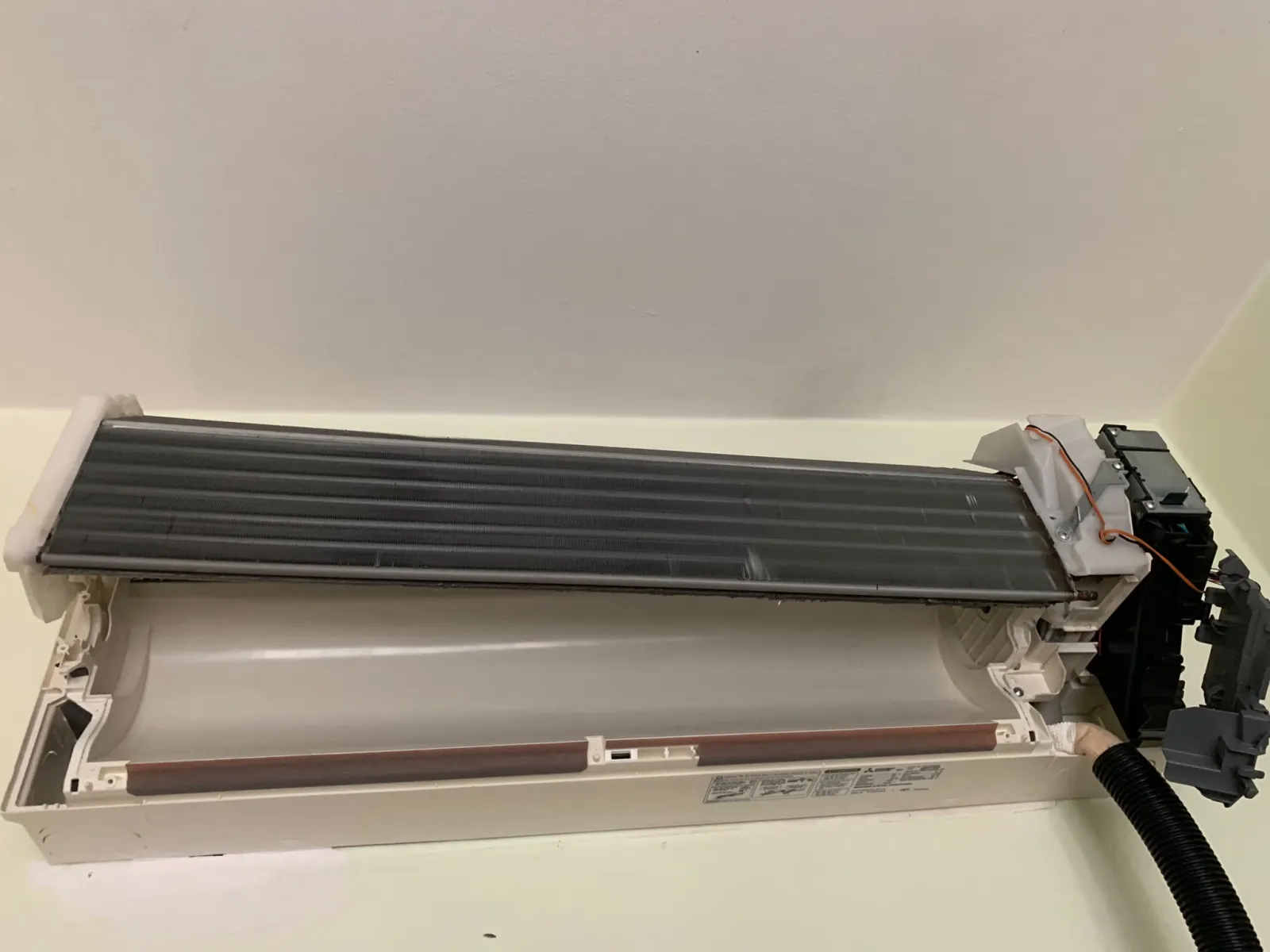
Coils corrode from the outside in. Years of condensate, cleaning chemicals and airborne acids attack the thin aluminium fins and the copper tubing threaded through them, and eventually produce a pinhole. Coil leaks are the ones people find hardest to accept, because there is nothing visible — the unit looks clean, and the gas is going out through a hole you could not see with the cover off.
Coils are also the reason a leak is sometimes discovered during a chemical overhaul rather than during a leak call: once the unit is dismantled, corrosion that was hidden behind the housing becomes obvious.
4. The condenser coil on the outdoor unit
Same mechanism, harsher environment. An outdoor unit sitting on an exposed ledge takes rain, sun and — on some estates — salt-laden air, and the fins corrode faster than anything indoors. Physical damage matters here too: a coil that was knocked during a renovation, or brushed by a ladder, can be leaking from a bent fin area that looks like nothing at all.
5. The interconnecting piping and its joints
The run between indoor and outdoor units should ideally be a single unbroken length of copper. It often is not. Long runs get joined, renovations force a re-route, and every brazed joint added is another candidate. Piping concealed inside a false ceiling or behind trunking is the least pleasant version of this problem, because finding the leak means opening finishes.
Older flats have a further complication: pipework installed decades ago may be thin-walled, badly insulated, or sized for a different refrigerant, which is why we usually recommend replacing the piping when a very old system is changed — the reasoning is set out in the guide to replacing aircon in older HDB flats.
Why "just top it up" gets expensive
Running a system low on refrigerant is not neutral. The compressor relies on returning refrigerant vapour for cooling and for carrying oil back around the loop. Undercharged, it runs hotter and drier than it was designed to, and it does that every hour the aircon is on. A compressor is the single most expensive component in the system; a slow leak that is fed rather than fixed is a bet against it.
There is a cost argument too. Our gas top-up prices are flat — R22 $115, R410A $130, R32 $170 — regardless of property type. Paying that twice a year to feed a flare joint that could have been remade is money spent on a symptom. The gas leak repair page sets out the full pricing.
What a leak repair actually costs
The honest answer is that it depends entirely on which of the five places above the gas is leaving, and that is why we test before quoting rather than after.
In most cases the repair costs only the flat top-up price, because the $45 visit and diagnosis fee is waived when you proceed — a flare remade or a valve core replaced is done during the same visit. Where the leak is in a coil or in concealed piping, the work is quoted upfront after the test, before anything is started. Unrelated faults found during the pre-check, such as drainage or electrical issues, are standard repairs from $80.
What we will not do is top up a system, say nothing, and let you find out in three months.
When a leaking unit is not worth repairing
Two situations change the maths. The first is a corroded evaporator or condenser coil on an older unit: coil replacement on an ageing system is often close enough to the cost of a new one that replacement is the better spend, particularly if the unit still runs R22. The second is a system that has leaked repeatedly at different points — that usually means the installation or the pipework is the problem rather than any single joint.
We would rather tell you that than sell a repair that buys a year. The replace or keep repairing guide sets out how we weigh it.
What you can check before calling anyone
- Look at the copper pipes at the indoor unit while it is running. Ice on the pipe or on part of the coil is a strong gas signal.
- Check whether the outdoor unit's valve caps are actually on.
- Note when it was last topped up. Twice in twelve months is a leak, not a coincidence.
- Check whether cooling faded gradually or stopped suddenly. Sudden is usually electrical or a fan; gradual is usually gas or fouling.
- Look for oil staining around the outdoor unit's connections — refrigerant carries oil, and a leak often leaves a residue.
None of that replaces a pressure test, but it tells you whether the conversation is about gas at all.
Tell us how often it has been topped up
That single number tells us more than anything else. Send us the system age, the refrigerant type if you know it, how many times it has been topped up and when, and whether the piping is concealed. We will tell you what the likely candidates are before we arrive, and the pressure test settles it on the day.
WhatsApp 9107 2601 about a gas leak check →
Related reading: top-up or leak repair? · what a gas top-up costs · why an aircon ices up · what a chemical wash cannot fix
Related: when the water is landing outside rather than on your floor, see aircon water dripping onto your neighbour's unit — who is expected to fix it, and the five faults that cause it.
A new leak that appears just after one fan coil was swapped usually starts at the joint made that day — see replacing one indoor unit in a System 3.