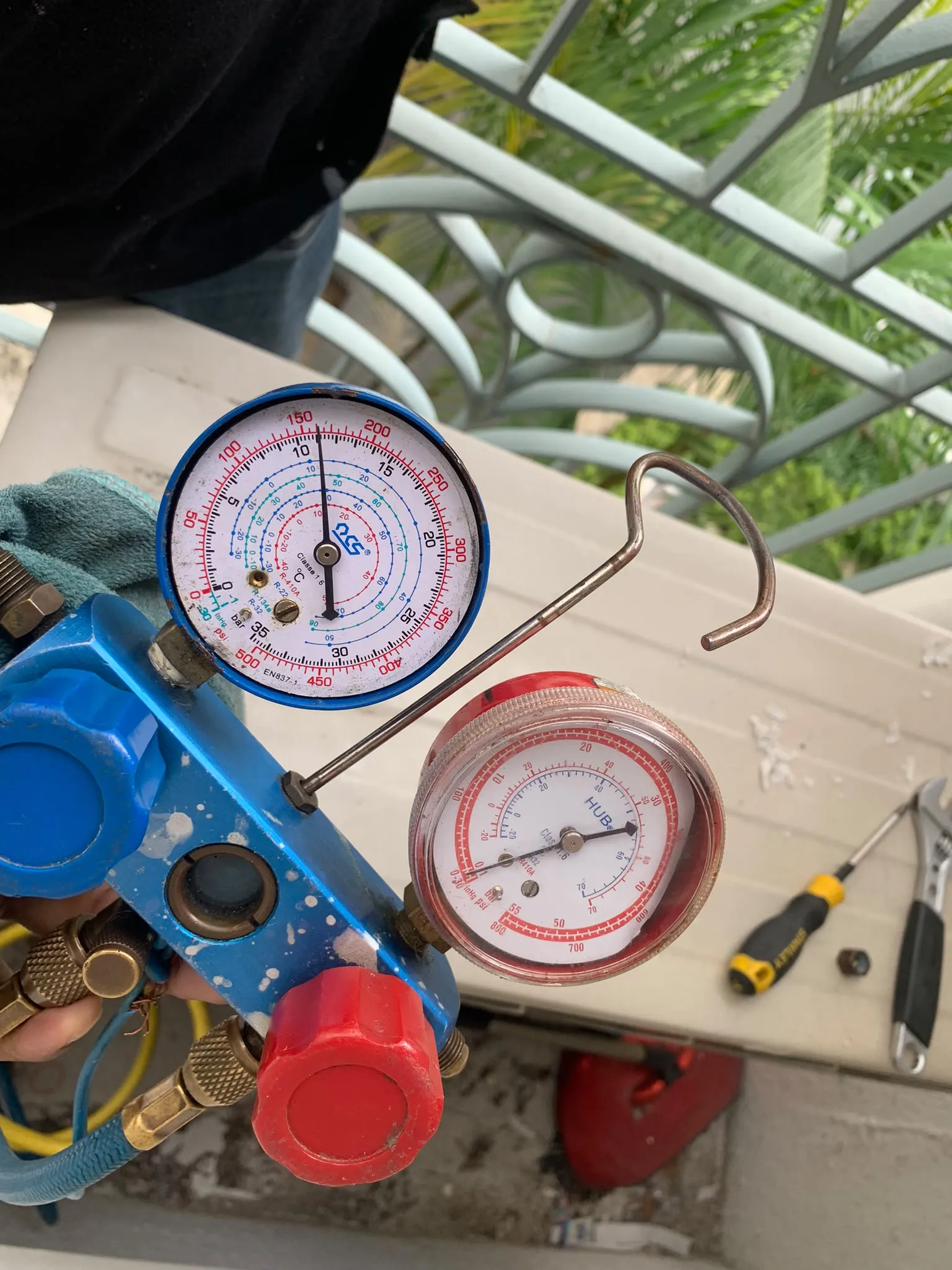
One of the three fan coils in your System 3 has stopped working. The other two are fine. The obvious question is whether you can just replace the broken one and leave the rest alone.
Sometimes you can. More often you cannot, and the reason has nothing to do with the fan coil itself. It is about what a System 3 actually is.
A System 3 is one system, not three
The name misleads people. A System 3 is one outdoor condenser connected to three indoor units through one refrigerant circuit. The three indoor units are not three aircons that happen to share a wall. They share gas, they share the compressor, and they share a control relationship with that specific outdoor unit.
That is why a fan coil is not a light bulb. Swapping one changes the system it sits in. Our note on how System 3, 4 and 5 differ covers the sizing side of that; this one is about what happens when a single unit in an existing system dies.
If you are still at the planning stage and deciding how many rooms should share one condenser in the first place, see one System 4 or two smaller systems.
The four things that decide it
1. Which refrigerant is in your system
This is the one that ends most conversations. Older Singapore systems run R22. A large middle generation runs R410A. Systems sold new today run R32. They are not interchangeable. They operate at different pressures, use different compressor oils, and require different service equipment.
If your condenser is charged with R410A and the replacement fan coil you have been offered is an R32 unit, that is not a job with a complication. It is the wrong part. You cannot put both refrigerants on one circuit, and you cannot simply refill an R410A condenser with R32.
Our published gas top-up prices are listed separately for R32, R410A and R22 for exactly this reason — they are three different jobs with three different materials, not three names for the same thing.
2. Whether the indoor unit matches the condenser
Indoor and outdoor units are sold as matched sets. The condenser's control board is designed around a particular indoor unit family, and the expansion device, sensor positions and communication protocol all belong to that pairing. Mixing brands on one circuit does not usually work, and where it appears to work, it works without any manufacturer standing behind it.
The practical problem is availability. If your system is eight years old, the exact model of that fan coil may no longer be made. Sometimes the manufacturer offers a current equivalent in the same family. Sometimes they do not, and that answer alone decides the question for you.
3. Whether the combination is still within what the condenser is rated for
A condenser is certified for a set of indoor-unit combinations, not for "any three units". Each indoor unit has a capacity, and the combination has to stay inside the range the outdoor unit was designed to serve.
This is where a quiet mistake gets made. A room that felt too warm gets a bigger fan coil than the one that failed, because it seems like a free upgrade while the wall is already open. The result is a system running outside its designed combination, and the usual symptom is not a dramatic failure — it is the other two rooms getting noticeably weaker.
4. How old the condenser is
If the outdoor unit is approaching the end of its service life, a new fan coil on an old condenser means the new part will outlive the system it was fitted to. You will pay for the fan coil now and for the whole system not long after, and the fan coil you paid for will very likely not be reusable with the replacement condenser.
That trade-off is the same one covered in when to replace your aircon versus keep repairing it, with the added twist that here you are not just repairing — you are buying a new component and attaching it to something old.
When replacing one unit is the right answer
It genuinely is, in a narrow set of cases:
- The system is young, and the same refrigerant and the same model family are still available
- The failure is physical and confined to that unit — a destroyed fan wheel, water damage from a leak above, a fried control board — rather than a symptom of the system as a whole
- The condenser and the remaining two indoor units test clean
- The capacity of the replacement matches what came out
If all four are true, replacing one unit is straightforward and sensible, and nobody should be pushing you towards a full system.
The step people do not price in
To change one fan coil, the refrigerant in the whole circuit has to be dealt with first. That means recovering the gas properly into a cylinder, or pumping it down into the condenser, before anything is opened. Then the new unit is connected, the joints are made, the circuit is pressure-tested and vacuumed, and the system is recharged.
Two things follow from that, and both matter to you:
All three rooms are down for the day, not one. The circuit is open. This is not a one-room inconvenience.
The gas is either recovered or released. Ask which. Venting refrigerant into the air is quick, free for whoever is doing it, and something you should not be paying someone to do. It is also the moment where a system that was never leaking acquires a leak, because a badly made flare joint at the new unit will surface weeks later as a system that is not cold. That failure pattern is set out in where refrigerant leaks actually happen.
The same applies to the copper. If the existing pipe run is old, it may need work rather than simply reconnecting — the issues around that are in replacing aircon in older HDB flats.
The honest arithmetic
People assume one of three units costs roughly a third of a system. It does not, and the reason is that most of the work is the same either way. The pump-down, the vacuum, the pressure test, the recharge, the trunking work and the commissioning happen whether you are changing one unit or three.
What is published on this site is the installation side: a new System 3 installation starts from $2,800, and the full price list is on the pricing page. A single-unit replacement is quoted on site, because the answer depends on the four questions above and on what we find when we look — not because we are being coy about it. What we can tell you before we come is that the gap between one unit and a full system is smaller than people expect, and that is the number worth having in front of you before you decide.
What to ask before you agree to anything
Whoever you use, these six questions will tell you quickly whether the person in front of you has thought about it:
- Which refrigerant is in my system now, and which does the replacement unit use?
- Is the replacement the same brand and model family as my condenser?
- Is the resulting combination still within what my condenser is rated for?
- Will the existing gas be recovered into a cylinder, or vented?
- Will the circuit be pressure-tested and vacuumed before it is recharged?
- What exactly is warranted after this, by whom, and for how long?
On that last one, keep the two halves separate in your head. The manufacturer warrants the new indoor unit. It does not warrant a compressor it did not supply, and it will not cover a compressor that failed because a mismatched unit was fitted upstream of it. The installer's workmanship warranty covers the installer's own work — on this site that is set out in full, and the published figure is a 90-day workmanship warranty on general servicing, chemical wash and chemical overhaul, and 2 years on a new installation.
What to do today
Before you call anyone, go and photograph two rating plates: the one on the side or underside of the failed indoor unit, and the one on the outdoor condenser. Between them they carry the model number, the serial number and the refrigerant type.
Those two photographs answer three of the four questions above before a technician has left his van, and they stop the conversation starting with a guess. If you still have the original invoice, photograph that too.
If you want us to look at it
Send us the two rating-plate photos with your enquiry and we will tell you honestly whether a single-unit replacement is on the table, before anyone comes out. If it is not, we would rather say so at that point than after the wall is open. Every booking includes the 9-point pre-check, and the fault is diagnosed before anything is quoted.
If a second-hand indoor unit has been offered to you as the cheap way to solve this, read what you are actually taking on with a used or reconditioned aircon first — matching is only the first of the questions.
WhatsApp us on 9107 2601 — usually a reply within five minutes.
Adding a unit rather than replacing one has the same starting question — whether the outdoor condenser has spare capacity. See adding an extra aircon unit to an existing system.