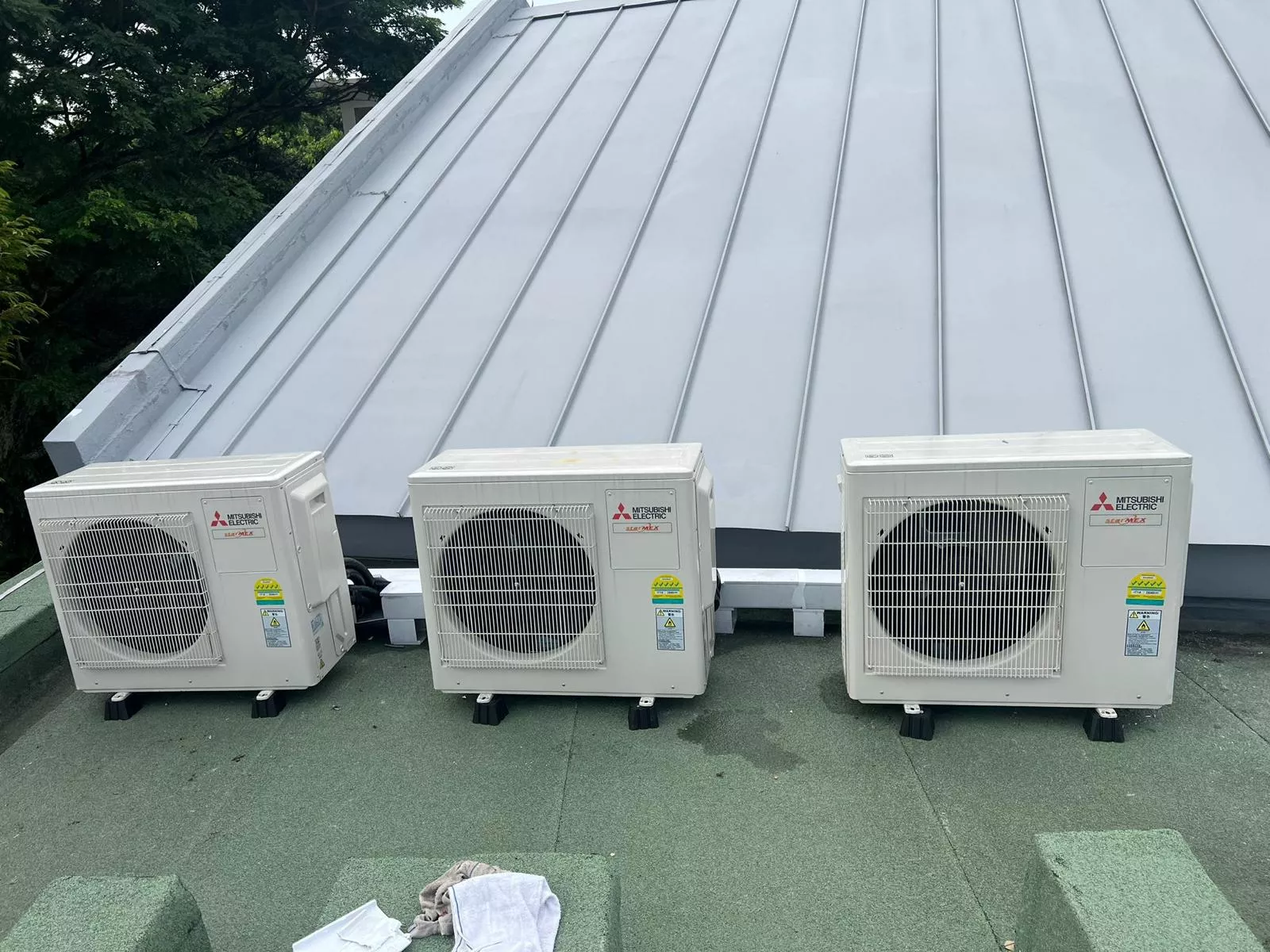
A store room turned into a home office, a spare bedroom that finally gets used, an extension at the back of a landed house — and the room has no aircon. The first idea is usually the cheapest-sounding one: just add one more indoor unit to the outdoor condenser that is already there. Sometimes that is exactly right. Sometimes it is not possible without extra work, and the two situations look identical from inside the room. The difference is on the roof or the ledge, not in the floor plan.
Why the answer is "check the outdoor unit," not "yes" or "no"
A multi-split system is one outdoor condenser feeding a fixed number of indoor units through one refrigerant circuit. That number is built into the unit at the factory — it is what "System 2," "System 3" and "System 4" actually mean. As covered in our guide to one System 4 versus two smaller systems, a System 4 cannot take a fifth indoor unit later, full stop, because the condenser was never built to run five. A System 3 running three units has zero spare capacity for the same reason. So the real question is not "can I add a unit" — it is "was my outdoor unit bought bigger than what is currently connected."
That happens more often than people expect. Some owners deliberately install a System 3 while only fitting out two rooms at first, planning to finish the third room later. Others buy exactly what they need with nothing spare. Both look the same from inside the flat — two or three indoor units on the walls — and the only way to tell them apart is to look at the outdoor unit itself.
How to tell if you actually have spare capacity
The outdoor condenser carries a data plate (usually on the side or back) with the model number and the maximum number of indoor units it is rated for. Compare that against how many indoor units are actually connected today. If the model number corresponds to a System 4 and only three rooms are cooled, there is a real spare port. If the model matches the number of rooms already running, there is none.
Reading the plate yourself is a useful first check, but it does not settle the whole question. Two things still need a technician on site: whether the existing piping route can reach the new room without an unusually long run, and whether the total cooling capacity is enough to share across one more room without every room losing performance when they all run at once — the same capacity math covered in our BTU sizing guide. A free site survey is where both get checked properly, and it is the same free survey aircons.sg offers for any new installation.
If there is spare capacity
Connecting a new indoor unit to a genuinely spare port is real work, not a five-minute job: a new fan coil mounted and levelled, a refrigerant line run from the outdoor unit to the new room, drainage with a continuous fall, an electrical connection, then a vacuum, leak test and gas charge before the whole system is tested together, not just the new unit on its own. Extra copper piping beyond a standard run, concealed trunking, or a new electrical point are all quoted upfront at the free site survey — the same rule that applies to any aircons.sg installation, so there is nothing added after the fact.
If there is no spare capacity — two real options
When the data plate shows the condenser is already maxed out, adding a unit "onto" the existing system is not on the table. There are two honest alternatives, and which one makes sense depends on the property, not on which sounds simpler:
- Replace the outdoor condenser with a bigger one — for example swapping a maxed-out System 3 for a System 4, keeping the existing indoor units and adding the new one. This is treated as a fresh installation of that system size, priced from the same published table as any new install: standard inverter System 4 from $3,500, premium tier from $4,500. The old condenser and its piping are assessed at the survey to see what can be reused.
- Install a separate single split for just the new room, with its own small outdoor unit, from $1,200 standard inverter or $1,500 premium. This is usually the simpler and cheaper route when there is ledge or wall space for one more condenser, and it means the existing system for the other rooms is never touched or interrupted.
Neither of these is a number this article can hand you without seeing the property — the site survey is what turns either option into a firm, final quote.
Where a second outdoor unit can go — and where it cannot
If the single-split route is the plan, the next question is whether a second condenser actually fits. In an HDB flat, every outdoor unit must sit on the flat's designated aircon ledge, on proper brackets — not the roof, and not the common corridor, in most blocks. Whether a second unit fits on that same ledge, or whether the ledge is already full, is exactly the kind of thing the free site survey checks rather than something to assume from the floor plan. Condo MCSTs can fix where condensers are allowed to sit, which is a separate check from the HDB rule. A landed house has no designated ledge and no fixed unit limit, which is why adding a unit there is usually the most flexible of the three property types, though condenser spacing, airflow and drainage still have to be worked out properly rather than squeezed in wherever there is a gap.
Who is allowed to do this work
For HDB flats, the work has to be carried out by a BCA-licensed contractor following HDB's placement rules — DIY or unlicensed installation can breach those rules and void the manufacturer's warranty on top of that, which turns a straightforward add-on into an expensive mistake if it is ever picked up later. This applies whether you are adding to a spare port or fitting a whole new condenser.
It does not matter who installed the original system
None of this depends on who put in the existing system. aircons.sg's installation work is brand-agnostic — units bought elsewhere, or installed by a different company originally, can still have a unit added by aircons.sg. What changes is the warranty: the new indoor unit and the new work carry aircons.sg's own 2-year installation workmanship warranty, plus the manufacturer's 5-year compressor warranty on any new unit supplied. That covers what was just installed. It does not retroactively extend to the existing outdoor unit or the rooms that were already running before the new work — those keep whatever warranty status they already had.
What to have ready for the free site survey
- A photo of the outdoor unit's data plate, or at least its model number.
- How many indoor units are connected to it right now.
- Which room needs cooling, and roughly how far it is from the existing outdoor unit or ledge.
- Property type — HDB, condo or landed — since the placement rules differ.
- Whether there is visible ledge, wall or roof space near the room for a second outdoor unit, in case that turns out to be the better route.
Bring that much and the survey settles the rest: whether the existing condenser has a genuine spare port, what the piping run to the new room actually involves, and which of the two options above comes out cheaper and less disruptive for that specific property.