It shows up on Carousell, in a reconditioned-aircon shop, or as an offer from a friend moving out: a System 3, barely used, a few hundred dollars, come and collect. Against a new installation, which we publish at from $2,800 for a System 3, the arithmetic looks unanswerable.
It is answerable. Not because second-hand aircon is a scam — there are situations where it is a sensible decision, and we will come to them — but because the advertised number covers one part of a job that has four parts, and the three unpriced parts are where the money and the risk sit.
You are buying hardware, not a working aircon
An aircon is not an appliance you plug in. Between the unit sitting on the seller's ledge and cold air coming out of yours, there is a removal, a set of copper pipes, a drain line, an electrical connection, a vacuum and a gas charge — which is to say, most of an installation. The seller's price stops at the first of those.
So the honest comparison is never "$400 versus $2,800". It is "$400 plus installation plus whatever this unit needs" versus "$2,800 for a new system, installed, under warranty". Once the comparison is written that way, some deals survive it and most do not.
The plate on the outdoor unit tells you more than the seller will
Before agreeing to anything, photograph the data plate on the outdoor unit. It carries the model number, the capacity and the refrigerant, and unlike everything else in the conversation it cannot be presented favourably.
The refrigerant line will read R32, R410A or R22. We publish a top-up price for all three — $170, $130 and $115 respectively — so none of them is a dead end today. But they are not interchangeable, they belong to different generations of equipment, and a unit running R22 is telling you plainly that it is the oldest of the three. If the reason it is being sold is that it keeps losing gas, you are buying the leak, not the unit. We have written separately on what the three refrigerants mean in practice, and on where refrigerant actually escapes from.
The capacity matters just as much, and is the thing buyers skip. A unit that was correctly sized for the seller's bedroom is not automatically correct for yours. Undersized, it runs continuously and never quite gets there; oversized, it short-cycles and leaves the room cold and damp.
The warranty is the part that does not transfer
This is the single biggest difference between new and second-hand, and it is worth being blunt about it.
When we install a new system, two separate covers apply. There is our own 2-year workmanship warranty on the installation — the piping, the brackets, the drainage, the connections, the things that are our doing. And there is the manufacturer's 5-year compressor warranty on the units themselves, which is the expensive component and the one nobody wants to gamble on.
Neither of those follows a second-hand unit to a new owner. The manufacturer's cover is attached to the original purchase and the original installation. And no installer, ourselves included, will warrant a compressor they did not supply and cannot vouch for — we can stand behind our own workmanship on the pipes and the mounting, and that is genuinely all it is possible to stand behind. If the compressor dies six weeks in, there is nobody to call.
People sometimes assume a workmanship warranty covers the whole installation including the hardware. It does not, and the distinction matters far more on a used unit than a new one. What a workmanship warranty actually covers goes through the boundary in detail.
What the coil has been doing for eight years
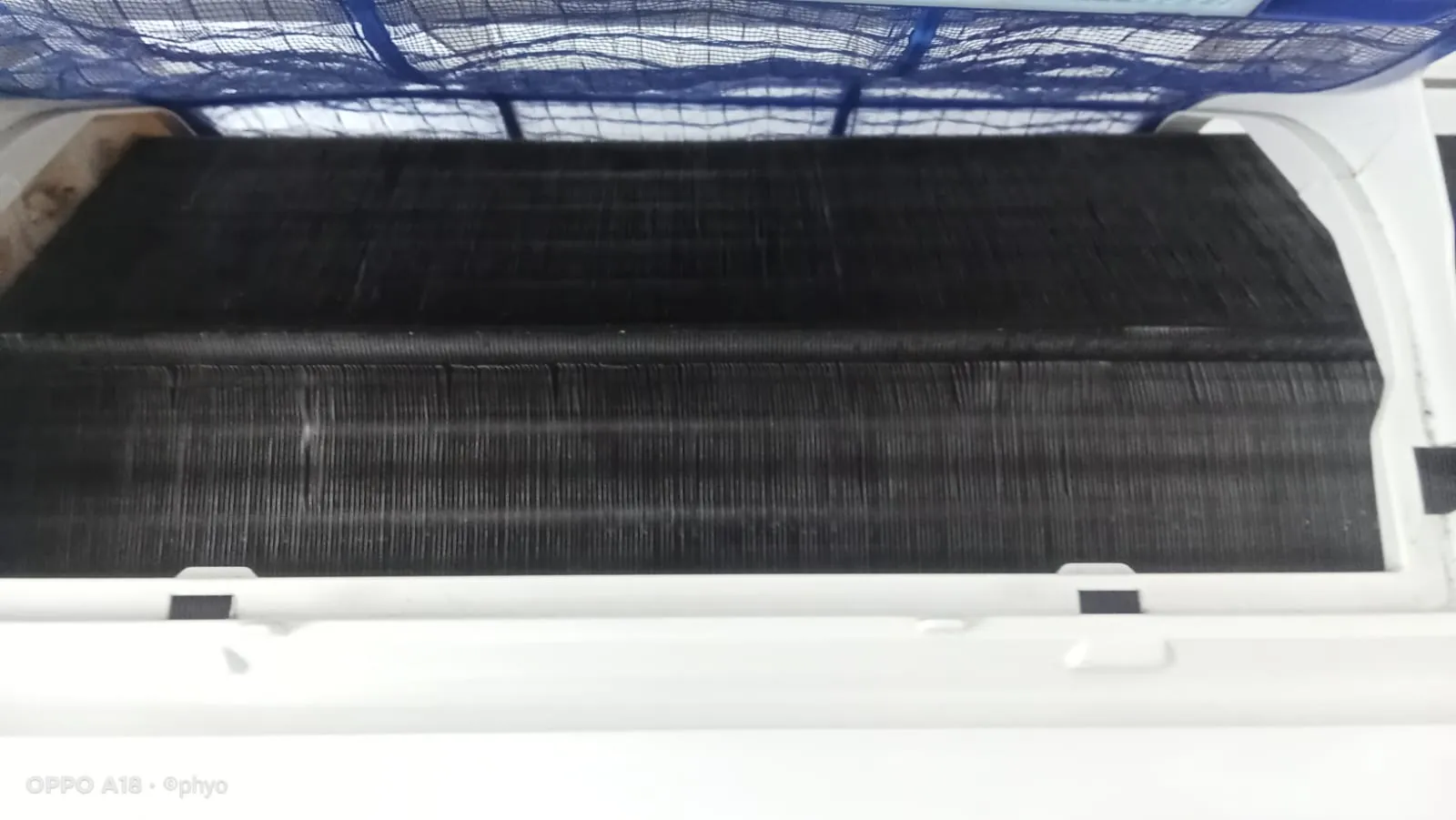
The photograph at the top of this article is an evaporator coil in a unit that was still running and still cooling, after a fashion. That black surface is years of dust and biofilm packed into the fins. Nothing about the unit's outward appearance announced it.
This is what you cannot assess from a listing photo, and it is why a second-hand unit should be seen running, in the seller's home, before money changes hands. Ask to feel the airflow. Ask when it was last serviced and whether it has ever had a chemical wash. Look at the fins with a torch. If the seller will not allow the unit to be inspected while it is still installed, that refusal is itself the answer.
Where a unit does need putting right, our published prices give you the figure to add to the deal: a chemical wash at $135 for one unit, or a chemical overhaul at $200 where the fan barrel and drain tray need stripping as well. Add a gas charge if it has lost pressure. A $400 unit that needs an overhaul and a top-up in its first fortnight has quietly become a $700 unit with no warranty.
The piping assumption that breaks budgets
Buyers of second-hand units almost always assume the copper already in their wall can be reused. Sometimes it can. Often it cannot, and it is not a judgement that can be made from the ground.
Existing piping may be the wrong diameter for the new unit's capacity. It may have been run with an inadequate drainage fall, which is the defect that produces water down the wall a year later. It may not have been properly flushed when the previous unit came out. Where none of that can be verified, the correct answer is new piping — and new piping is a large share of what an installation costs, which removes most of the saving that motivated the purchase.
This is also why a used unit and a renovation are a poor combination. In a renovation the first fix has to be right before the ceiling closes, and building that around hardware of unknown condition is a bad trade. Getting the aircon sequence right in a renovation covers why.
When a second-hand unit is a reasonable decision
There are cases, and they have a shape in common: short horizon, low stakes, or a matching problem.
- A landlord fitting out a unit for a short tenancy, where the aircon needs to work for a defined period rather than a decade.
- One room in a house that is otherwise fine — a study, a store room, a rarely used guest room — where failure is an inconvenience rather than a problem.
- Matching an existing system. If one indoor unit on a System 3 has failed and the model is no longer sold, a used unit of the same model can be the only way to avoid replacing the whole system. That is a genuinely good reason, and the constraints are set out in replacing one indoor unit on a System 3.
What these have in common is that nobody is relying on the unit to be the household's main cooling for the next ten years. Where that reliance does exist, the missing warranty stops being a technicality.
The five questions to ask before you agree
- What is on the outdoor unit's data plate? Model, capacity, refrigerant. Ask for a photograph, not a description.
- Can I see it running before it is removed? A seller with nothing to hide will say yes.
- Why is it being sold? Moving house is a reason. "It just needs a top-up" is a symptom.
- Are the indoor and outdoor units a matched set from the same installation? Mixed units are a different and harder job.
- Who is removing it, and who carries the risk if it is damaged coming off the wall? Settle this before, not after.
If the answers are good and the unit is young, a second-hand purchase can work out. If two or more of them are vague, the saving is being borrowed against a future repair bill.
The honest position
We install new systems and we also service and repair whatever is already on the wall, including units we did not supply, so we have no particular interest in talking anyone out of a bargain. What we do see, regularly, is the second half of this story: a unit bought cheaply, installed, and needing an overhaul, a gas charge and eventually a compressor, with no warranty behind any of it.
The test is simple. Write down the unit price, the installation, the likely first service, and the value of the two warranties you are giving up. If that total is still comfortably under a new installation, it is a real saving. If it is close, it is not a saving — it is the same money with the risk moved onto you.
Send us the plate photograph and what you have been offered and we will tell you which of the two it is, with no obligation either way. WhatsApp us on 9107 2601 — usually a reply within five minutes.