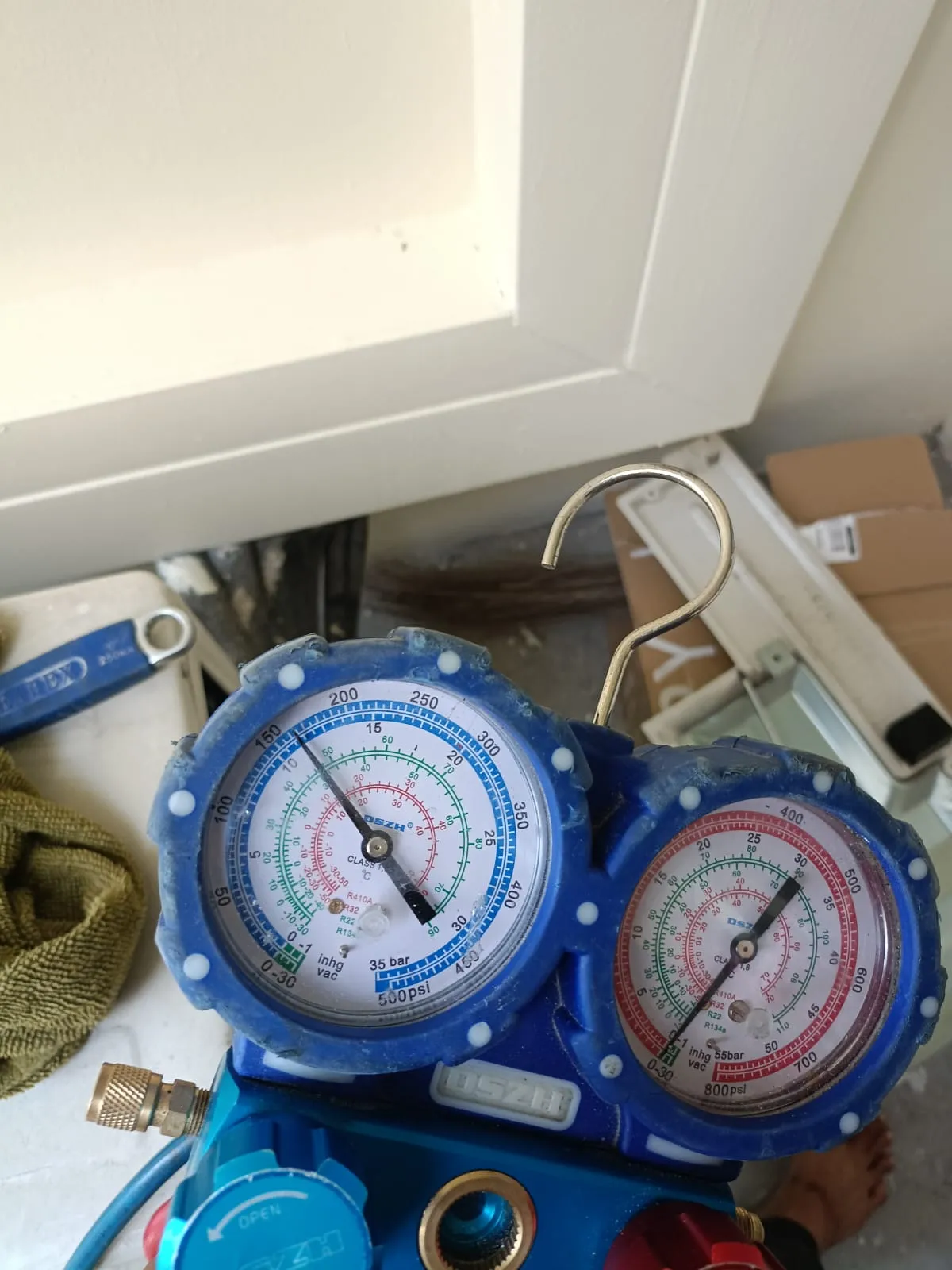
Every few months someone asks us the same question in almost the same words: "I'm moving out next month — can I bring my aircon with me?" The unit is three years old, it cost a few thousand dollars, and leaving it screwed to a wall for the next occupant feels like throwing money away.
The honest answer is yes, technically, almost always. The useful answer is that whether you should depends on four things, and most people only find out about them after the unit is already off the wall and sitting in a lorry.
What a relocation actually is
People say "move the aircon" as if it were a wardrobe. It is not one job, it is two, separated by a period in which nothing works and everything is vulnerable.
The dismantle. The refrigerant in the system has to be recovered into the outdoor unit before anything is opened — a pump-down. The pipe ends are then cut and sealed so that air and moisture cannot get in. Indoor units come off their brackets, the outdoor unit off its ledge, the drainage is disconnected and the trunking usually comes off the wall in pieces. The old pipe run stays in the wall or gets pulled out, depending on what the new owner or the landlord wants.
The reinstall. At the new place this is a fresh installation in every respect except that you already own the equipment. New pipe run, new brackets, new drainage fall, new electrical connection, then a pressure test, a vacuum, and only then the refrigerant released back into the system.
Two site visits, two lots of labour, and materials that mostly do not travel between the two addresses. That last point is where the surprise lives.
The four things that decide whether it is worth it
1. How old the unit is
An aircon that is one or two years old, still under warranty and running well is usually worth moving. One that is eight or nine years old, has already needed a gas top-up and sounds tired is usually not — you are paying installation labour on a machine that may need replacing within a year or two of arriving. We wrote about where that line falls in how long an aircon should last in Singapore, and the decision framework in when to replace versus keep repairing applies here almost unchanged.
2. Whether the new place can take it
This is the one that catches people. A System 3 that suited a four-room flat does not automatically suit the next home. Ask, before you commit to moving anything:
- Is there a ledge or condenser space, and is it approved for the size and weight? HDB has rules about where a condenser may sit, and a condo has its own. Our guide to the HDB aircon ledge covers what to check.
- Does the number of indoor units match the number of rooms you want cooled? A System 3 is three indoor units and one outdoor unit sized for that combination. You cannot simply add a fourth indoor unit later because the new flat has an extra bedroom.
- Are the room sizes similar? A unit sized for a small bedroom will struggle in a bigger, west-facing living room, and an oversized unit in a small room cools fast and leaves the air clammy. That is the whole argument in our BTU sizing guide, and it does not stop applying just because you already own the machine.
- Is it a condominium? Many MCSTs require an approved contractor, a work permit and specific working hours before anyone touches a facade or a ledge. That is covered in condo servicing and MCST rules.
3. What actually gets reused
The equipment travels. Most of the installation does not.
Copper piping is cut to the length of the old route. Even if it survives removal without kinking, it is now the wrong length and has been open to the air. Insulation is usually damaged coming off. Trunking is cut to the old walls. Brackets are drilled into the old ledge. The drainage pipe is cut to the old fall. Refrigerant is lost in small amounts at every disconnection, so the system almost always needs topping up on the other side.
In practice, a relocation is priced as a dismantle plus a near-complete installation, using your equipment instead of new equipment. It is cheaper than buying a new system. It is nothing like as cheap as "just moving it".
4. Whether you actually own it
If you are renting, the aircon is almost certainly the landlord's, even if you paid for servicing throughout the tenancy — and taking it would be removing a fixture. If you installed one yourself with permission, get the arrangement in writing before you plan around it. We set out who owns and who pays what in aircon servicing in a rental: tenant or landlord.
If you are selling a flat, the aircon is usually part of the sale unless it is excluded in the option or the inventory list. Take it out after the buyer has seen it working and you have a dispute, not a saving.
What goes wrong, and why
The unit is dismantled without a pump-down. If the refrigerant is simply vented and the pipes left open, moisture and air get into a system designed to contain neither. The result shows up weeks later at the new place as poor cooling, ice, or a compressor that works far harder than it should. This is the single most common thing done badly in a rushed move.
Nobody pressure-tests the new pipe run. A relocated system has more joints than a new one, and every joint is a potential leak. Skipping the pressure test and the vacuum saves an hour and creates a slow leak that costs a gas top-up every few months. The symptoms are exactly the ones in gas top-up or leak repair, and they are avoidable.
The moving date and the renovation date collide. The aircon has to go in after the ceiling and the wall finishes are done, but the pipe route has to be decided before they are closed up. Deciding the aircon at handover means either chasing walls that were just painted or running exposed trunking you did not want.
The old flat is left with a hole and a stub of pipe. Making good after removal is somebody's job. Agree in advance whether it is yours, and whether "making good" means sealing the sleeve or patching and painting.
Nobody serviced it before it moved. A unit that has been running for years is far easier to reinstate properly if the coil and blower are cleaned while it is off the wall and accessible. Doing it later means opening the unit all over again.
The sequence that works
- Decide, honestly, whether the unit is worth moving — age, condition, and whether it fits the next home.
- Have the new place surveyed before you book the removal. Ledge, pipe route, electrical point, drainage fall.
- Book both halves with the same contractor if you can. When one party dismantles and another reinstalls, every fault afterwards is somebody else's fault.
- Service the unit while it is off the wall.
- Insist on a pump-down at the old address, and a pressure test and vacuum at the new one. Ask for it in the quotation, not on the day.
- Run it for an hour before the technician leaves, and check that it cools and drains without dripping.
When to buy new instead
If the system is well past the halfway point of its life, if the new home needs a different number of indoor units, or if the fit-out is already opening walls and ceilings, buying new is often the better answer — you get a warranty, a system sized for the rooms you actually have, and a pipe route designed for the new place rather than inherited from the old one. Our installation cost guide and what a standard installation includes set out what that involves.
And if the old unit is genuinely fine, the sensible answer is the boring one: move it, but treat the reinstall as a real installation rather than a favour.
Tell us about the move
Send us the two addresses, the system type and roughly how old it is, and we will tell you straight whether moving it is worth the labour. A site survey is free, and it is far cheaper to find out that the new place cannot take the unit before it comes off the wall than after.
WhatsApp 9107 2601 about relocating your aircon →
Related reading: what a standard installation includes · replace or keep repairing · tenant or landlord: who pays
Before anything comes off the wall at either address, it is worth knowing when a condenser bracket has to be replaced.