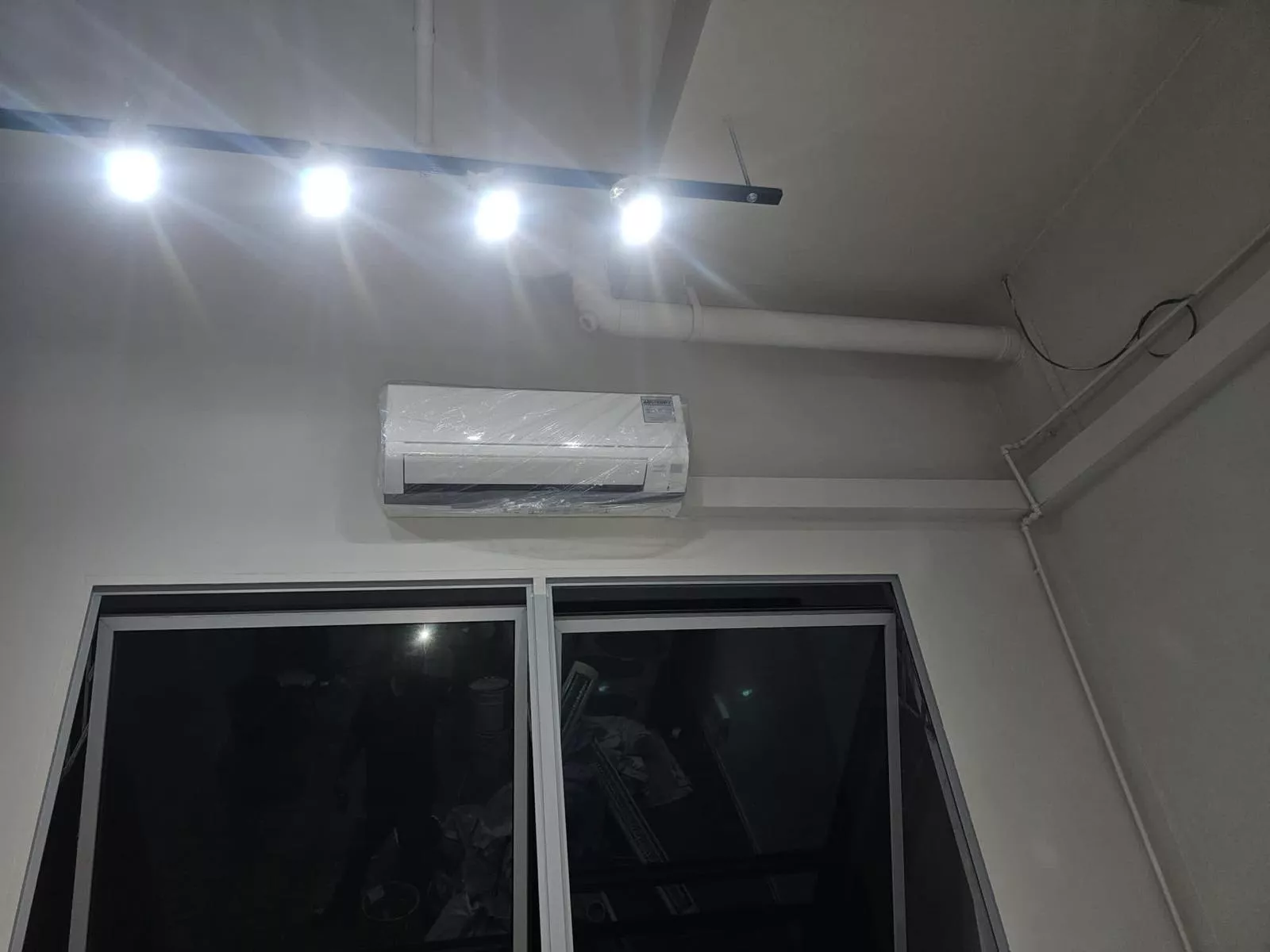
If your aircon is not cooling or blowing warm air, the most common cause is low refrigerant — either from normal depletion (which happens slowly over 2–4 years) or a leak (which recurs within weeks). A gas top-up costs $115–$170 per outdoor circuit (not per indoor unit) in Singapore depending on refrigerant, and takes about 20 minutes; if there is a leak and a dedicated pressure test is needed, it is $180 per FCU, piping replacement is HDB $520 per fan coil unit, or condo $700 per fan coil unit, and joint repairs, coil repair and concealed pipe work are quoted after the test. The five tell-tale signs are: weak cooling despite low temperature setting, ice on the indoor unit coil or pipes, hissing sounds near the outdoor compressor, higher electricity bills without increased usage, and the compressor running continuously without cutting off.
The Five Clear Signs Your Aircon Is Low on Refrigerant
Refrigerant does not 'run out' like petrol. A sealed aircon system should hold its gas indefinitely. If levels drop, it is either a slow leak (pinhole in copper pipe, flare-nut corrosion, brazed joint failure) or years of minor losses through service valve caps and connections. Here is what you will notice:
1. Room Temperature Stays High Even at 16°C Setting
You set the thermostat to 16°C or 18°C, the fan runs, but the room never cools below 26°C or 27°C. This is the single most reported symptom. Low refrigerant means the evaporator coil cannot absorb enough heat, so the air passing over it barely chills. If the aircon used to cool the room to 22°C within 15 minutes and now takes an hour or never reaches target, suspect low gas first — especially if the filter is clean and airflow is strong.
2. Ice or Frost Buildup on Indoor Unit Coil or Copper Pipes
Counterintuitively, low refrigerant can cause freezing on the evaporator coil. When gas pressure drops below design spec (typically 65–75 psi for R410A at 25°C ambient), the remaining refrigerant evaporates too early in the coil, creating an ice patch. You will see white frost on the copper pipes entering the indoor unit, or the entire coil may ice over and drip water continuously even when the aircon is off. This is not a drainage problem — it is a refrigerant problem.
3. Hissing, Bubbling or Gurgling Sounds from Outdoor Unit
A healthy compressor hums steadily. If you hear a hiss (like air escaping a tyre) near the compressor, service valves, or flare nuts, refrigerant is leaking. Bubbling or gurgling inside the outdoor unit suggests the system is trying to circulate liquid and vapour unevenly because total charge is low. These sounds are loudest when the compressor first starts or shuts down. Do not ignore them — a leak will worsen, and running the aircon with very low gas can burn out the compressor (a costly repair quoted after diagnosis).
4. Electricity Bill Rises Without Extra Usage
An aircon low on gas runs longer to attempt the same cooling. The compressor does not cut off because the thermostat never reaches setpoint, so you pay for continuous runtime. One customer in Clementi reported her monthly bill jumped from $110 to $160 over three months; after a gas top-up (leak was a loose service-valve cap), the bill returned to $115 the following month. Check your bill history — a 20–30% increase with no lifestyle change is a red flag.
5. Compressor Runs Non-Stop Without Cycling Off
Inverter aircons modulate speed, but even they should reduce compressor speed or pause briefly once target temperature is reached. Non-inverter units cycle on and off every 8–12 minutes in steady-state. If the compressor never stops and the room never cools, the system is starved of refrigerant. The thermostat keeps calling for cooling, the compressor obliges, but without enough gas the heat-exchange cycle cannot complete.
Gas Top-Up vs Leak Repair: What's the Difference and When You Need Each
Many homeowners book a 'gas top-up' assuming it is a routine task, like topping up engine oil. It is not. Refrigerant should last years. If you need a top-up more than once every two to three years, you have a leak — and topping up without fixing the leak is throwing money away.
What a Standard Gas Top-Up Involves
A gas top-up (also called a refrigerant recharge or regas) takes 15–25 minutes per unit. The technician:
- Connects a manifold gauge set to the outdoor unit service valves to measure current pressure (low-side and high-side).
- Compares readings against the refrigerant type and ambient temperature chart (e.g., R410A should read ~120 psi low-side, ~280 psi high-side at 30°C ambient when running).
- Adds refrigerant from a cylinder in small increments (50–100 g at a time for split units, 200–500 g for multi-split or cassette) while monitoring pressure and superheat.
- Runs the aircon for 5–10 minutes to verify stable pressure and cooling performance.
Cost in Singapore: $115–$170 per outdoor circuit, by refrigerant (R22 $115, R410A $130, R32 $170). The price is charged per outdoor circuit, not per indoor unit, and covers the visit, labour, and gas. Quoted prices are final.
When a Leak Repair Is Necessary
If the aircon was recently topped up (within the past 12 months) and is low again, you have a leak. Common leak sites:
- Flare-nut joints at the outdoor unit service valves (especially if over-tightened during previous servicing).
- Brazed joints where copper pipes were welded during installation — vibration or poor workmanship can crack the solder.
- Evaporator coil pinhole leaks from internal corrosion (more common in coastal or high-humidity units, or if condensate was acidic due to mould).
- Condenser coil damage from external impact (e.g., pressure-washer during façade cleaning, or aircon bracket shifted and pipes bent).
A proper leak repair includes:
- Leak detection: electronic sniffer tool, UV dye tracer, or soap-bubble test at suspected joints.
- System evacuation: remaining refrigerant is recovered (not vented to atmosphere — venting is illegal under NEA guidelines).
- Repair: re-flare and re-tighten nut, re-braze joint, or replace section of pipe. Coil leaks sometimes require coil replacement.
- Vacuum test: system is evacuated to ~500 microns and held for 15–30 minutes to confirm no moisture or air remains.
- Pressure test: system is pressurised with nitrogen to 400–450 psi and left for 30 minutes; pressure must not drop.
- Recharge: correct amount of refrigerant is added by weight or subcooling method.
Cost: the gas top-up is a flat price (R22 $115 / R410A $130 / R32 $170). If a dedicated pressure test is required it is $180 per FCU, and piping replacement is HDB $520 per fan coil unit, or condo $700 per fan coil unit; joint repairs, coil repair and concealed pipe work are quoted after the test (see /aircon-gas-leak-repair-cost). If the fix is a top-up, that flat price is all you pay.
How Often Should You Need a Gas Top-Up?
| Scenario | Expected Interval | Action |
|---|---|---|
| New installation, no leaks | 3–5 years | Top-up only if cooling degrades |
| Older system (>8 years), minor seal wear | 2–3 years | Top-up; monitor next year |
| Top-up needed again within 12 months | N/A | Leak repair mandatory |
| Coastal unit or high-floor exposure | 2–3 years | Check coil corrosion annually |
What Technicians Check During the 9-Point Pre-Check (Included with Every Aircons.sg Service Booking)
When you book a standard aircon service with aircons.sg (minimum $55 for one unit), the technician performs a 9-point pre-check before and after servicing. This inspection catches low refrigerant and other issues transparently, so you know exactly what is wrong and what it will cost to fix — no surprise charges.
Refrigerant Pressure and Superheat Test
The technician connects gauges to measure low-side and high-side pressure, then calculates superheat (the difference between actual suction-line temperature and the saturation temperature for that pressure). Correct superheat for R410A is 8–12°C; for R32, 5–10°C. Low superheat or low pressure confirms undercharge. High superheat suggests a restriction (blocked filter-drier or capillary tube) or severe undercharge.
Amperage Draw on Compressor
A clamp meter measures compressor current. A 1.0 HP non-inverter compressor should draw 4–6 A when running; if it draws 2–3 A, the system is undercharged and the compressor is not working hard enough (ironically, this will eventually overheat the motor because there is insufficient refrigerant to cool it internally). High draw (>7 A) suggests overcharge, a seized fan, or a failing compressor.
Evaporator Coil and Pipe Inspection for Ice
The technician opens the front panel and checks the coil for frost or ice. If present, the filter is checked first (a clogged filter can also cause icing). If the filter is clean and ice is still there, low refrigerant is the cause. The service is paused, the aircon is turned off to let ice melt, and a top-up or leak repair is quoted.
Visual and Soap-Bubble Leak Check at Service Valves
Flare nuts and service-valve caps are inspected. A soapy water spray on joints will bubble if gas is escaping. Most leaks at the outdoor unit are at these points because caps are left loose or washers have degraded. Tightening or replacing the cap and washer often solves the problem; a top-up is then done to restore pressure.
Condensate Drainage and pH Check
Acidic condensate (pH below 6) can corrode the evaporator coil from the inside, eventually causing pinhole leaks. The technician collects a drip sample and tests with pH paper. If acidic, a chemical overhaul (not just a standard service) is recommended to remove mould and biofilm that produce the acid.
If any issue is found, the technician explains it on-site, shows you the gauge readings or the ice buildup, and provides a fixed-price quote. If you approve the additional work (e.g., gas top-up, leak repair, chemical wash), the $55 service fee is part of the total cost. If you decline, the $55 covers the visit and diagnosis, and no further charge is made.
DIY Checks You Can Do Before Calling a Technician
You cannot measure refrigerant pressure yourself without a manifold gauge set, but you can rule out simpler causes and gather information that speeds up the technician's diagnosis.
Check and Clean the Air Filter
A clogged filter cuts airflow by 40–60%, which can mimic low-gas symptoms (weak cooling, ice on coil). Remove the filter, hold it up to light — if you cannot see through it clearly, wash it with soapy water, rinse, and dry completely. Reinstall and run the aircon for 30 minutes. If cooling improves, the filter was the problem. If not, suspect refrigerant.
Inspect the Outdoor Unit Fan
Go to the outdoor compressor. Is the fan spinning when the aircon is on? If the fan is off or spinning slowly, the compressor will overheat and the system will not condense refrigerant properly, causing high head pressure and poor cooling. Fan-motor replacement is a separate repair, quoted after the pre-check, and takes about 30 minutes. This is not a gas issue, but it is often confused for one.
Feel the Copper Pipes at the Outdoor Unit
When the aircon is running, the larger copper pipe (suction line, coming from the indoor unit back to the compressor) should feel cool and slightly damp (condensation). The smaller pipe (liquid line, going from compressor to indoor unit) should feel warm. If the large pipe is warm or at room temperature, refrigerant is low. If both pipes are very hot, the system is overcharged or the compressor is failing.
Listen for Unusual Sounds
Stand near the outdoor unit for one minute. A healthy compressor hums steadily with a low whirr from the fan. Hissing, bubbling, clicking, or rattling are abnormal. Record a short video on your phone — the technician can often pre-diagnose from audio.
Common Mistakes That Waste Money and Delay the Real Fix
Booking Repeated Top-Ups Without a Leak Test
Some contractors will top up your gas every six months without questioning why it is low. You pay the flat top-up rate ($115–$170 per outdoor circuit) each time, and within months the problem returns. After three top-ups you have paid three times over and still have a leak. Fixing the leak once—quoted after the pre-check, with most leaks costing only the flat top-up—would have solved it permanently. Always ask: 'Why is the gas low?' If the answer is vague ('gas depletes naturally'), push for a leak test or book with a contractor who includes diagnostics.
Topping Up Gas Without Cleaning the Coil
If the evaporator coil is clogged with dust and mould, adding refrigerant will not restore full cooling because airflow is still restricted. The correct sequence is: clean the coil (standard service or chemical wash), then check refrigerant. Many technicians do it backwards, top up first, and the customer is disappointed when cooling is only marginally better.
Using the Wrong Refrigerant Type
R410A, R32, and R22 are not interchangeable. Mixing them damages the compressor and contaminates the system. Some older or careless technicians will top up an R410A system with R22 because 'it is cheaper' — this voids any warranty and can cause a compressor burnout within weeks. Always confirm the refrigerant type on the outdoor-unit nameplate and ensure the technician uses a dedicated cylinder and hose set for that gas.
Ignoring MCST or HDB Façade Rules During Leak Repair
If the leak is in pipework that runs along the external wall (common in HDB and older condos), repair may require a gondola or ladder access. HDB requires a permit for external works; MCST (condo management) may require you to coordinate with façade contractors. Skipping this and having the technician 'just do it' can result in a fine or an instruction to redo the work during approved hours. Check with your town council or MCST office first if the leak is external.
Why Leak Repairs Sometimes Fail and How to Avoid It
Not all leak repairs last. A poor repair can fail within days; a good one lasts the life of the aircon. Here is what separates them:
Skipping the Vacuum and Pressure Test
After repairing the leak, the system must be evacuated to remove air and moisture (which cause acid formation and corrosion). A proper vacuum pulls the system down to 500 microns or lower and holds for 15 minutes. Then a nitrogen pressure test at 400 psi for 30 minutes confirms the repair. If the contractor skips these steps and just tops up the gas, moisture remains in the system, the leak may not be fully sealed, and you will be back within a month.
Re-Using Old Flare Nuts and Ferrules
Copper flare fittings are single-use or good for 2–3 re-flares at most. Over-tightening or re-using a worn ferrule creates micro-gaps that leak slowly. A competent technician cuts back 5–10 cm of pipe, flares it fresh, and uses a new ferrule and cap. Cost difference is negligible ($2–$5 in parts) but the reliability gain is significant.
Not Addressing Root Cause (e.g., Vibration, Corrosion)
If the leak was caused by pipe vibration (outdoor unit not properly secured, or pipe touching a wall), repairing the joint without damping the vibration means the joint will crack again. If the coil corroded due to salty coastal air, repairing one pinhole does not stop others from forming — a coil replacement or protective coating is needed. A good technician identifies and addresses the root cause, not just the symptom.
Frequently Asked Questions
How long does a gas top-up last?
In a leak-free system, a gas top-up should last 3–5 years or longer. If you need another top-up within 12–18 months, you have a leak. The top-up itself takes 15–25 minutes per unit. Refrigerant does not 'evaporate' or 'run out' under normal conditions — it circulates in a closed loop indefinitely unless there is a breach.
Can I top up aircon gas myself?
Legally, no. Refrigerant handling in Singapore requires certification under NEA and BCA rules (for commercial premises). DIY top-up kits sold online are intended for automotive use and are not calibrated for split aircon systems. Overcharging can damage the compressor; undercharging wastes money. More importantly, venting refrigerant during connection or disconnection is illegal and harms the environment. Always engage a licensed technician.
What is the difference between R410A, R32, and R22 refrigerant?
R22 is an older HCFC refrigerant, phased out globally since 2020 due to ozone-depletion concerns; it is expensive and hard to source in Singapore. R410A is a common HFC blend used in most aircons sold between 2010 and 2020; it has zero ozone-depletion potential but high global-warming potential. R32 is the current standard (2018 onwards), with lower GWP, better energy efficiency, and lower cost. You cannot mix them — each requires specific compressor oil and pressures.
Why does my aircon ice up even though it is low on gas?
Low refrigerant reduces pressure in the evaporator coil. The remaining gas evaporates too early, causing the coil temperature to drop below freezing (even though the room is warm). This freezes the moisture in the air passing over the coil, forming ice. It seems contradictory — 'low gas should mean less cooling' — but the thermodynamics of refrigerant phase-change make localised freezing possible. Once gas is topped up, the coil temperature stabilises and the ice stops forming.
How much does a leak repair cost in Singapore?
The gas top-up is a flat price (R22 $115 / R410A $130 / R32 $170). If a dedicated pressure test is needed it is $180 per FCU; piping replacement is HDB $520 per fan coil unit, or condo $700 per fan coil unit; joint repairs, coil repair and concealed pipe work are quoted after the test. Quoted prices are final. A 90-day workmanship warranty covers the repair; if the same leak recurs within that period, we return and re-do the work at no charge.
Book Your Aircon Diagnosis and Gas Top-Up or Leak Repair with Aircons.sg
If your aircon is blowing warm air, icing up, or running non-stop without cooling, you need a proper diagnosis — not guesswork. Every aircons.sg service booking (from $55 for one unit) includes the 9-point pre-check: refrigerant pressure test, amperage measurement, coil and pipe inspection, and leak detection. If a gas top-up or leak repair is needed, you get a transparent fixed-price quote on the spot, and the $55 minimum is part of the total cost. Same-day service is available, and all work is backed by a 90-day workmanship warranty. No hidden fees. WhatsApp us now at +65 9107 2601 — tell us your symptom, share a photo of the outdoor unit nameplate (so we know the refrigerant type), and we will confirm timing and cost before we arrive. Honest diagnosis, transparent pricing, done by people who actually do the work.
Going deeper: if the answer is a leak, the five places refrigerant actually escapes explains where to look and what each one costs to put right.