The first sign is rarely your own ceiling. It is a neighbour at the door, or a note in the letterbox, or a photograph forwarded by the management office showing water running down somebody else's window at four in the afternoon.
Water coming off an aircon and landing on the unit below is one of the few faults where somebody else notices before you do, and where the pressure to fix it quickly comes from outside your household. It is also one of the most misdiagnosed. Most people assume the aircon is "leaking" and needs gas. Usually it needs nothing of the sort.
Here is what is actually happening, who is expected to sort it out, and what to check before you let anyone start dismantling things.
Where the water comes from — and why it is almost never a "leak"
An air conditioner in Singapore is a dehumidifier that happens to make a room cold. Warm, wet air passes over a cold coil, moisture condenses on the fins, and it runs down into a drain tray under the coil. A flat running two units overnight produces litres of water. All of it has to go somewhere.
So when water appears outside, it is condensate that has failed to reach its drain — not refrigerant, which is a gas and leaves no puddle. There are five common versions, and they need completely different fixes.
1. The condensate drain is choked
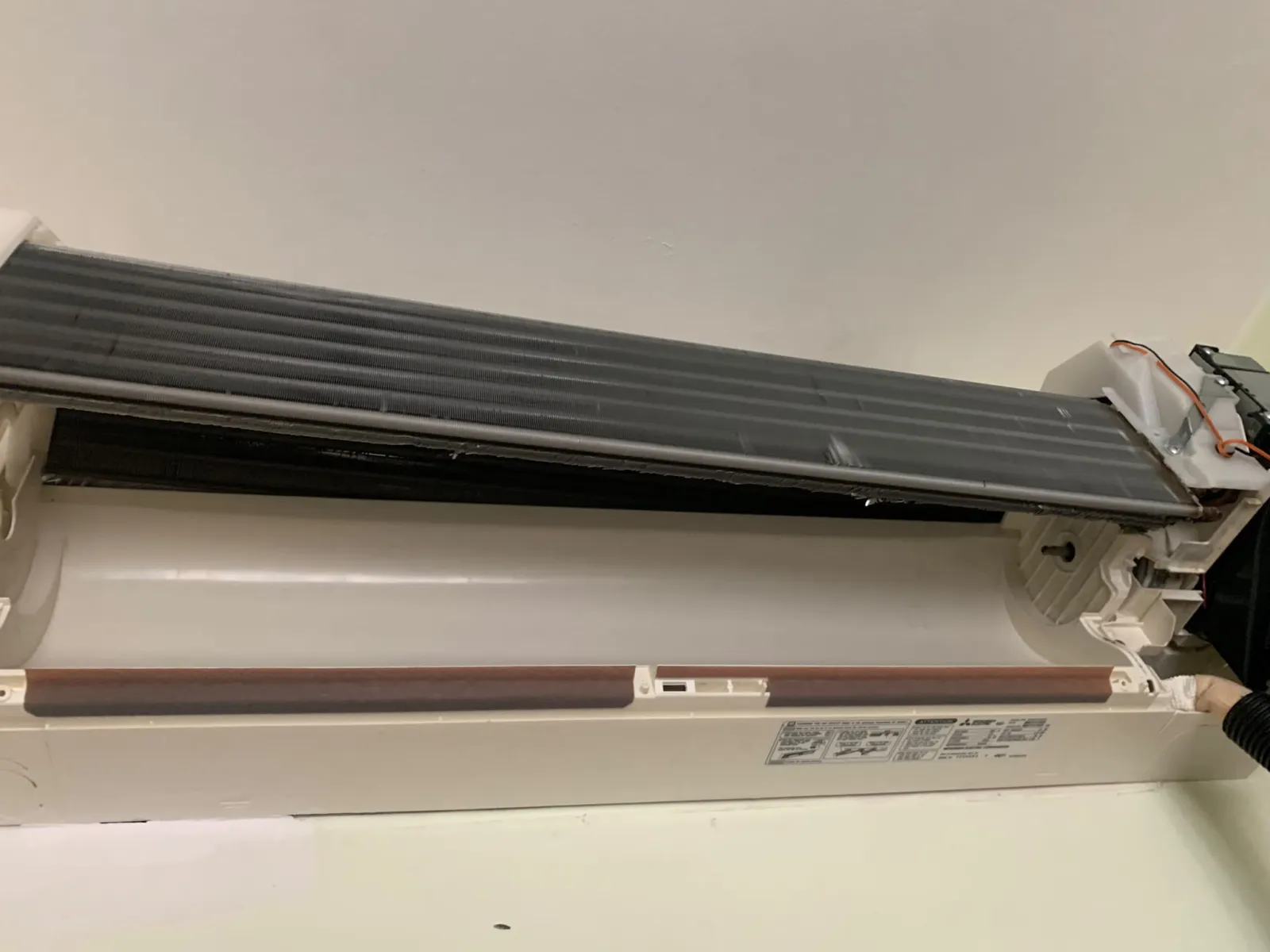
The commonest by a wide margin. Dust, sludge and biological growth build up in the drain tray and the drain pipe until water backs up. Once the tray overflows, it spills over the front lip of the fan coil and runs down the inside wall, or it goes out through the wall sleeve and down the outside of the building.
If the indoor unit has been dripping onto the floor as well as outside, this is nearly always the answer. Clearing it is routine work — it is part of what a proper servicing visit does, which is why the flats that get this letter are usually the flats that have not been serviced in a long time. Our separate piece on why an aircon leaks water indoors covers the same fault from the inside.
2. The drain pipe has no fall, or has lost it
The condensate line runs by gravity. It needs a continuous downward slope from the fan coil to the discharge point. When there is a dip, a sag in a long horizontal run, or a section that was pushed upward to clear an obstruction during a renovation, water sits in the low point instead of running away. It stagnates there, silts up, and then blocks.
This one matters because clearing the choke fixes it for a few months and then it returns. If a unit chokes repeatedly, the problem is not the cleaning interval. It is the pipework, and the pipework has to be re-run.
3. The drain discharges outside by design, and the outlet has blocked
Plenty of older installations were set up to drain onto the condenser ledge or into a floor outlet on the ledge rather than into a proper waste point. That is fine until leaves, dust or nesting material block the ledge outlet. The water then puddles on the ledge and finds the edge.
Worth knowing before you blame the machine: sometimes the aircon is working perfectly and it is the ledge drain that is blocked. Look at the ledge before you look at the unit.
4. Condensation on uninsulated or damaged pipe lagging
Refrigerant piping runs cold. Where the foam lagging has split, perished in the sun, or was never properly wrapped at a joint, the bare copper condenses moisture out of the air exactly like a cold glass on a table. That drip forms outside, on the pipe run, with a perfectly clean drain tray indoors.
The tell is that the water comes off the pipe run or the trunking, not from the wall penetration or the ledge. It is also the version most likely to drip only during the hottest, most humid part of the day.
5. Ice forming on the outdoor pipework, then melting
This one is a warning, not a nuisance. When a system is short of refrigerant the pressure drops, and ice can form on the coil indoors and on the valves and pipework at the condenser. It builds while the unit runs, then melts and drips once it shuts off — which is why the water often appears at odd hours with the aircon switched off.
If you are seeing frost or ice anywhere, stop treating this as a drainage complaint. Something has caused the charge to drop, and a system losing refrigerant will keep losing it until the leak is found. We wrote separately about where refrigerant actually escapes from.
Who is expected to fix it
In practice the letter arrives at the unit the water is coming from. That is the part people find unfair, and it is also the part that does not change: whether it is HDB, the town council or a condominium's managing agent writing to you, the position is that the water originates from your installation and it is yours to stop.
A few consequences worth being clear about:
- If you rent, it gets fixed first and argued about afterwards. The tenancy agreement decides who pays. A choked drain following a missed servicing cycle usually lands with whoever the agreement made responsible for servicing, which in most Singapore tenancies is the tenant. A drain pipe that has never had proper fall is a defect in the property, which is the owner's. Fix first, settle after — the complaint does not pause while you read the agreement. We covered who pays for aircon servicing in a rental in more detail.
- In a condo, the managing agent may also care who does the work. Many MCSTs restrict work on ledges and facades, and some maintain a list of permitted contractors. Check before you book, not after — see MCST rules and approved contractor lists.
- Damage to the unit below is a separate conversation from the drip itself. Stopping the water is straightforward. If it has been running for weeks onto somebody's window, awning or laundry, that part is between the two households — which is the practical reason to stop the source immediately, so the list stops growing.
What to check yourself before you call anyone
Ten minutes of looking will usually tell you which of the five it is, and it changes what you should be asking for.
- Is the indoor unit also dripping? Water on the wall under the fan coil, or on the floor, points hard at a choked drain or a full tray.
- Does it drip while running, or after it stops? While running suggests drainage or condensation. Only after shutting off suggests ice melting, which is the refrigerant warning.
- Is there frost or ice anywhere? On the indoor coil, on the copper pipes at the condenser, on the valves. Ice changes the whole diagnosis.
- Where exactly does the water start? Stand where you can see the ledge and the pipe run. Water leaving the wall sleeve, water off the trunking, and water spilling off the ledge are three different faults with three different fixes.
- Is the ledge outlet clear? Look for leaves, dust cake, nesting material. This costs nothing to check and occasionally ends the whole problem.
- When was it last serviced, and do you have the invoice? If you are a tenant, that invoice is the document the argument turns on.
What we would not do is switch the unit off and hope. Ice melts and produces one more round of dripping; a choked drain simply resumes when you switch back on.
What a proper visit should do
A visit that only flushes the drain and leaves has fixed today and not next month. What we would expect to see done is: open up the fan coil and inspect the tray rather than just poking the pipe; flush and vacuum the full drain line to the discharge point; confirm the line actually falls all the way; check the lagging on the pipe run for splits; check the ledge outlet; and run the unit long enough to confirm the water is going where it is supposed to.
If ice was involved, none of that is enough on its own — the charge and the leak have to be dealt with, or you are back in a few weeks. And if the drain pipe has no fall, you should be told that plainly and offered the option to re-run it, rather than sold a cleaning cycle that will not hold.
We do not price this from a description, because the difference between clearing a choke and re-running a drain line is the difference between one visit and a small job. What we will do is look at it and tell you which one it is before anyone starts.
The short version
Water outside is condensate, not gas, and it is almost never a "leak" in the sense people mean. Find out whether it drips while running or after stopping, look for ice, and look at where the water actually starts — wall sleeve, pipe run or ledge. A choked drain is routine; a drain with no fall keeps coming back until the pipework is corrected; and ice means you have a refrigerant problem wearing a drainage problem's clothes. Whoever the letter is addressed to, stop the water first and settle the bill afterwards, because the complaint does not wait.
Getting a letter about water dripping from your aircon?
Tell us what you are seeing and we will tell you which of these it is likely to be before we come. We check the tray, the full drain run, the lagging and the ledge outlet, and we will say plainly if the fix is pipework rather than a clean. Message us on WhatsApp, or see what a visit covers on aircon servicing and aircon repair.
Drainage faults are workmanship rather than equipment, which matters if the company that installed the system has since closed: where an orphaned warranty leaves you.
Also worth reading: water Stains Under Your Aircon Trunking: When It Is Condensation, Not a Leak.