You call the number on the sticker stuck to the side of your fan coil and it rings out. You try again a week later and it is disconnected. The company that installed your system two years ago, and whose warranty card is still in your kitchen drawer, has quietly stopped existing.
This happens more often in this trade than in most. Aircon installation has a low barrier to entry, a lot of small operators, and a business model where the money arrives at installation and the obligations arrive for years afterwards. When one of them closes, the customers usually find out the same way you did.
The good news is that you have probably not lost everything. The bad news is that what you have lost is usually the half people assume is safe.
You had two warranties, not one
Almost every aircon installation carries two entirely separate promises, from two entirely separate parties. People treat them as one thing because they were sold as one package.
The equipment warranty — from the manufacturer
This is the brand's promise about the hardware. It belongs to the manufacturer, it is tied to the unit itself, and it does not die when the installer does. If your compressor fails and it is still within the manufacturer's coverage, that is a claim against the brand's Singapore service operation, not against the company that mounted it on your wall.
The workmanship warranty — from the installer
This is the installer's promise about the work: that the pipework was flared and sealed properly, that the bracket is sound, that the drain falls the right way, that the system was evacuated and charged correctly.
This one is gone. A workmanship warranty is a promise from a company, and when the company is dissolved there is nobody left to be held to it. No other installer inherits it, and none will honour it — not out of unhelpfulness, but because standing behind work you did not do and cannot see inside is not a thing any competent contractor can offer.
The frustrating part is that workmanship covers most of what actually goes wrong in years two to five. Which is why it is worth knowing exactly what you still have.
What to do this week
1. Find the invoice, then photograph the serial plates
Manufacturer claims are made against the unit, and the unit is identified by its serial number, not by your memory of when you bought it.
Go and photograph the rating plate on every indoor unit and the outdoor condenser. On a wall-mounted fan coil it is usually behind or under the front flap; on the condenser it is a printed label on the casing. Capture the model number, the serial number and anything that looks like a date code, and keep those photos somewhere that is not a phone you might lose.
Then find the original invoice or delivery order. It establishes the purchase date, which is normally what the coverage period runs from. If your installer issued it, it is still valid evidence even though he is gone — a receipt does not stop being a receipt because the shop closed.
2. Check whether the entity actually closed
Worth five minutes before you write the warranty off. A company that has stopped answering its phone has not necessarily been dissolved, and if it still exists, its obligations still exist too.
Singapore company records are public. You can look the business name up and see whether the entity is live or struck off, and whether it was a private limited company or a sole proprietorship — which matters, because a sole proprietor who has simply moved on is a different situation from a Pte Ltd that has been wound up.
3. Contact the brand directly, not a middleman
Go to the manufacturer's own Singapore service channel with your model and serial numbers and ask two questions: is this unit still within its warranty period, and what does that period cover.
Ask the second one properly. Equipment warranties are frequently split — the compressor is often treated differently from the rest of the system, and parts are often treated differently from the labour to fit them. "Still under warranty" can mean the part arrives free and you pay someone to install it.
4. Ask what would void it
This is the question people skip, and it is the one that decides whether your remaining warranty is real.
Manufacturers commonly expect a unit to have been installed by an authorised installer and to have been maintained. If your installer was never authorised for that brand, or if nobody has serviced the system since it went in and there is no record of it, a claim can be refused on grounds that have nothing to do with why the part failed.
You cannot change the past on either point. You can start a record from today, and a documented service history from now on is materially better than nothing when a claim is assessed.
The faults that are now yours
With the workmanship warranty gone, these become your cost. It is worth knowing which is which so you are not arguing with a brand about something they were never covering.
- Gas leaks at joints. Refrigerant does not get consumed. A system that is low on gas is leaking, and a leak at a flare joint or a poorly brazed connection is an installation fault, not an equipment fault. This is the most common orphaned-warranty problem we see.
- Drainage. A drain pipe laid without enough fall, or run into the wrong place, produces water where you do not want it. That is workmanship.
- Mounting and brackets. Vibration, noise and movement usually trace back to how it was fixed.
- Undersized or wrongly routed pipework. Rarely visible, occasionally the reason a system has never quite performed.
Equipment faults — a failed compressor, a failed PCB, a fan motor — remain the brand's business if the coverage is live.
Getting a second opinion without getting sold to
The moment you say "my installer has closed down", you become an easy sale. Some of what gets recommended at that point is genuinely needed and some of it is not.
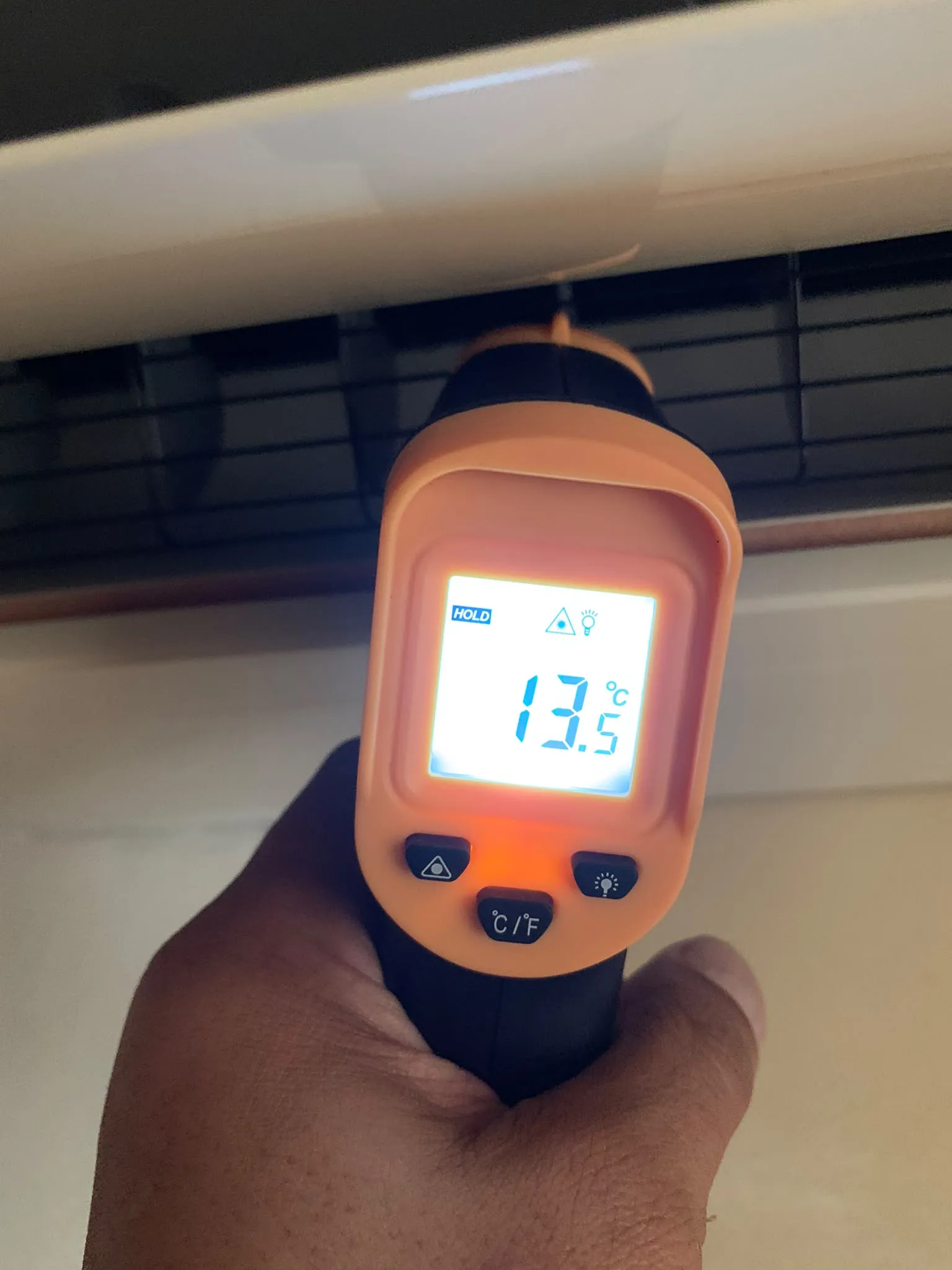
Two things protect you. First, ask for the diagnosis before the quote — what is actually wrong, and how was that determined. Second, ask for something measurable. A technician who has checked the system properly can tell you the supply air temperature at the fan coil and whether the pressures were within range, and those are numbers you can write down and compare against the next opinion.
Be equally wary of the opposite failure: a company that agrees to "take over your warranty" is either misunderstanding the situation or managing your feelings. What an honest company will offer is a warranty on their own future work, which is a different and much more useful promise. Our note on what a workmanship warranty actually covers sets out what that should include.
If you are the one buying next time
The way to not be here again is not to find a company that cannot fail. It is to hold the documents yourself:
- Insist on an itemised invoice with model and serial numbers written on it
- Register the equipment warranty with the manufacturer yourself, in your name, if the brand allows it
- Keep a dated record of every service, however brief
- Confirm in writing what the workmanship warranty covers and for how long, before you pay the balance
- Check the installer is authorised for the brand you are buying, rather than assuming
None of that costs anything at the time, and all of it survives the installer. If you are buying into an existing setup rather than a new one, the same logic applies — see checking the aircon before you buy a resale flat.
If you want us to look at it
We will not pretend to honour someone else's warranty, and we will tell you plainly which of your problems is an equipment claim you should be making against the brand rather than a job you should be paying us for.
Message us on WhatsApp about an orphaned aircon warranty.
If your unit is new rather than second-hand, the same exercise happens at handover: photographing the rating plates and checking the installation before the defects period closes.
This is also the scenario that makes the purchase route matter — see buying your aircon through the ID or direct.
Also worth reading: prepaid aircon maintenance contracts: what happens if the company closes