You collect the keys, walk the unit with the developer's representative, and everything works. The aircon comes on, the air is cold, and nobody thinks about it again until something goes wrong — which, on a new unit, is usually somewhere between the fourth and the tenth month.
By then the question is no longer "what is wrong with it". The question is "whose problem is this", and the answer depends almost entirely on what you did in the first few weeks.
Two clocks start on handover day, and they are not the same clock
The first is the defects liability period in your sale and purchase agreement. It is the window in which the developer is obliged to make good defects in the unit they handed you. Read your own agreement for the exact wording and the exact length — for private residential purchases in Singapore it is commonly counted in months from the date you are given vacant possession, but the document you signed is the authority, not a number from a blog. Note the end date somewhere you will actually see it.
The second is the manufacturer's warranty on the equipment itself, which belongs to the brand and is tied to the serial number on the machine. Those two clocks can start on different days and run for different lengths. A developer's defects period may close while a compressor warranty still has years to run, and the reverse happens too.
They cover different things, and the distinction is the whole game. A drain that was never given enough fall is workmanship. A compressor that fails is equipment. Dust in the fan coil after ten months is neither — that is maintenance, and it is yours. We set out the same split in more detail in what a workmanship warranty actually covers.
The walkthrough most people do, and the one worth doing
The handover walkthrough usually amounts to switching each unit on and standing under it. That confirms one thing — that the system was charged and powered — and misses everything that shows up later.
Here is what is worth twenty minutes on a day when someone from the developer is still standing next to you.
Run every unit at the same time, for at least half an hour. A multi-split shares one condenser and one refrigerant circuit. Switching each fan coil on for two minutes one at a time is not the same test as running the whole system together, which is how you will actually use it. If one room never quite gets there while the others are running, that is worth writing down on the day rather than discovering in December.
Pour water into the drain pan and watch where it goes. This is the thirty-second test that prevents a ceiling stain, and it is the single most useful thing you can do at handover. Condensate drainage is gravity-fed; if the pipe run does not fall consistently, water backs up. It will not show on day one because the unit has barely made any condensate yet. It shows in month three.
Look at the trunking and the pipe route, not just the unit. Where does the refrigerant pipe leave the room, and is the insulation continuous the whole way? Bare lagging joints sweat, and sweating in a bulkhead is a stain waiting to happen.
Find the condenser and check you can get to it. On a new condo this is on the aircon ledge, and how that ledge is reached decides what every future service visit costs and whether some contractors will quote at all. What to check about an aircon ledge before you buy covers the access question in full.
Photograph the rating plates. Every indoor unit and the outdoor condenser carries a plate with the model and serial number. Photograph all of them on handover day and put the photos somewhere you can find them in three years. This takes four minutes and it is the record that makes a warranty claim possible after the installer has moved on — a point that becomes painfully clear when the company that installed the system no longer exists.
Count the units and check they match what you paid for. On a new unit the aircon is part of the specification. If the brochure said four fan coils and there are three, that is a handover item, not an aircon item.
The trap: "I'll leave it alone until the defects period ends"
This is the most common and the most expensive mistake, and the logic behind it feels sound: it is new, it is under warranty, why touch it.
Because servicing is not a defect claim. It is maintenance, and nobody else is going to do it for you.
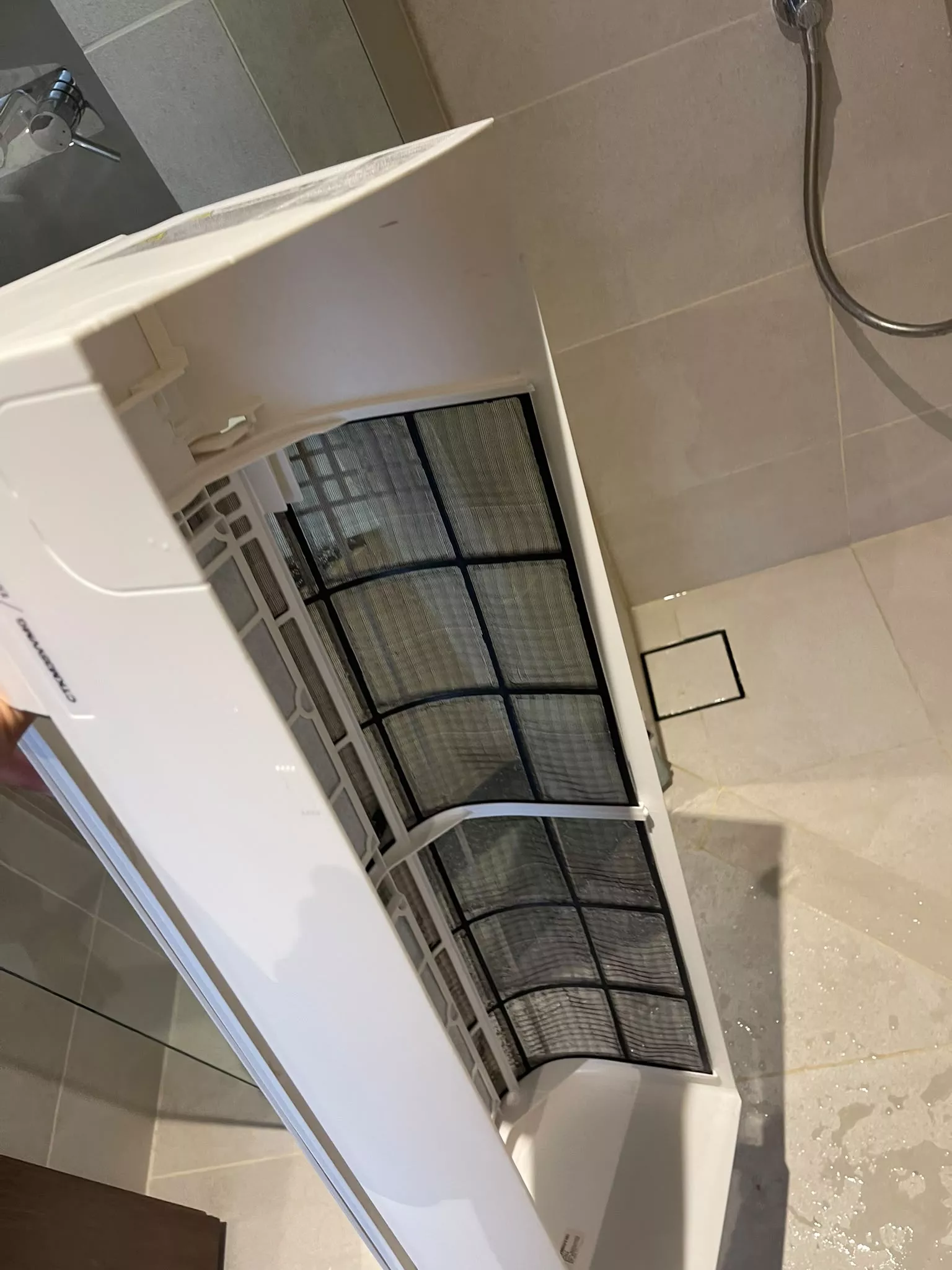
A new fan coil in Singapore is pulling humid air across a cold coil from the day you move in. Ten or twelve months of that with no cleaning produces exactly what you would expect on the blower barrel and the drain pan. When you then report weak cooling or a smell at month eleven, the honest answer is that it is not a defect — and you have spent the whole defects period generating a maintenance problem instead of using it.
Keep the invoices. A dated servicing record is what separates "this unit was maintained and still failed" from "this unit was never touched", and that sentence decides claims. It is the same document that matters in a rented property, for the same reason.
Does servicing it yourself, or using an outside contractor, void anything?
Read the warranty card that came with your unit rather than taking anyone's word for it, including ours — the conditions are printed on it and they vary by brand.
What is generally true: a manufacturer's warranty covers the equipment, and it expects the equipment to be maintained. What tends to cause trouble is not who cleaned it but whether anyone did, and whether any work carried out was the kind that should not have been. DIY chemical washing and work by someone unqualified are the two that turn up repeatedly in refused claims.
If your development has an appointed contractor during the defects period and you want to keep everything simple, use them for that period and keep the receipts. Just do not confuse "there is an appointed contractor" with "servicing is included" — those are different arrangements, and it is worth asking which one you actually have.
How to raise a defect so it is still a defect next month
In writing, dated, with photographs, to whoever your agreement names. Not to the site foreman in passing.
Describe behaviour rather than diagnosis: "the second bedroom unit drips from the left corner of the casing after it has been running for about an hour" is far more useful than "the aircon is leaking", and it is much harder to close as no-fault-found. Say when it happens, how often, and what the unit is doing at the time.
Then keep your own copy of everything. The defects period ends on a date, and a list you can produce on that date is worth more than a memory of a conversation.
What we would look at if you asked us to come before the period closes
Roughly two months before your defects period ends is the useful moment for an independent look, because there is still time to raise anything found.
What matters at that point is the drainage on every unit, the state of the insulation on the pipe runs, whether the system holds its charge, and whether the installation itself was done in a way that will hold up — brackets, pipe routing and flare joints are workmanship, and workmanship problems are the ones that stay yours forever once the window closes. Every booking with us includes a 9-point pre-check for that reason; on a repair visit the $45 minimum covers the visit and the diagnosis, and anything beyond that is quoted after the pre-check rather than before it.
The other thing worth knowing is that a whole-home visit is cheaper per unit than doing rooms piecemeal — the per-unit rate falls to $25 from five units, which for most new condos means doing the entire place in one visit costs less than two separate call-outs.
If you are buying rather than collecting
None of the above applies to a resale purchase, where there is no developer and no defects period, and the checks are completely different. That is a separate exercise, covered in checking the aircon before you buy a resale flat.
The short version
- Find the end date of your defects liability period and write it down.
- Photograph every rating plate on handover day.
- Do the drain-pan water test on every unit, in front of someone.
- Service the units during the period — the warranty is not a substitute for maintenance.
- Raise anything you find in writing, with photos and dates.
- Have someone look at the installation about two months before the window closes.
If you want us to look at it
Tell us which development, how many units, and when the place was handed over. If what you are describing sounds like a developer's defect rather than a servicing job, we will tell you that first, because raising it with them is free and calling us is not.
WhatsApp us on 9107 2601 — usually a reply within five minutes. Servicing and chemical wash prices are on the pricing page, and if the problem turns out to be a fault rather than dirt, aircon repair is the other side of it.