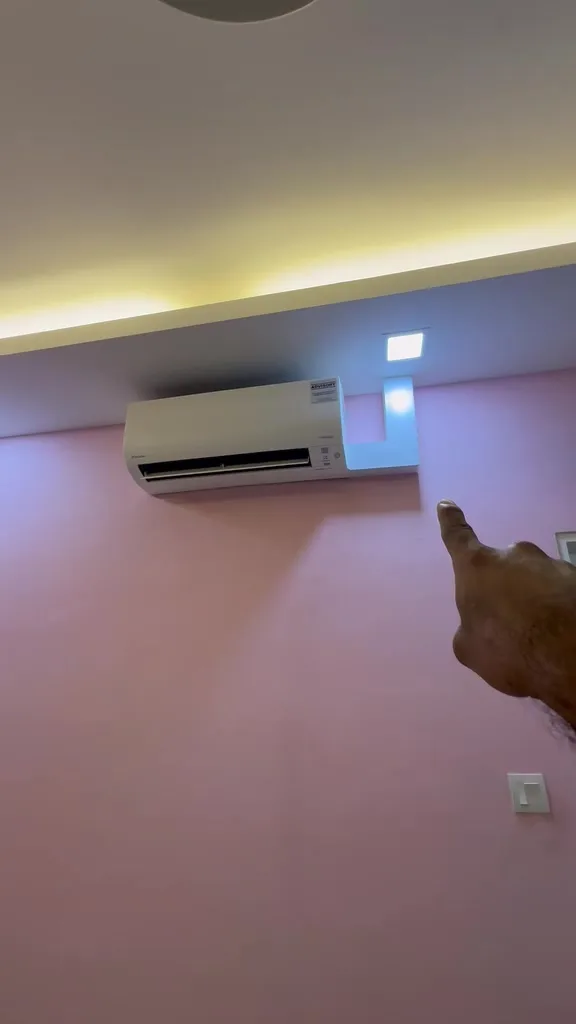
Pictured above: a bedroom in a Bukit Panjang condo on 18 November 2026, on one of our jobs. The wall unit the hand is pointing at is new. It replaced one indoor unit on a Daikin system that was otherwise kept. The owner did not buy a new system. They replaced the one part that had worn out, and the pipes that went with it. The steps are on the live job page.
That is the situation this post is about. You have a System 2, 3 or 4: one outdoor unit on the ledge, two to four indoor units in the rooms. One of them has started to fail. It is weak, noisy, leaking or dead, and the others still cool. Someone has told you "better change the whole system", or you are wondering whether you should.
First, make sure the fault really is in that one unit
On a System 2, 3 or 4, every indoor unit is fed by the same outdoor unit. The outdoor unit holds the compressor, which does the actual cooling work for every room. That gives you a simple first test you can run yourself.
- One room is bad and the other rooms are cold. The shared outdoor unit is doing its job for the others, so the problem is more likely in that room: its indoor unit, its drain, or the pipes running to it.
- Every room is warm at the same time. Look at what the rooms share: the outdoor unit, the compressor, or the refrigerant. Replacing one indoor unit will not fix that.
Run all the units at the same setting for 10 to 15 minutes and compare. If one room is behind but still somewhat cool, it may not be a failing unit at all. Our guide to why one room never gets cold on a System 3 or 4 goes through the causes that have nothing to do with the hardware being worn out.
Then let the pre-check confirm it. Every service booking starts with our 9-point pre-check. It includes a power and thermostat test, a temperature drop measurement between the air going in and the air coming out, a refrigerant pressure reading, a drainage flow check, an outdoor condenser inspection and a fan blower spin test. Those points are what separate "this indoor unit is worn out" from "this indoor unit is dirty", "the drain is blocked" or "the system is short of gas". The $55 for 1 unit covers the visit, the pre-check and normal servicing. If you go ahead with the fix, the $55 is part of the total. If you decide not to, it covers the visit and the diagnosis, and nothing more.
Three things that look like a dead unit and are not
Before anyone talks about replacing an indoor unit, rule these out. Each has a published price on our pricing page, far below the cost of new hardware.
- It is dirty. Weak airflow and a musty smell are often a fouled coil or blower wheel. Normal servicing is $55 for 1 unit. A chemical wash is $135 for 1 unit, and a chemical overhaul, with full disassembly, is $200 for 1 unit.
- It is the drain. Water dripping from one unit is, on our repair page, a blocked drainage pipe in 90% of cases. A standard repair (drainage, electrical) is $80.
- It is short of gas. Gas top-up is priced per outdoor circuit, not per indoor unit: R22 $115, R410A $130, R32 $170. If gas keeps running low, there is a leak, and a nitrogen pressure test at S$180 per indoor unit tested finds which pipe it is. The aircon cannot be used for 2 to 3 days while the test runs. Leak repair, once found, is S$520 for HDB and S$700 for a condo.
If the pre-check finds one of these, the conversation about replacing hardware is over before it starts.
When the indoor unit itself is worn out
Sometimes the unit really is at the end. The fan motor or bearings have gone, the casing is brittle, the board has failed, or the unit has had the same repair more than once. Fan motor and bearing replacement is part of our repair work, and PCB replacement is quoted on site. The question then is whether to keep paying for parts in the old unit, replace that unit, or replace the whole system.
Our repair page gives the rule we work to: if the repair costs more than 50% of replacement, and the unit is over 8 years old, replacement makes more sense. Newer or higher-end units often justify the repair. Both conditions matter. A cheap fix on a twelve-year-old unit may only be the first of several.
What replacing just one indoor unit involves
On the Bukit Panjang job, after earlier checks, the owner went ahead with a repair on one indoor unit. Our team:
- fitted a new Daikin wall blower as a like-for-like replacement;
- replaced the pipes to that unit and concealed them again;
- topped up R32 refrigerant;
- carried out a leak check;
- booked a later visit to finish the ceiling patch, with no painting.
"Like-for-like" is the key phrase. The new indoor unit has to be one the existing outdoor unit can run with: the same brand, the same refrigerant, and a model that matches the system. You cannot hang any wall unit you like on an existing outdoor unit and expect it to work. So the first question is always whether a matching unit can still be had for your outdoor model. On an older system, especially one still on R22, ask that at the pre-check before anything else. If no matching unit is available, the choice is made for you.
Notice too that the pipes were replaced, not just the indoor unit. Worn pipes and a tired blower can keep a system short of gas and weak on cooling, so the job replaced both rather than topping up alone. If the pipes to that room run above a false ceiling, they have to be reached through the ceiling, which is why that job needed a patch and a second visit. Our post on concealed aircon pipes in a condo ceiling covers that part of the job in detail. Concealed pipe work is quoted after the test, not published as a fixed figure.
We do not publish a single price for replacing one indoor unit, because it depends on the model the outdoor unit needs, the pipe run, and whether the pipes are exposed or hidden. It is quoted after the pre-check, and you decide before any work starts.
When the whole system is the better buy
Replacing one indoor unit is the right answer when the outdoor unit and the other rooms are healthy. It is the wrong answer in these cases:
- The fault is in the outdoor unit. If the compressor has failed, every room is affected, and the repair is quoted on site because the price varies by model and by refurbished or brand-new unit. Before accepting that diagnosis, read how to check before you pay for a compressor.
- The system is old and the other units are not far behind. If one unit has failed at twelve years, the others are the same age and have run in the same climate. Replacing one unit now and another next year can cost more than one planned replacement.
- No matching indoor unit is available for your outdoor unit.
- The 50% rule is crossed on a unit over 8 years old.
For a sense of scale, our published installation prices are: single split from $1,200, System 2 from $2,200, System 3 from $2,800 and System 4 from $3,500 on the standard inverter tier. Premium brands (Daikin, Mitsubishi Electric) are single split from $1,500, System 2 from $2,800, System 3 from $3,300 and System 4 from $4,500. These are "from" prices. The final figure comes after the free site survey, and the quote is final once given. Removal and disposal of an old system is one of the items listed on our installation page as possibly costing extra, so ask for it to be in the quote.
If the unit is old but you are not sure it is beyond saving, our guide to overhaul or replace walks through the signs that only show once the unit is opened.
The warranty difference, which people forget to compare
The two routes come with different cover, and it belongs in the decision:
- A repair, including replacing one indoor unit, carries our 90 days on workmanship, plus the manufacturer's warranty on parts.
- A new installation carries our 2-year installation warranty, plus the manufacturer's 5-year compressor warranty on the units.
On a young system, the compressor in the outdoor unit you are keeping may still be inside its own manufacturer's warranty, which is a good reason to keep it and replace only the indoor unit. On an old system, the compressor you keep has no cover left, and a new system resets the clock. Have the installation date and the model and serial numbers from the outdoor unit ready. You need them to check either way.
Questions to ask before you approve either route
- "Is the fault in this indoor unit, its pipes, its drain, or the outdoor unit?" Ask which pre-check points showed it.
- "What did the gas pressure read?" A number, not "OK". Low gas points to a leak, not a worn unit.
- "Is a matching indoor unit available for my outdoor model, and is it the same refrigerant?"
- "Are the pipes to this room being replaced too, and are they exposed or above a ceiling?"
- "If the ceiling is opened, who patches it and is painting included?"
- "What warranty comes with this route, and on what?"
Good answers to these make the decision for you. If the outdoor unit is sound, the other rooms are cold, a matching unit exists and the system is not near the end of its life, replace the one unit. If two or more of those are not true, get the installation quote and compare.
Send us the details
The fastest way to a firm answer is a pre-check. When you message us, tell us the system type (System 2, 3 or 4), the brand, roughly how old it is, which room is the problem and what it is doing, and whether the other rooms are still cold. A photo of the outdoor unit's data plate helps. Prices on our pricing page are the prices you pay, and you decide before any work starts.