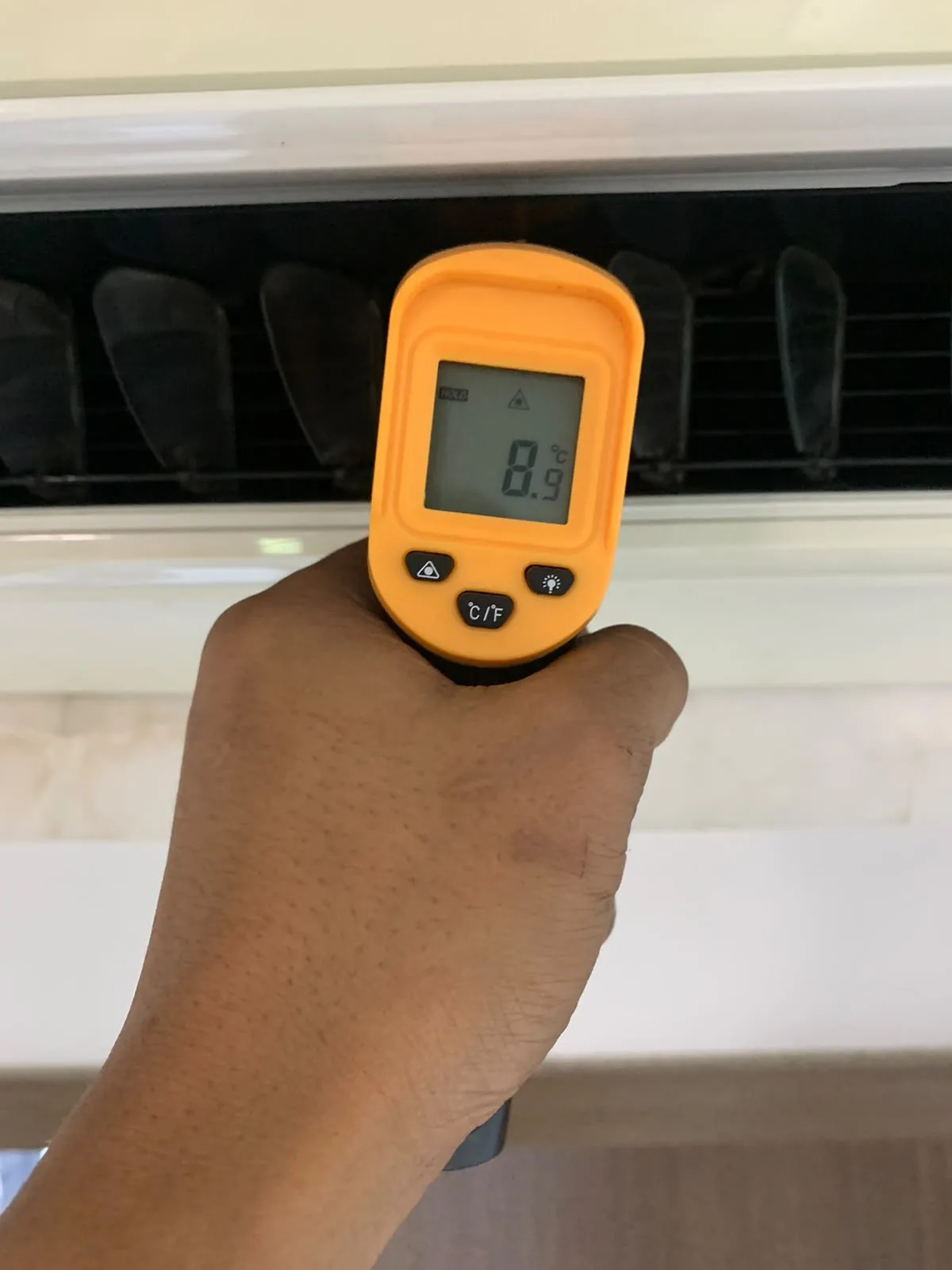
Pictured above: an infrared thermometer pointed into the vent of a wall-mounted aircon in a Canberra condo, on one of our jobs on 17 November 2026, right after a normal service. It reads 8.9°C. Before the service, the same kind of reading on the two units in that home was 15.6°C and 17.6°C. After it, 8.9°C and 9.5°C. Those four numbers are on the live job page, with the photos taken on the day.
This post is about why that pair of readings matters more than how clean the unit looks when the technician packs up, and how you can use the same simple check on your own aircon: before the visit, after it, and a few weeks later. It is the one piece of evidence that a service changed something you can feel, and it costs you almost nothing to collect.
The problem with judging a service by eye
Most people judge an aircon service by three things: the technician took the cover off, there was dirty water in the tray or the bag, and the filter looks clean now. All three tell you work was done. None of them tells you the unit cools better than it did this morning.
A normal service on our aircon servicing page means the roller and blower are dismantled, the filter, coil and drainage are cleaned and flushed, and there is a basic check of cooling, electrical connections and the outdoor unit. That is $55 for 1 unit, $90 for 2, $120 for 3, $160 for 4 and $35 per unit from 5. If that work was done properly on a unit that was only dirty, the air coming out should be noticeably colder afterwards. If it was done and the air is no colder, then either the unit was not very dirty to begin with, or the problem was never dirt.
That second case is the one worth catching early. A service cannot fix low refrigerant, a leaking pipe or a failing part. A before-and-after reading tells you on the day whether you are in the "dirt" case or the "something else" case, instead of finding out three weeks later when the room is still warm.
What the reading actually measures
An infrared thermometer reads the temperature of whatever surface it is pointed at. Aimed into the vent of a running aircon, it picks up the louvres and the inside of the outlet, which are being chilled by the air leaving the coil. It is not a lab instrument, and the number depends on where you point it and how long the unit has been running. That is fine, because you are not comparing it with a textbook figure. You are comparing the same unit with itself.
Our technicians do a more complete version of this as point 2 of the 9-point pre-check: a temperature drop measurement, the difference between the air going into the unit and the air coming out. Our pre-check page puts it plainly: it tells us whether the issue is gas-related or cleaning-related. The pre-check is included with every service booking and takes about 10 to 15 minutes, before any cleaning starts. So the "before" reading is already being taken on our visits. What this post adds is how to read it yourself, and what to do with the result.
How to take a reading you can trust
You need an inexpensive infrared thermometer from a hardware shop, or you can simply ask the technician to show you theirs. Then keep the conditions the same each time:
- Same setting. Cool mode, the same set temperature and the same fan speed every time. Write the setting down.
- Let it run first. Give the unit at least 10 to 15 minutes to settle with the door and windows closed before you read it. A reading taken a minute after switching on means nothing.
- Same spot. Point at the middle of the outlet, at the same distance, with the louvre in the same position. Moving the aim from the middle to the edge can change the number on its own.
- Read every unit. If you have three aircons, read all three. The difference between them is often more telling than any single number.
- Write it down with the date. A note on your phone is enough: date, room, setting, reading. That note becomes your record for the next visit and for any warranty question.
Then do the same thing after the technician has finished and the unit has run for another 10 to 15 minutes, and once more two or three weeks later.
Reading the result: four patterns
We do not publish a single "correct" vent temperature, and we would be wary of anyone who does without knowing your unit, your room and your setting. What we can tell you is how to read the change.
| What you see | What it usually points to | What to do |
|---|---|---|
| Clearly colder after the service, and still colder a few weeks later | The problem was dirt, and the service removed it | Nothing. Keep to the usual servicing interval |
| Barely changed, and the room still feels warm | The problem may not be dirt: low gas, a leak, or a part | Ask what the pre-check found and what the next step is before the technician leaves |
| Colder after the service, but back to the old reading within weeks | Grime the normal service did not reach, or refrigerant slowly going | Tell us the dates and readings; a chemical wash or a gas check may be the next job |
| One unit much warmer than the others in the same home | Something specific to that unit | Point it out at the visit so that unit gets checked first |
The Canberra job is the first row. Both units had a dusty blower wheel, and one had started dripping water, which is what made the owner call. Dirt on the blower and coil can choke the drain and stop the air from getting properly cold. A normal service cleared it, and both readings went from the mid-to-high teens to under 10°C on the same day.
When the reading does not move
This is the result to act on while the technician is still in your home. If the air is no colder after a service, ask three questions:
- What did the pre-check show? The temperature drop and the gauge reading on the refrigerant are both part of it. Our pricing page says that a standard service visit includes a gas pressure check as part of the $55 servicing minimum.
- Is it gas? If the pressure is low, a gas top-up is priced per outdoor circuit, not per indoor unit: R22 $115, R410A $130, R32 $170, as listed on our pricing page. Indoor units that share one outdoor unit share one circuit.
- If it needed gas, why did it lose gas? Refrigerant is not used up. If it is low, it went somewhere. A nitrogen pressure test finds the leak, at S$180 per indoor unit tested, and the aircon cannot be used for 2 to 3 days while it runs. Leak repair, only if needed, is S$520 for HDB and S$700 for a condo. You decide before any work starts.
If a service was the wrong job, you want to know now, not after a second service that also changes nothing. Our aircon still not cold after servicing guide goes through what to check at home before you call back.
When the reading comes back
The third row of the table is the slow one. The unit was colder after the service, and you were happy, and a few weeks later it is back where it started. Your notes are what make this easy to sort out, because "it was 9 degrees on the 17th and it is 15 now" is a fact a technician can work with, while "it feels warm again" is not.
Two things commonly cause it. One is grime that a normal service does not reach: a normal service cleans the filter, coil, roller and blower, but a chemical wash goes further, with a water tray and cover fitted and chemical put on the coil and blower before rinsing. A chemical wash is $135 for 1 unit, $245 for 2, $345 for 3, $425 for 4 and $100 per unit from 5. The other is refrigerant going slowly, which the readings will show as a steady drift rather than a sudden change. Either way, tell us your dates and readings when you message.
Our servicing work carries a 90-day workmanship warranty. A dated reading from the day of the service and another from a few weeks later is exactly the kind of record that makes a warranty conversation short and fair on both sides.
What to ask for on the day
You do not need to own a thermometer to get the benefit of this. On any service visit, ours or anyone else's, it is reasonable to ask:
- "What was the reading before you started, and what is it now?" Ask for both, on each unit.
- "What did the gas pressure read?" A number, not "OK".
- "Was there anything you could not fix with a service?" A drain that is still slow, a noisy blower, a unit that is much warmer than the others.
- "Can I take a photo of the reading?" Our live job pages carry exactly these photos, so it is a normal request.
A technician who has done the work properly will have no trouble answering any of these, and the answers take about a minute. If you want to know what else a normal service should include, line by line, read what is included in a general aircon service. For the bigger job, how to check an aircon overhaul was really done covers the checks that apply when the unit comes off the wall.
Book a service with the readings recorded
Every visit starts with the 9-point pre-check, including the temperature drop measurement, and a normal service takes about 30 to 45 minutes per unit after that. The $55 for 1 unit covers the visit, the pre-check and normal servicing, and the price you see on our pricing page is the price you pay. If you already have readings of your own, put them in the message: they help us tell you which job your aircon actually needs.