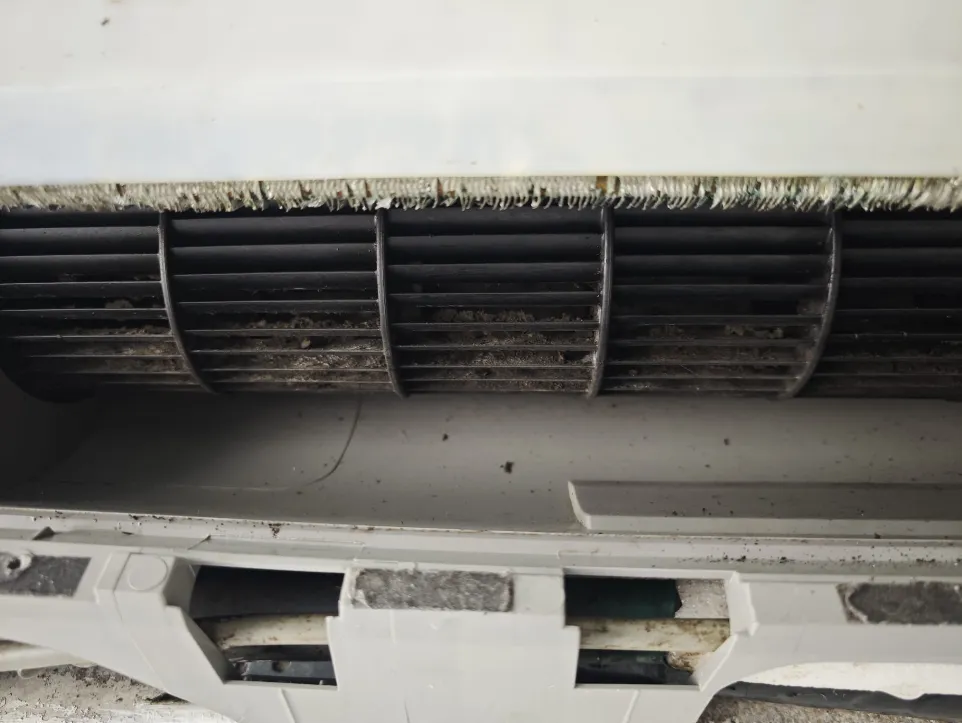
You switch the aircon on and a trail of ants is walking down the wall beside it. Or the unit stopped working the same week you noticed a gecko living behind the trunking. Or there are twigs and droppings on the ledge by the outdoor unit and the fan outside has stopped turning. Nobody sells aircon service as pest control, so this is a question that falls between two trades, and it is easy to call the wrong one first.
This post sets out where small animals and insects actually get into an aircon, what they can do to the parts that matter, what you can check safely yourself, what you should not do, what a service visit does and does not cover, and when the right call is to a pest-control company rather than to us.
Where they get in
An aircon is a warm, dark, sheltered box with a pipe running from it to the outside, and that is exactly what small animals look for. There are four usual routes.
- The cavity behind the front panel of the indoor unit. When the cover is off, the blower, the coil and the drain tray sit in a closed space that is dark and damp whenever the unit has been running. Anything small that gets in finds it comfortable.
- The drain pipe from the outlet. The unit drains water out through a pipe, and a pipe is also a way back in. A drain that stays wet is not easy for insects to travel up, which is one reason a blocked or dried-out drain is worth fixing.
- The gap where the pipes go through the wall. The pipes, the drain and the cable pass through a hole to the outdoor unit. If the hole is not sealed tightly, it is a ready-made doorway into the room and the back of the indoor unit.
- The outdoor unit and the ledge it sits on. Ants and other insects get into the casing, and on a ledge or in an open service yard a bird will happily use the sheltered corner behind and beside a condenser for a nest. Leaves, plastic bags and twigs also blow in.
None of this means your aircon is dirty or badly installed. A unit on a high-floor ledge or next to a planter can have the same visitors as one at ground level. What matters is what they do once they are in.
What they can do to the unit
The honest summary is that most of the time they do nothing and the problem is a nuisance, not a fault. When there is a fault, it is usually one of these.
- A blocked drain. Insects, debris and nest material can collect in the drain tray or the drain pipe. The unit then drips inside the room, which is the symptom people notice first. Our post on why clearing a drain never holds covers the recurring case.
- A control board that stops working. The control board (the PCB) is the electronics that run the unit. Insects or a small animal on a board, or the moisture and mess that come with them, can stop it responding. The usual symptoms are a unit that will not turn on, a blinking light or an error code, or a unit that behaves erratically. Our post on PCB replacement sets out what to ask before you approve a quote, because "the board is gone" is a diagnosis you should ask to be shown.
- An outdoor fan that cannot turn. A nest, twigs or a plastic bag at the outdoor unit can block the fan or the airflow. Inside the flat, the indoor fan runs and the air stays warm. That is the situation in fan running but blowing warm air, and the checks in that post are safe to do from indoors.
- Droppings and mess on the coil and in the blower. That is a cleaning job, not a repair, and it is what a service or wash is for.
The signs, and what each one usually means
- A line of ants on the wall near the unit or the trunking. Usually an entry route along the pipe hole or the trunking. The ants are a symptom; the question is where they are getting in.
- Water dripping inside, with no other sign. Possible drain blockage. See above.
- The unit will not turn on, or shows an error, soon after you noticed a pest. Possible control board problem. Switch off and do not keep trying.
- Indoor fan runs, air stays warm, and there is debris or a nest on the ledge. Possible outdoor fan or airflow problem.
- A smell that is not mould or vinegar. Something may have died inside the unit or the pipe. That is a job for a technician.
- Scratching or chirping from the unit or the pipe hole. Something is inside the casing or the pipe. Switch the unit off.
What not to do
- Do not spray insecticide or any liquid into the unit, the vents or around the electrical area. Liquid on a control board is a good way to turn a pest problem into a PCB replacement.
- Do not open the casing or poke the drain pipe. You can break a drain connection or push a blockage deeper.
- Do not reach out of a window or climb onto a ledge to clear a nest or the outdoor unit. This is the most dangerous item on the list. If you cannot see it safely from inside the flat or a service yard, leave it for the technician.
- Do not take a nest down yourself. If it is on a ledge, check with whoever manages the building before anything is removed.
- Do not keep running a unit that has stopped responding, or that you think has something inside.
What you can safely do first
- Switch the unit off with the remote, and off at the wall switch or isolator if you know where it is.
- Look, from where you are standing, at the pipe hole, the trunking and the underside of the indoor unit for a trail or a gap. A photo is more useful than a description.
- Wipe an ant trail and keep food away from that wall. It does not fix the entry point, but it stops the trail getting stronger.
- If the outdoor unit can be seen safely, note what you can see: debris, a nest, droppings. Do not touch it.
- Write down when you first noticed it and what the unit did. "It stopped cooling three days after I saw the gecko" is far more useful than "it is not working".
What a service visit covers, and what it does not
On our published job list, normal servicing is dismantling the roller and blower, cleaning the filter, coil and drainage, flushing, and a basic check. If there are droppings or debris on the blower and the coil, that is the clean-out. A chemical wash goes further on the coil and the blower, and our chemical wash page lists what is included.
Every service booking also starts with the 9-point pre-check. Two of its nine points matter here: the drainage flow check, which verifies that the drainage pipe is clear, and the outdoor condenser inspection, a visual check of the fan, the condenser coil and the external pipework. The pre-check page describes both, and it also lists a power and thermostat test, which confirms the electrical supply and the board's response before any disassembly.
What a service visit is not is pest control. We clean and check the unit and can tell you where something has been getting in. We do not remove a colony from a wall cavity, treat a building for pests or take down a nest from a shared ledge. If the source is in the wall, the trunking or the ceiling void, that belongs to a pest-control company, and after they have dealt with it the unit can be cleaned.
Which job is which
- Droppings, debris or insects on the blower and the coil: a service or a wash, depending on how much there is. See the prices below.
- A blocked drain from debris: the aircon repair page lists a standard repair for drainage or electrical faults at $80.
- A control board that no longer responds: the same page lists compressor and PCB replacement as quoted on site, with no published figure. Ask to see what was found and why it has to be replaced.
- A nest, colony or infestation in the building: a pest-control company first.
Questions to ask whoever comes
- Where did it get in, and can I see it?
- Is the drain clear after you checked it?
- Is the control board working, and what did you test to know?
- Is there anything at the pipe hole that should be sealed, and who does that?
- If a part has to be replaced, what exactly is it, and can I see the old one?
What the published prices are
For reference, these are the prices on the pricing page.
- Normal servicing, wall unit: $55 for 1 unit, $90 for 2, $120 for 3, $160 for 4, and $35 per unit from 5.
- Chemical wash: $135 for 1 unit, $245 for 2, $345 for 3, $425 for 4, and $100 per unit from 5.
- Standard repair for drainage or electrical faults: $80.
- Compressor or PCB replacement: quoted on site.
If you would like us to look at it
Tell us what you saw, where, and what the unit did afterwards. A photo of the pipe hole or the ledge helps. WhatsApp us on 9107 2601 and we will tell you what a visit would cover before we come.