The fastest way to cut your aircon electricity bill in Singapore is regular servicing every 3 months (saves 15-25%), setting temperature to 24-25°C instead of 20°C (saves 10-15%), and replacing units older than 10 years with inverter models (saves 30-40%). A typical 3-room HDB running aircon 8 hours daily pays $80-120/month; these changes can drop that to $50-75. Clean filters, proper insulation, and fixing refrigerant leaks add another 10-20% in savings.
Why Your Aircon Bill Is High: The Real Culprits
Most Singaporeans blame their aircon for high electricity bills, but the root cause is usually neglect, not the unit itself. An aircon pulling 900W when new can draw 1,400W after two years without servicing — that's a 55% jump. Here's what's actually driving your bill up:
Dirty Components Force Harder Work
When filters, coils, and blower wheels accumulate dust, airflow drops by 30-50%. Your compressor runs longer to achieve the same cooling, burning more electricity. In Singapore's 80%+ humidity, mould and biofilm grow fast — we see units with 5mm-thick gunk on evaporator coils after just 6 months in kitchens or ground-floor units. That layer acts as insulation, forcing the system to work overtime.
Refrigerant Leaks Cost You Twice
A slow R410A leak drops cooling capacity while the compressor runs continuously trying to compensate. You pay for wasted electricity and the eventual top-up. Leaks typically cost $80-150 in extra electricity over 6 months, plus $120-280 to repair and regas. Older R22 systems leak more often due to worn seals — another reason to upgrade.
Wrong Temperature Settings
Every degree below 24°C increases energy consumption by roughly 5-7%. Setting your aircon to 20°C in a bedroom costs 20-28% more than 24°C for minimal comfort gain. Singaporeans often over-cool because they mistake poor airflow (from dirty units) for insufficient cooling, then crank the temperature down instead of servicing the system.
Old Non-Inverter Technology
Non-inverter aircons are on/off systems: compressor runs at 100% until target temperature, then shuts off completely, then restarts. Inverter models modulate compressor speed from 20-100%, maintaining temperature with 30-50% less energy. If your aircon is over 8 years old and non-inverter, replacement pays for itself in 3-4 years through electricity savings alone.
Regular Servicing: The 15-25% Saving You're Missing
This isn't a sales pitch — it's thermodynamics. A well-maintained aircon uses 15-25% less electricity than a neglected one. We measure this with clamp meters on every job. Here's the servicing frequency that actually works in Singapore's conditions:
| Usage Pattern | Recommended Frequency | Annual Cost (per unit) | Electricity Saved |
|---|---|---|---|
| Heavy (10+ hrs/day, kitchens, ground floor) | Every 2 months | $240-300 | $180-280/year |
| Normal home use (6-10 hrs/day) | Every 3 months | $160-200 | $120-200/year |
| Light (bedrooms, <6 hrs/day) | Every 4 months | $120-150 | $80-120/year |
| Rarely used (guest rooms) | Every 6 months | $80-100 | $40-60/year |
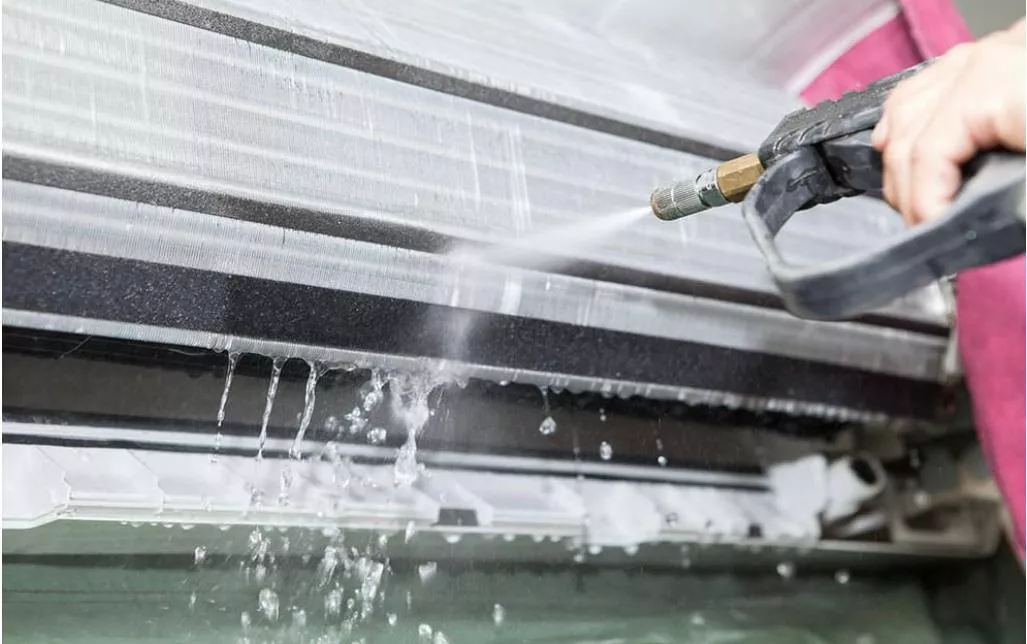
General servicing ($40-50 per unit,) includes filter cleaning, coil washing, drain clearing, and blower wheel cleaning. Chemical wash ($80-120) is needed yearly for heavy-use units or when you notice weak airflow, strange smells, or water leaking. We do a free 9-point pre-check before recommending chemical wash — many competitors push it unnecessarily.
What Servicing Actually Does for Your Bill
Clean filters restore airflow, reducing compressor runtime by 10-15%. Clean evaporator coils improve heat exchange efficiency by 15-20%. A cleared drain prevents water backup that can damage the blower motor (replacement costs $180-250). Checking refrigerant pressure catches slow leaks early, before they cost you $100+ in wasted electricity. Tightening electrical connections prevents arcing that wastes energy as heat.
Temperature, Timer, and Usage Habits That Cut Bills
You can save 10-20% on your aircon bill without spending a dollar, just by changing how you use the system. These aren't 'tips' — they're quantifiable changes we've tested across hundreds of units.
Set Temperature to 24-25°C
24°C is the sweet spot for Singapore homes: cool enough to sleep comfortably, warm enough to avoid overcooling. At 80% humidity, 24°C feels like 22°C in drier climates due to reduced evaporative cooling from your skin. Going from 20°C to 24°C saves roughly 20% on electricity — that's $15-25/month on a typical bedroom unit. If 24°C feels warm, your aircon needs servicing, not a lower temperature setting.
Use Timers, Not All-Night Running
Set your aircon to turn off 1-2 hours before you wake. Your room stays cool from thermal mass (walls, furniture, bedding) and you save 15-25% of overnight electricity. A 900W unit running 8 hours nightly costs about $35/month at $0.30/kWh; cutting 2 hours saves $9/month per room. Use the built-in timer or a smart plug ($15-30 from hardware stores).
Close Doors and Curtains
An open door to a non-airconditioned area makes your aircon work 20-30% harder. Sunlight through windows adds 200-500W of heat load depending on glass type and orientation. Blackout curtains ($20-60 from IKEA or Taobao) cut heat gain by 60-80%. West-facing bedrooms benefit most — afternoon sun is brutal in Singapore.
Fan-Only Mode During Mild Weather
When outdoor temperature drops to 26-27°C (late night, rainy days), fan mode uses 30-50W versus 600-1,000W for cooling mode. You still get air circulation without the compressor running. Rare in Singapore, but when it happens, use it.
When to Repair, When to Replace
An old, inefficient aircon can cost you $300-500 extra per year in electricity compared to a new inverter model. But replacement costs $600-1,200 per unit installed, so timing matters. Here's the decision framework we give customers:
Replace If Your Unit Is:
- 10+ years old and non-inverter: Electricity savings pay back replacement cost in 3-4 years. Older units also need frequent repairs ($150-400 each) as compressors and PCB boards age.
- Using R22 refrigerant: R22 is phased out globally; top-ups now cost $180-280 versus $80-120 for R410A or R32. Next leak might cost more to fix than replacing the whole system.
- Needing a second compressor replacement: Compressor replacement costs $450-700. If it fails twice, other components (PCB, fan motor) are also near end-of-life. Better to replace entire unit.
- Costing $60+ monthly to run one room: A modern 9,000 BTU inverter uses 600-750W versus 900-1,100W for old non-inverter. That's $15-25/month saved per unit, $180-300/year.
Repair If:
- Unit is under 7 years old: Most components still have useful life. Even a $300 repair is cheaper than $900 replacement.
- It's an inverter model with minor issues: Inverter aircons running R410A or R32 are worth repairing unless the compressor fails.
- Only the PCB or fan motor failed: These are $150-280 repairs on units worth keeping.
Inverter Models Save 30-50% Electricity
New aircons must meet BCA's Minimum Energy Performance Standards. Look for 4-5 tick ratings. A 9,000 BTU 5-tick inverter uses 550-650W versus 900-1,000W for old 1-2 tick non-inverter. On a unit running 8 hours daily, that's $12-18/month saved, $144-216/year. Multiply by 3-4 aircons in a typical home and you're saving $430-860 annually.
Insulation, Installation, and Hidden Losses
Even a perfectly serviced aircon wastes electricity if installed poorly or fighting avoidable heat gain. These fixes have upfront costs but pay back within 1-3 years.
Pipe Insulation Prevents Heat Gain
The refrigerant pipe running from indoor to outdoor unit should be fully insulated. Exposed copper pipe, common in older HDB installations, gains 3-5°C of heat before refrigerant reaches the indoor coil, wasting 8-12% of cooling capacity. Re-insulating costs $80-150 during servicing or installation. We check this in our 9-point pre-check.
Outdoor Unit Placement and Shade
Compressors work harder in direct sunlight. An outdoor unit in full sun runs 5-10% less efficiently than one in shade. If your compressor sits on a west-facing ledge with no cover, consider installing a simple metal shade ($50-100 from hardware shops). Don't block airflow — the unit needs 30cm clearance on sides for ventilation. In HDB flats, this sometimes requires MCST approval for ledge modifications; check before installing.
Seal Air Leaks Around Indoor Unit
Gaps around the indoor unit casing let warm, humid air into the cooling coil area, increasing condensation (water leaks) and runtime. Check for gaps where the unit meets the wall or ceiling. Seal with acrylic caulk ($5 from hardware stores). Takes 15 minutes, saves 3-5% electricity.
False Ceiling and Ducted System Losses
Ducted aircon systems hidden in false ceilings lose 10-20% of cooling through poorly insulated ducts and leaky joints. If you have ducted aircon and high bills, get the ducts inspected. Sealing and re-insulating costs $300-600 but saves $200-400/year in larger homes. More common in condos and landed properties than HDB.
Frequently Asked Questions
Does turning aircon on and off waste more electricity than leaving it running?
No. This myth comes from old non-inverter units with high startup current, but even then, the startup surge lasts only 5-10 seconds. Leaving an aircon running in an empty room for 2 hours wastes far more electricity than turning it off and on twice. Inverter aircons have minimal startup cost. Turn off when you leave a room for more than 30 minutes.
How much does aircon really cost per hour in Singapore?
A typical 9,000 BTU inverter aircon uses 0.6-0.75 kWh. At $0.30/kWh average electricity rate (varies by provider and usage tier), that's $0.18-0.23 per hour. Non-inverter or older units use 0.9-1.1 kWh, costing $0.27-0.33/hour. An 8-hour night costs $1.44-2.64 per room. Multiply by 30 days and 2-3 rooms to estimate monthly bills.
Will a smart thermostat save me money?
Smart thermostats and infrared controllers ($80-200) let you schedule aircon remotely and monitor usage. Savings come from remembering to turn off aircon when you're out, not from the device itself. If you already use timers and turn off aircon when leaving, smart controls save little. If you often forget and leave aircon running in empty rooms, they'll pay for themselves in 4-8 months.
Should I switch to R32 refrigerant to save electricity?
You can't retrofit R32 into an R410A system — refrigerants aren't interchangeable due to different pressures and lubricants. R32 is 3-5% more efficient than R410A and has lower global warming potential, but the difference is small. When replacing an old unit, choose R32 if available at similar price. Don't replace a working R410A unit just for R32; the electricity savings don't justify the cost.
How do I know if my high bill is the aircon or something else?
Turn off all aircons for 24 hours and check your smart meter or next day's usage. A typical 4-room HDB uses 3-6 kWh daily without aircon (fridge, lights, electronics). With aircon, usage jumps to 15-30 kWh daily depending on how many hours and rooms. If your usage is high even with aircons off, the culprit is your water heater (3,000W), refrigerator (old models use 150-300W constantly), or something else running 24/7.
Track, Measure, and Adjust
You can't improve what you don't measure. Check your monthly electricity bill and divide total kWh by 30 to get daily average. A 4-room HDB running 2-3 aircons nightly should use 15-25 kWh/day. If you're over 30 kWh/day, something's wrong — either the aircons need servicing, you're overcooling, or another appliance is the problem.
Smart plugs with energy monitoring ($25-40) let you measure individual aircon consumption. Plug one in for a week to see actual usage. Compare against the rated wattage on the unit nameplate. If actual draw is 30%+ higher than rated, the unit needs servicing or repair. We use clamp meters to measure this during servicing — it's part of our free 9-point pre-check.
Want to cut your aircon bill by 20-40% starting this month? The fastest wins are regular servicing, setting temperature to 24°C, and using timers. If your aircon hasn't been serviced in 4+ months, weak airflow and high electricity bills are guaranteed. We do a free 9-point pre-check before any work, transparent pricing, and same-day service across Singapore. WhatsApp us at +65 9107 2601 with your postal code and how many units you have — we'll give you an exact quote in under 5 minutes, no sales rubbish. All work comes with a 90-day workmanship warranty.