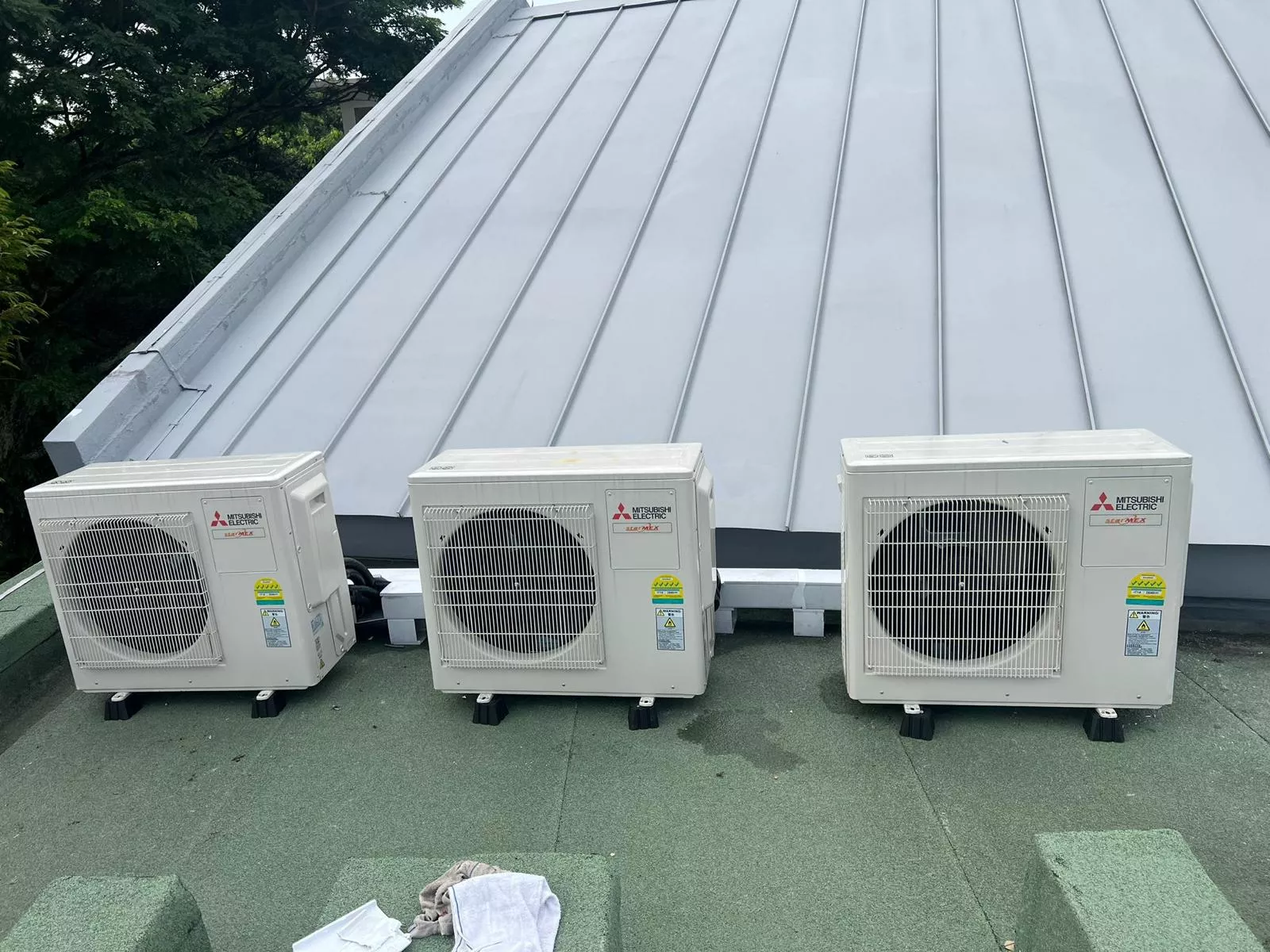
For a typical 3-room HDB, a System 3 aircon (one compressor, three indoor units) costs $2,400–$3,800 installed and suits bedrooms plus living room. A 4-room flat usually needs System 4 ($3,200–$4,800) to cover three bedrooms and living area. A 5-room or executive flat benefits from System 5 ($4,000–$6,000) for four bedrooms plus living, or if you want zone cooling across open-plan spaces. The right choice depends on room count, layout, and whether you cool all rooms simultaneously or zone by zone.
What System 3, 4 and 5 Actually Mean
A multi-split aircon system connects multiple indoor fan-coil units (FCUs) to a single outdoor compressor. The number — 3, 4, or 5 — refers to how many indoor units that compressor can power. System 3 = three indoor units, System 4 = four, System 5 = five.
Each indoor unit can be a different capacity (9k BTU in a bedroom, 12k BTU in the living room) and can be switched on or off independently. The outdoor compressor adjusts its output based on how many units are running. This is different from a window unit (one box, one room) or a single-split system (one outdoor unit dedicated to one indoor unit).
Advantages of Multi-Split Over Multiple Single-Splits
- One compressor on the ledge: HDB bomb-shelter ledges and balconies have limited space. A System 4 uses one outdoor unit instead of four.
- Neater piping: One refrigerant line-set runs from the compressor, then branches to each room. Less exposed trunking along corridors.
- Lower upfront cost (usually): Buying one System 4 is cheaper than four separate single-split sets, especially after accounting for installation labour.
- Easier maintenance scheduling: One compressor means one chemical overhaul appointment when the time comes, rather than coordinating four separate units.
Trade-Offs to Know
- Single point of failure: If the compressor trips or fails, all indoor units go down. With separate single-splits, one failure leaves the others working.
- Sizing complexity: The compressor must be large enough to handle all indoor units running at peak load simultaneously, yet efficient when only one or two rooms are in use. Inverter technology helps, but cheap fixed-speed multi-splits waste energy.
- Refrigerant leak impact: A leak anywhere in the system affects all units. Topping up gas is a single job, but diagnosing which branch leaked can add time.
Matching System Size to HDB Room Count and Layout
| HDB Flat Type | Typical Rooms to Cool | Recommended System | Installed Price Range (SGD) |
|---|---|---|---|
| 3-room (2 bedrooms) | Master, Common, Living | System 3 | $2,400–$3,800 |
| 4-room (3 bedrooms) | Master, Common 1, Common 2, Living | System 4 | $3,200–$4,800 |
| 5-room (3 bedrooms + study) | Master, Common 1, Common 2, Study, Living | System 5 | $4,000–$6,000 |
| Executive (4 bedrooms) | Master, Common 1, Common 2, Common 3, Living | System 5 | $4,000–$6,000 |
When to Downsize: System 3 for a 4-Room Flat
If you rarely use one bedroom (guest room, store room) or prefer a portable fan there, a System 3 can cover master bedroom, one common bedroom, and the living room. This saves $600–$1,200 upfront. You can always add a window unit or portable aircon to the fourth room later if needed. Just ensure the compressor's total capacity (BTU) matches the three rooms you do cool — undersizing leads to poor humidity control and longer run times.
When to Upsize: System 5 for a 4-Room Open-Plan Reno
Knocked down the kitchen wall for an open-concept living-dining-kitchen? That enlarged space may need two indoor units (one 12k BTU cassette over the dining area, one 9k BTU wall-mount in the original living zone) plus three bedrooms = five units total. A System 5 gives you the flexibility to zone cooling: run only the dining cassette during dinner prep, or all five during a house party.
Component Breakdown and What Drives the Price Spread
A complete System 4 installation includes the outdoor compressor, four indoor fan-coil units, copper refrigerant piping (typically 10–20 metres), PVC condensate drain pipes, wall brackets, electrical wiring from the DB board, and labour. Here's what shifts the final invoice from the low end to the high end of the range.
Brand and Inverter Technology
- Budget tier ($3,200–$3,800 for System 4): Brands like Midea, Akira, or older Mitsubishi non-inverter models. Fixed-speed compressors cycle on-off, noisier, higher electricity bills. Suitable if you cool rooms only 2–3 hours per day.
- Mid-tier ($3,800–$4,300): Daikin, Mitsubishi Electric, Panasonic inverter multi-splits. Variable-speed compressors ramp smoothly, quieter, 30–40% more efficient over a year. This is the sweet spot for daily use in Singapore heat.
- Premium tier ($4,300–$4,800+): Daikin VRV-style systems with advanced zoning, or Mitsubishi Electric Starmex with nanoe-X air purification. Adds smart-home integration, finer temperature control, better humidity removal in the 80%+ RH Singapore climate.
Piping Run Length and Concealment
Standard quotes assume ~15 metres of copper piping total. If your compressor sits on a far-end balcony and one bedroom is at the opposite corner, you may need 25+ metres. Every additional metre of ¼-inch and ⅜-inch copper pair costs $8–$12 in material, plus labour to secure and insulate it. Concealed trunking (boxed-in along the ceiling or wall) adds $15–$25 per metre over exposed PVC trunking. For a neat finish in a renovated flat, budget an extra $300–$600 for full concealment.
Outdoor Unit Placement: High-Floor Constraints
HDB flats above the 10th floor often require the compressor on a reinforced bracket cantilevered from the bomb-shelter ledge, with additional tie-downs to meet BCA wind-load rules. Some installers charge $150–$300 for high-floor bracket upgrades. If your ledge is already crowded (water heater, laundry rack, previous owner's abandoned compressor), expect extra metalwork or even MCST approval if you need to mount on a common façade (rare in HDB, more common in condos).
R32 vs R410A Refrigerant
Newer models (2020 onward) use R32, which has lower global-warming potential and runs 5–8% more efficiently than R410A. R32 systems cost the same upfront but save $50–$80 per year in electricity for a typical 4-room household. When the time comes for gas top-up (every 3–5 years if no leaks, sooner if there is one), R32 costs about $80 per kg versus $70 per kg for R410A — negligible difference. Avoid any new R22 systems; R22 is phased out under the Montreal Protocol, and topping up gets progressively harder and more expensive.
Installation Timeline and Coordination
From purchase order to cool air, expect 5–10 working days for a straightforward System 3, 4 or 5 install in a resale flat, or 3–5 days if the trunking routes and DB board are already prepped during renovation.
Step-by-Step Process
- Site survey (30–60 min): Technician measures rooms, checks ledge space, confirms DB board capacity (a System 4 draws ~20–30 A at full load; your circuit breaker must handle it). Quotes exact piping length, any high-floor bracket needs, and trunking options.
- Delivery and bracket install (half day): Outdoor compressor and indoor units arrive. Team installs the compressor bracket, checks ledge drainage, and secures the unit. This step can be noisy — inform neighbours if you're in a condo.
- Indoor unit mounting (half day to full day): Wall-mounted units need reinforced backing if the wall is hollow Gypsum board. Cassette units (ceiling-recessed) require false-ceiling access and may need carpenter coordination. Installers drill through walls for piping, fit brackets, hang units, level them to ensure condensate drains correctly.
- Piping, wiring, and vacuuming (half day): Refrigerant lines are flared and brazed (welded), insulated, and tested for leaks using nitrogen pressure (450–500 psi held for 15 minutes). Condensate pipes slope at least 1:100 to prevent backflow. Electrical cables run from the outdoor isolator to the DB board. Finally, the system is vacuumed to remove air and moisture, then charged with refrigerant.
- Commissioning and handover (1 hour): Each indoor unit is powered on, airflow checked, temperature drop verified (inlet to outlet should be 10–12°C). You'll get a quick run-through of the remote controls and any Wi-Fi app pairing.
Coordination If You're Renovating
If your flat is undergoing renovation, schedule aircon rough-in (piping and wiring) after hacking and before false-ceiling or partition-wall closure. The carpenter builds the bulkhead around the piping; the aircon installer returns after painting to hang the indoor units and commission. This sequence keeps trunking hidden and avoids dust contamination during hacking. Expect two site visits: rough-in takes half a day, final install another half day.
Running Costs and Energy Efficiency
Electricity is the ongoing expense. A System 4 household running the master bedroom overnight (8 hours) and living room evenings (4 hours) will see roughly 300–400 kWh per month attributable to aircon, or $70–$95 on the SP Group bill at current tariffs (~$0.24/kWh as of 2025). Here's how to keep that number toward the lower end.
Inverter Savings Over Fixed-Speed
An inverter System 4 consumes about 2.8–3.2 kW when all four units run at startup, then drops to 1.2–1.8 kW once rooms reach set-point. A non-inverter model cycles: 3.5 kW on, 0 kW off, 3.5 kW on again. Over a month, inverter saves 25–35% — that's $18–$28 monthly, or $216–$336 yearly. The inverter premium ($400–$600 upfront) pays back in under two years.
Zone Cooling: Don't Run All Units Unless You Need To
One advantage of multi-split is independent control. If you're working from home in the study, run only that unit. Running one 9k BTU fan-coil draws roughly 0.7–0.9 kW; running all four draws 1.5–2.0 kW even at cruise. A household that habitually switches off unused rooms can halve aircon costs compared to leaving everything on 24/7.
Regular Servicing to Maintain Efficiency
Clogged filters and dirty coils force the compressor to work harder. A neglected System 4 can see energy consumption creep up 15–20% over two years. Standard servicing every three months (for units running daily) keeps airflow optimal. At aircons.sg, the 9-point pre-check included with any service booking (minimum $45 for one unit; add $35 per additional unit for System 3/4/5 jobs) covers filter cleaning, coil inspection, drain-line flushing, and refrigerant pressure check. If the tech finds low gas or a dirty blower wheel that needs a chemical wash, you'll get a transparent quote on the spot — and the $45 minimum rolls into the total if you proceed.
Common Mistakes When Choosing System Size
Undersizing the Compressor Capacity
A System 4 compressor rated at 28k BTU total will struggle if you pair it with four 9k BTU indoor units (36k BTU demand). The result: compressor runs continuously, never quite reaching set temperature, higher electricity draw, shorter compressor lifespan. Always ensure the outdoor unit's capacity equals or exceeds the sum of all indoor units at their nominal rating. Reputable installers size this automatically, but DIY online purchases sometimes mismatch components.
Ignoring Refrigerant Pipe Distance Limits
Most residential multi-split systems allow a maximum pipe run of 20–25 metres from compressor to the farthest indoor unit, and a maximum height difference (vertical rise) of 10–15 metres. In a high-floor HDB, if the compressor is on the 12th-floor ledge and you want an indoor unit in a 14th-floor loft extension (rare but possible in maisonettes), you may exceed the vertical limit, causing oil-return problems and compressor damage. Check the manufacturer's installation manual limits during the site survey.
Choosing the Cheapest Brand Without Checking Aftersales
A $2,400 System 3 from an unknown brand may use a compressor with no local parts distributor. When it fails in year four, you're looking at a full replacement instead of a $600 compressor swap. Daikin, Mitsubishi Electric, and Panasonic have extensive Singapore service networks and stock spare parts for models up to ten years old. The $400 premium buys you that peace of mind and a unit that's easier to service long-term.
Skipping the Workmanship Warranty Check
Manufacturer warranties (usually 1 year parts, 5–6 years compressor) don't cover installation defects: refrigerant leaks at flare joints, condensate pipe slope errors, loose electrical terminations. A proper installer offers a separate workmanship warranty. At aircons.sg, every installation comes with a 2-year workmanship warranty and every repair a 90-day one — if a joint we brazed leaks or a drain we routed overflows, we'll return and fix it at no charge. Always confirm this in writing before deposit payment.
System 3, 4 or 5: Decision Flowchart Summary
- Count the rooms you cool daily: Bedrooms, living room, study. Exclude store rooms, balconies, or rooms you use twice a year.
- Check your ledge space: Measure width and depth. A typical System 4 compressor is ~900 mm wide × 350 mm deep × 700 mm tall. If you share a ledge (some old HDB layouts), confirm clearance.
- Budget for inverter mid-tier if you run aircon >4 hours daily: The energy payback is real. Fixed-speed is acceptable only for weekend-use vacation apartments.
- Match indoor capacities to room size: 9k BTU for bedrooms ≤12 m², 12k BTU for master bedrooms or living rooms 12–20 m², 18k BTU for open-plan spaces >20 m². The installer will calculate heat load (window area, sun exposure, occupancy), but these rules of thumb get you 90% there.
- Add one extra unit allowance if future-proofing: Planning to convert the study into a nursery that needs cooling? Go System 4 instead of System 3 now, leave the fourth indoor unit's piping stubbed and capped. Adding a fan-coil later costs $400–$600; adding a whole new outdoor unit costs $1,500+.
Frequently Asked Questions
Can I install a System 5 in a 4-room HDB if I want extra cooling in the living room?
Yes. You can put two indoor units in the living area (one near the dining zone, one near the sofa) plus three bedrooms, totalling five units. This gives finer temperature control in the open space and avoids a single oversized 18k BTU unit blasting cold air unevenly. Just ensure the outdoor compressor's capacity covers all five indoor units combined, and that your ledge has space for the larger compressor.
What happens if one indoor unit in my System 4 breaks — do all four stop working?
Usually no. A failed indoor fan motor or PCB in one unit won't shut down the other three; the compressor simply ignores the non-responsive unit. However, a compressor failure or a major refrigerant leak in the shared outdoor section will stop all indoor units until repaired. This is the main trade-off versus separate single-split systems.
How often should I service a multi-split system, and does it cost more than servicing single units?
Service every three months if you run the aircon daily, or every six months for light use. Cost scales with the number of indoor units: at aircons.sg, the first unit is $45 (includes the 9-point pre-check and standard cleaning), then $35 for each additional unit in the same system. A System 4 quarterly service is therefore $45 + 3×$35 = $150, covering all four indoor units plus the outdoor compressor inspection. That's cheaper than four separate $60 single-split appointments.
Is R32 refrigerant worth insisting on, or is R410A still fine in 2025?
R32 is the better choice for new installations. It's 5–8% more efficient, has one-third the global-warming potential of R410A, and is the direction all manufacturers are moving. R410A remains widely available and serviceable, so if you're buying a discounted 2019-stock unit, it's not a deal-breaker — but given equal price, pick R32. Avoid R22 entirely; it's phased out, and gas top-ups are increasingly expensive and hard to source legally.
Can I mix different brands of indoor units on one System 4 compressor to save money?
No. Multi-split systems require matching indoor and outdoor units from the same manufacturer, often the same model series, because the compressor's control board communicates digitally with each indoor PCB. Mixing a Daikin compressor with a Mitsubishi fan-coil will either not work at all or cause erratic behaviour and void warranties. Stick to one brand across the entire system.
Get the Right System Size, Installed Right
Choosing between System 3, 4 or 5 comes down to room count, your cooling habits, and budget for quality components. A properly sized inverter multi-split from Daikin, Mitsubishi Electric or Panasonic will serve a typical HDB household for 10–12 years with routine servicing, lower electricity bills than separate single-splits, and the flexibility to cool only the rooms you're using. If you're unsure whether your 4-room layout needs System 4 or if System 3 plus one window unit makes more sense, or if your ledge can physically fit the compressor you want, WhatsApp the aircons.sg team at +65 9107 2601. We'll talk through your floor plan, quote transparent pricing (no hidden fees), and schedule a site survey if needed. Every installation includes our 2-year workmanship warranty and a proper commissioning check — because getting the system size right is only half the job; installing it right is the other half.
Related: What aircon installation actually costs in Singapore — our published system prices, what they include, and what moves the final figure.