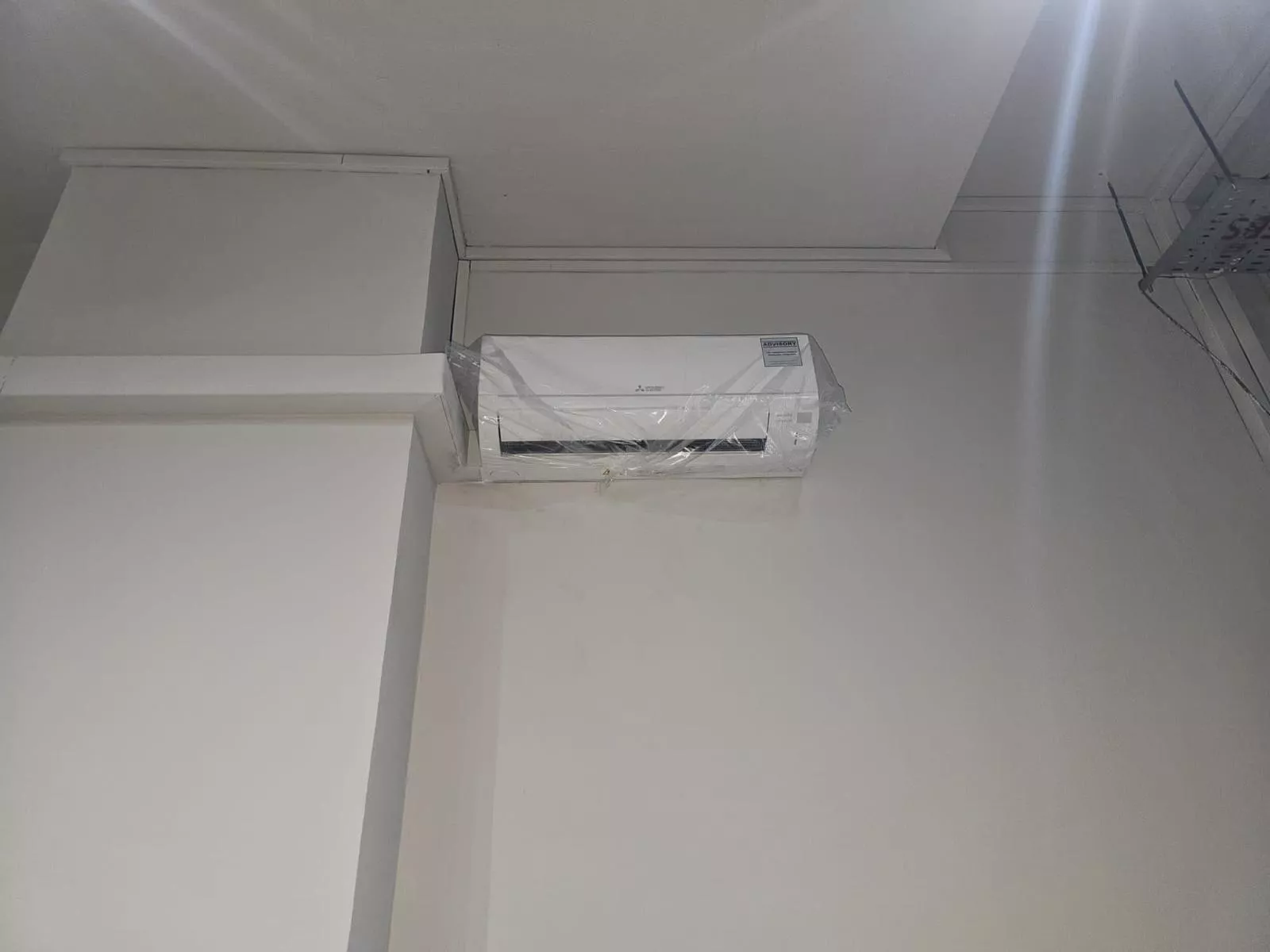
Inverter aircons save 30–50% on electricity versus non-inverter units in typical Singapore use (8–12 hours daily). An inverter system costs $200–400 more upfront but recoups that premium in 18–30 months through lower bills. For HDB flats and condos running aircon overnight or all day, inverter is the clear winner. Non-inverter suits guest rooms or short-burst cooling (under 3 hours daily) where the higher running cost doesn't accumulate. Both need the same servicing cadence—quarterly for heavy use, every 3–4 months otherwise—and the 9-point pre-check included with every aircons.sg service booking ($55 for 1 unit) covers both types equally.
How Inverter and Non-Inverter Compressors Work
A non-inverter aircon uses a fixed-speed compressor. When the room hits target temperature, the compressor shuts off completely. When the thermostat detects warmth, it restarts at full power. This stop-start cycle—common in units installed before 2015—draws a large inrush current every time the compressor kicks in, spiking electricity demand and wearing motor windings faster.
An inverter aircon uses variable-frequency drive (VFD) technology: the compressor never stops, but ramps down to 20–30% capacity once target temperature is reached, then modulates speed to match heat load. No hard restarts mean lower peak current, smoother temperature control (±0.5°C versus ±2°C for non-inverter), and much quieter operation at steady state.
Both types use the same refrigerants—R32 and R410A are standard in Singapore since the R22 phase-out—and both require identical installation: bracket mounting (HDB needs HDB-approved contractors for external ledge work), copper piping, condensate drainage, and electrical isolation. The difference is purely in the compressor controller PCB and the motor driver circuitry.
Electricity Cost Comparison: Real Singapore Numbers
Electricity tariffs in Singapore hover around $0.28–$0.35 per kWh (2024 SP Group Open Electricity Market rates). A 9,000 BTU non-inverter unit draws roughly 900–1,000 W at full load; an equivalent inverter model draws 600–700 W at full load and averages 300–400 W once the room stabilises.
Monthly Running Cost (9,000 BTU Unit, 8 Hours Daily)
| Compressor Type | Average Power Draw | Monthly kWh (8 hrs × 30 days) | Monthly Cost (@$0.30/kWh) |
|---|---|---|---|
| Non-Inverter | 850 W | 204 kWh | $61 |
| Inverter | 450 W (modulating) | 108 kWh | $32 |
| Savings | — | 96 kWh | $29/month |
Over a year, that's $348 saved. If the inverter unit cost $350 more than the non-inverter at purchase, payback is 12 months. In practice, street prices for 9,000 BTU non-inverter systems (Mitsubishi, Daikin, Midea) run $550–$750 supplied and installed; inverter equivalents are $800–$1,100, so the delta is $200–$400 depending on brand and installer markup.
Usage Scenarios and Break-Even
- Heavy use (10+ hours daily): bedrooms, work-from-home study, 24/7 elderly care. Inverter pays back in 12–18 months.
- Moderate use (6–8 hours daily): living rooms, evening-only bedrooms. Inverter pays back in 20–30 months.
- Light use (under 3 hours daily): guest rooms, storage rooms with occasional occupation. Non-inverter is often cheaper over the unit's 10-year lifespan because the compressor rarely cycles and the upfront premium isn't recovered.
Singapore's year-round heat and 80–85% humidity mean most households run aircon daily. For those profiles, inverter is the financially rational choice even before counting comfort (steadier temperature, lower noise) and environmental benefits (lower carbon footprint per cooling hour).
Servicing, Repairs, and Longevity
Both inverter and non-inverter aircons need regular servicing every 3–4 months (quarterly if you run them heavily). Dust clogs the evaporator fins, mould grows in the blower housing, and condensate drains silt up regardless of compressor type. The 9-point pre-check included with every aircons.sg service booking covers filter cleaning, coil inspection, drain flushing, refrigerant pressure check, electrical connection tightening, thermostat calibration, and blower fan cleaning—all identical steps for both architectures.
Common Failure Modes
| Component | Non-Inverter | Inverter |
|---|---|---|
| Compressor | Hard-start relay and run capacitor wear from repeated inrush; typical lifespan 8–12 years | VFD board and IGBT transistors can fail (heat, humidity); compressor itself lasts 10–15 years due to gentler operation |
| PCB / Controller | Simple thermostat and relay board; repairs $80–$150 | Microcontroller and power electronics; board replacement $180–$350 |
| Fan Motor | Single-speed; bearing replacement $60–$100 | Variable-speed or brushless DC; motor replacement $100–$180 |
| Refrigerant Leak | Gas top-up $80–$120 (R410A/R32); same for both | Gas top-up $80–$120 (R410A/R32); same for both |
Inverter control boards are more complex, so out-of-warranty PCB replacement costs more. However, the compressor—the single most expensive component—sees less mechanical stress in an inverter system, often outlasting non-inverter compressors by 2–4 years. On balance, total cost of ownership (purchase + electricity + repairs) over 12 years favours inverter for any household running aircon more than 4 hours daily.
Refrigerant and Gas Top-Up
Both types use R32 or R410A refrigerant (R22 is fully phased out as of 2020 under the Montreal Protocol). Gas top-up procedures are identical: recover remaining refrigerant, vacuum the system, recharge to manufacturer spec (typically 650–750 g for a 9,000 BTU split), and leak-test. Cost is $80–$120 for top-up, $45–$60 for leak detection if needed. Inverter aircons do not leak more often—leak rate depends on installation quality (flare joints, brazed connections) and vibration exposure, not compressor type.
Installation Considerations in Singapore
HDB Flats
HDB allows aircon installation on approved brackets and ledges. For both inverter and non-inverter, the outdoor condenser must be installed on the metal bracket outside the window or on the designated aircon ledge (common in newer 4-room and 5-room flats). Do not place condensers on bamboo poles or unapproved cantilever arms—HDB can issue notices and fines. Inverter condensers are sometimes slightly heavier (by 2–4 kg) due to the VFD board, but all modern brackets support up to 60 kg, so weight is not a constraint.
Condominiums and Landed
Condos often require MCST approval for external works, including condenser placement and facade drilling. Inverter units run quieter (outdoor noise drops from ~55 dB to ~48 dB at low speed), which helps if your neighbour's bedroom window is adjacent to your condenser. Landed homes have fewer restrictions; the main consideration is avoiding direct sunlight on the condenser (use a louvre or awning) to maintain efficiency, regardless of inverter or non-inverter type.
Electrical Supply
Both require a dedicated 15 A or 20 A circuit breaker and 2.5 mm² cable. Inverter aircons have lower peak current draw because they avoid the hard-start inrush, so existing wiring that handled a non-inverter unit will handle an inverter replacement with no upgrades. If you're installing multiple units, calculate total load: Singapore HDB mains are typically 40 A or 60 A single-phase; a 5-room flat running three 9,000 BTU inverter aircons simultaneously draws roughly 15–18 A combined, well within limits.
Which Should You Choose?
Go Inverter If:
- You run the aircon more than 4 hours daily—bedrooms, living areas, home offices.
- You value quiet operation and stable temperature (especially for babies, elderly, or light sleepers).
- You plan to keep the unit for 8+ years—the electricity savings compound and the longer compressor lifespan pays off.
- You want to reduce carbon footprint—lower kWh per month translates directly to lower grid demand and emissions.
Go Non-Inverter If:
- The room is used sporadically—guest bedroom, storeroom, workshop—under 3 hours daily.
- Budget is extremely tight and you need cooling now; the $200–$400 upfront difference matters more than long-term savings.
- You're renting short-term (under 2 years) and won't capture the payback period.
For the typical Singaporean household—HDB 4-room or 5-room flat, two working adults, aircon in bedrooms from 10 p.m. to 7 a.m. and living room evenings—inverter is the better buy. The math is unambiguous once runtime exceeds 1,200 hours per year (roughly 3.3 hours daily).
Frequently Asked Questions
Can I retrofit an inverter compressor into my existing non-inverter aircon?
No. The compressor, outdoor unit casing, control board, indoor unit PCB, and wiring harness are all different. Retrofitting costs more than buying a new inverter system. If your non-inverter unit is over 8 years old and the compressor fails, replace the whole system with an inverter model rather than repairing.
Do inverter aircons really last longer?
The compressor itself does—10 to 15 years versus 8 to 12 for non-inverter—because it avoids hard-start mechanical shock. However, the electronics (VFD board, sensors) can fail earlier due to heat and humidity. Overall lifespan is comparable; the inverter edge comes from lower cumulative running cost, not dramatically longer hardware life.
Does inverter aircon cooling feel different?
Yes. Inverter units maintain temperature within ±0.5°C of setpoint by modulating compressor speed, so you feel less of the warm-cold cycling common with non-inverter on-off operation. Humidity control is also better because the evaporator runs continuously at lower capacity, removing moisture steadily rather than in bursts.
Is chemical wash different for inverter versus non-inverter aircons?
No. Chemical wash (or chemical overhaul if the unit is heavily soiled) involves the same steps: dismantle the indoor unit, flush the evaporator coil and blower with alkaline cleaner, rinse, reassemble. The outdoor condenser coil is cleaned the same way. Cost is identical—$80–$120 for chemical wash per unit, $150–$220 for chemical overhaul. Both types benefit from chemical cleaning once a year if you run them daily.
Will switching to inverter aircon lower my SP bill noticeably?
Yes, if you currently run non-inverter units heavily. Replacing two 9,000 BTU non-inverter bedroom aircons (8 hours nightly each) with inverter models saves roughly 190 kWh per month, or $57/month at $0.30/kWh. That's $684 per year—enough to fund quarterly servicing for your entire home and still pocket $400+. The savings show up within the first billing cycle.
Book Your Aircon Service With Transparent Pricing
Whether you run inverter or non-inverter, both need the same care: regular filter cleans, coil inspections, and drain flushing to maintain efficiency and prevent breakdowns. Every aircons.sg service booking starts at $55 (minimum for 1 unit) and includes the full 9-point pre-check—filter cleaning, coil inspection, refrigerant pressure check, drain flush, thermostat calibration, and more. If the technician finds your gas is low, coils are choked, or the PCB is failing, you'll get a transparent quote on the spot (prices are final). If you're weighing an upgrade from non-inverter to inverter, the same visit can assess your existing system's condition and advise on replacement timing. We're on-site same day across Singapore, and every job is backed by a 90-day workmanship warranty. WhatsApp us at +65 9107 2601 to book—no contact forms, no back-and-forth, just straight answers from the people who do the work.