You are about to renovate an HDB flat or a condo, the aircon is on your handover checklist, and the quote from your interior designer does not mention it. So the question comes up: do you get the aircon serviced before the renovation starts, or after it finishes? It sounds like a small scheduling detail. Booked in the wrong order, it costs you a wasted service fee and, in the worst case, a leaking unit dripping onto brand-new carpentry.
The short answer for almost every home: service after the renovation, not before. The one thing you do before is protect the units and, if there is an existing fault, get it checked. Here is why the order matters and how to run it so nobody argues about it later.
Why "before" almost always wastes the money
Renovation is a dust factory. Hacking a wall, screeding a floor, sanding skirting, cutting a false ceiling, spraying paint — each of these throws fine cement, wood and filler dust into the air, and that dust does not politely stay on the floor. It rides the room's air currents straight into anything with a fan inside it.
An aircon fan-coil is exactly that. Its blower wheel spins thousands of times a minute and pulls room air across the coil. During works, it pulls in renovation dust and lays it down where a normal service never reaches: bridging the thin aluminium fins of the coil, caking the blower wheel's little cups, and settling into the drain pan where it turns to sludge the first time condensation runs through it.
So if you service before the renovation, you have paid to clean a unit that is about to get filthy again within days. General servicing on this site is $45 for one unit, dropping to $25 per unit from five units up. Spending that the week before your contractor starts hacking is money you will spend twice, because the unit will need cleaning again after the works regardless.
The real risk: running a unit while the dust is flying
The bigger mistake is not the wasted fee — it is switching the aircon on during renovation. It is hot, the workers are sweating, and someone flips it on to cool the room. Now the fan is actively sucking cement dust onto a wet coil. That dust sets hard, the drain pan silts up, and the first time you run the unit properly after moving in, the blocked drain backs up and water drips out of the fan-coil — often onto the very feature wall or built-in cabinet that was just installed.
The rule during works is simple: keep the units off and covered. A good renovation contractor wraps every fan-coil in plastic sheeting and tapes it shut before hacking or painting. If yours has not mentioned it, that is your first thing to raise — today, before the deposit is paid.
When the units are removed, not just covered
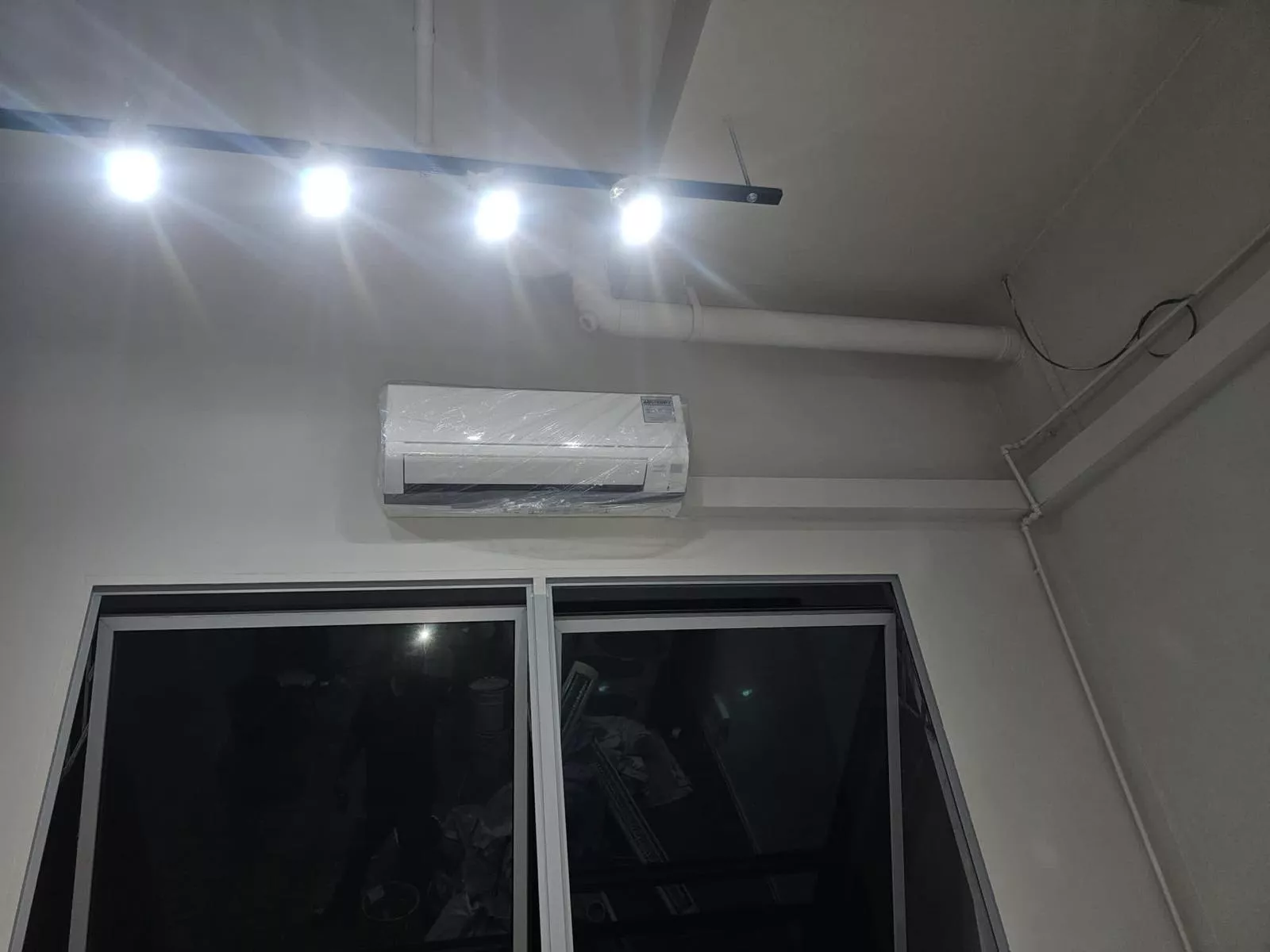
Sometimes covering is not enough. If you are building a new false ceiling that encloses the fan-coil, changing the position of a unit, or the renovation touches the wall the unit sits on, the fan-coil has to come off and go back up afterwards. That is a relocation job, not a service, and it changes your timeline: the unit is only reinstalled near the end of the works, and the servicing (or a chemical wash if the coil was exposed) happens after it is back on the wall and tested for cooling and drainage. The photo on this article shows exactly this situation — a new wall-mounted split still in its factory wrapping, going into a room with bare walls and exposed conduit. New or old, the unit does not get uncovered until the dusty trades are done.
Does a general service clear it, or do you need a chemical wash?
After the renovation, how deep a clean you need depends on how well the unit was protected:
- Wrapped and switched off the whole time: the dust mostly sat on the outside of the plastic. A general service — filter wash, coil wipe-down, drain flush — usually clears it.
- Left uncovered, or run during the works: dust has bridged the coil fins and packed the blower wheel, and no amount of surface wiping reaches it. That needs a chemical wash, which on this site starts at $135 for one unit (and $100 per unit from five units up), because the coil and blower come out for a proper soak.
You do not have to diagnose this yourself. Tell the technician what was done in the flat — hacking, ceiling, painting — and whether the units were covered, and they will tell you which service the unit actually needs. If you want the numbers side by side first, the full aircon servicing price list is published on the site.
The one thing worth doing BEFORE the works
There is a case for a pre-renovation visit, but it is not a service — it is a check. If a unit is already giving trouble (weak cooling, a smell, water marks under the fan-coil, ice on the pipe), get it looked at before the renovation swallows it. The reason is access: once the false ceiling closes, the trunking is boxed in and the feature wall is up, a technician trying to reach a fault has to undo finished work. It is far cheaper to fix a known problem while the ceiling is still open. If the units are healthy, skip this — a pre-reno service on a working unit is the wasted fee described above.
Coordinating with your renovation contractor
Aircon sits in the gap between trades, which is where things fall through. A few things to settle in writing before works begin:
- Who protects the units? Confirm the interior designer or contractor will wrap and switch off every fan-coil, and that it is part of their scope — not something you assumed.
- Who reinstalls if a unit comes down? If the ceiling or wall works need the unit removed, agree whether the renovation team's aircon subcontractor puts it back, or whether you are bringing in your own installer. Get the drainage fall and cooling re-tested after reinstatement.
- Book the service for after the final clean. The last dusty jobs are usually painting and the post-reno general cleaning. Book the aircon service after those, not between coats, or you clean the unit into a room that is still shedding dust.
The sequence, in order
- Before: only a check, and only if a unit is already faulty — fix known problems while access is open.
- During: units off and wrapped in plastic; never run them to cool the workers.
- After the last dusty trade: book a general aircon service, or a chemical wash if the units were exposed or run during works.
For more on the timing side of this, our guide on getting the aircon sequence right in a renovation covers when a new unit should go in relative to the ceiling. If your works are already done, clearing out the dust after a renovation walks through what each visit covers. And if you are simply deciding when to book a routine clean, see the best and worst months to service your aircon in Singapore.
Tell us what is happening in the flat
Message us the scope of your renovation and how many units you have, and we will tell you whether to hold off until the works finish and whether a general service or a chemical wash is the right call afterwards.
WhatsApp us on 9107 2601 — tell us what is being done in the flat and we will sort the timing with you.