You found the model you wanted at a price that looked good. Maybe it was an online listing, maybe a shop or a fair, maybe a friend's tip. Now it has to go on your wall and your ledge, and the person who sold you the box is not the person who will drill the holes. So you ask for an installation quote on its own, and a number comes back. Is it complete? What is it missing? Who is responsible if the cooling is poor in six months?
We install units customers have bought elsewhere, and the same few gaps come up in this situation. This guide walks through what to settle before you pay for the unit, what a complete installation actually contains, how the warranties split, and how to compare a unit-plus-installer total fairly against a supply-and-install quote. Every figure below is one already published on our pricing page or on the installation cost page.
Get the survey before you buy the unit
This is the one step people skip because the unit looked like a bargain. A free site survey and a BTU recommendation are part of how we quote an installation, and they settle three things that are expensive to get wrong after the box is delivered:
- How many indoor units you need and which size. A single split, a System 2, 3 or 4 each share one outdoor condenser across a different number of rooms. If you want to size it yourself first, the free aircon calculator works from a floor plan.
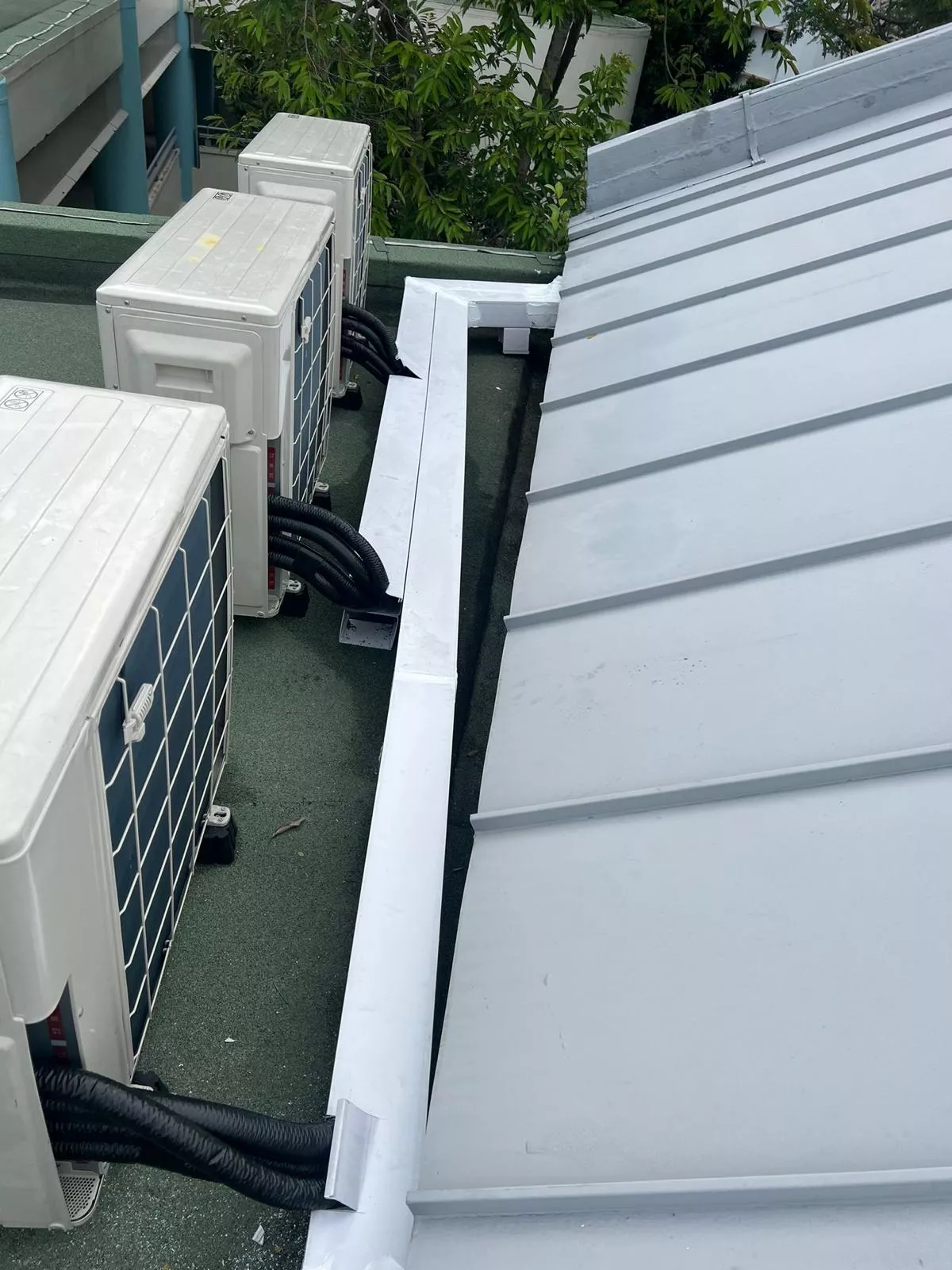
- Where the outdoor unit goes. The outdoor unit has to fit the space and sit on proper brackets. In an HDB flat that space is the designated aircon ledge. Our guide to what the ledge allows covers it, and the practical step is to put the outdoor unit's dimensions from the spec sheet next to a tape measure on your ledge before you pay.
- Whether the electrical side is ready. Older properties sometimes need an isolator or a dedicated point added. We check that at the survey.
A unit that is the wrong size for the room, or too big for the ledge, is not something even a good installer can fix.
What a complete installation contains
"Installation" is not one thing, and an install-only quote that lists a single figure can hide which parts are in and which are out. This is what our standard installation includes, taken from the published installation page:
- Free site survey and BTU recommendation
- Indoor and outdoor unit mounting on proper brackets
- Insulated copper refrigerant piping (standard length) and drainage piping
- Electrical wiring and isolator connection
- Vacuum, leak test and correct gas charge
- A full performance test on every unit
- Removal and disposal of your old units, on request
Then there is the second list: the things that are quoted separately because they depend on your home. Extra copper piping beyond the standard run, concealed trunking for a cleaner finish, or a new electrical point. We quote these upfront at the survey, never added afterwards. When you compare two installers, put the two lists side by side and ask each one which line the other's price leaves out.
These questions put the comparison on paper:
- Is the piping length in the price, and what is the standard run? Extra length beyond the standard run is a separate charge, so a short quote can simply mean a short run.
- Are the brackets, drainage piping and isolator included? They are part of our standard installation. Another quote may price them as extras.
- Is there a vacuum and leak test, and a performance test on every unit? Skipping them saves time on the day and costs you later.
- Is removing my old unit included? On request on ours. Elsewhere it may be a fee, or not offered.
- What exactly does the workmanship warranty cover, and for how long? Ours is 2 years on the installation. Get any other installer's in writing.
Two warranties, two documents
This is the part that confuses people most. When you buy the unit in one place and have it installed in another, you end up holding two warranties that are not the same thing:
- The installation warranty covers the workmanship: the mounting, piping, wiring and drainage. Ours is 2 years and applies whether the unit came from us or from elsewhere.
- The manufacturer's warranty covers the unit itself. It is set by the brand and the seller. On the units we supply, the manufacturer's 5-year compressor warranty comes with them. For a unit you bought elsewhere, the terms are whatever its warranty card says, and we cannot speak for any brand.
Before you pay for the unit, ask the seller one question in writing: does the manufacturer's warranty depend on who installs it, or on a particular type of installer? Then you know before the box arrives, not when something fails. Keep the receipt, the model and serial numbers, the delivery order and our installation invoice together in one place, and note the installation date on them. If you ever need to claim, the first question is always when it was installed and by whom.
The HDB rule that applies whoever sells the unit
For an HDB flat, the installation must be carried out by a BCA-licensed contractor, with the outdoor condenser on the flat's designated aircon ledge on proper brackets, not on the roof or the common corridor in most blocks. That applies to a unit bought online exactly as it does to one we supply. The rules are in our HDB installation rules guide, and it is worth reading before you commit to a model, because an outdoor unit that does not fit the ledge is the kind of problem that forces a purchase to change.
Delivery and the installation day
Agree the delivery date with the seller before you fix the installation date, so the units are in the flat when the installer arrives. When they are delivered, check the boxes for damage and photograph anything you are unsure of before you sign for it. A dented outdoor unit is far easier to deal with on the day it arrives than after it has been bolted to a ledge.
A System 3 or System 4 in a typical flat is usually a full day for us. The order rarely varies: brackets and mounting first, then piping and drainage, then electrical, then the vacuum and leak test, then the gas charge, and finally a performance test on every unit before we leave. That last stretch is the one to insist on: a system that skips the vacuum and performance tests can run for weeks before it shows up as poor cooling, and by then it looks like a fault rather than a shortcut.
How to compare the total fairly
We do not publish an install-only price. The pricing page lists "from" prices for a complete system, standard inverter then premium tier: single split from $1,200 and $1,500, System 2 from $2,200 and $2,800, System 3 from $2,800 and $3,300, System 4 from $3,500 and $4,500. They are a starting point, and the final figure depends on your property, the piping run and the brand. An install-only quote is given after the free survey.
So the fair comparison is a total, not a unit price. Add the price of the unit you found to the install-only quote, including anything the quote lists separately, then set that against a supply-and-install quote for the same system. Make sure both name the same model, the same BTU size and the same tick rating. Two quotes can look identical until you notice one is a 2-tick unit and the other a 5-tick, and that gap shows up on your electricity bill for years.
Sometimes the unit you found is genuinely the better buy. Sometimes the totals come out level and a single warranty settles it. Either is a reasonable answer; buying first and discovering the installation costs afterwards is not. If your unit came from a roadshow or fair, read what the roadshow package price excludes before you add the installer on top.
A short checklist before you pay for the unit
- Book the free site survey and get the BTU recommendation and the number of indoor units.
- Measure the outdoor space and compare it with the outdoor unit's dimensions on the spec sheet.
- Get the model number and tick rating of the unit in writing.
- Ask the seller whether the manufacturer's warranty depends on who installs.
- Get the install-only quote itemised, with the piping length and the extras listed.
- Add the two prices and compare the total with a supply-and-install quote for the same system.
- Agree the delivery date, and keep all the paperwork together.
If you have not bought yet, or the box is already sitting in the flat, tell us the system type, your property type and the brand and model. WhatsApp us on 9107 2601 and we will arrange the free survey and tell you what an installation of that unit would involve. For the full "from" prices and what moves them, see the aircon installation cost page, or our broader installation cost guide.
Frequently asked questions
Can aircons.sg install an aircon I bought online or from another shop?
Yes. We install units you have already bought yourself or online, as well as the Mitsubishi Heavy Industries (MHI) inverter systems we supply. The 2-year installation warranty applies either way.
Do you publish an install-only price?
No. The pricing page lists "from" prices for a complete system (single split from $1,200, System 2 from $2,200, System 3 from $2,800, System 4 from $3,500, standard inverter). An install-only figure is quoted after the free site survey.
Which warranty covers what if I buy the unit elsewhere?
Two separate warranties. Our 2-year warranty covers the installation workmanship. The unit's own manufacturer warranty is a different document, set by the brand and the seller. Keep both in writing, and ask the seller whether the manufacturer's cover depends on who installs the unit.
Should I buy the aircon before or after the site survey?
After. The survey and BTU recommendation settle how many indoor units you need, which size, and where the outdoor unit sits. Buying first risks a unit that is the wrong size or too big for the ledge.
Who can install an aircon in an HDB flat?
The work must be done by a BCA-licensed contractor, with the outdoor condenser on the flat's designated aircon ledge on proper brackets, not on the roof or common corridor in most blocks.