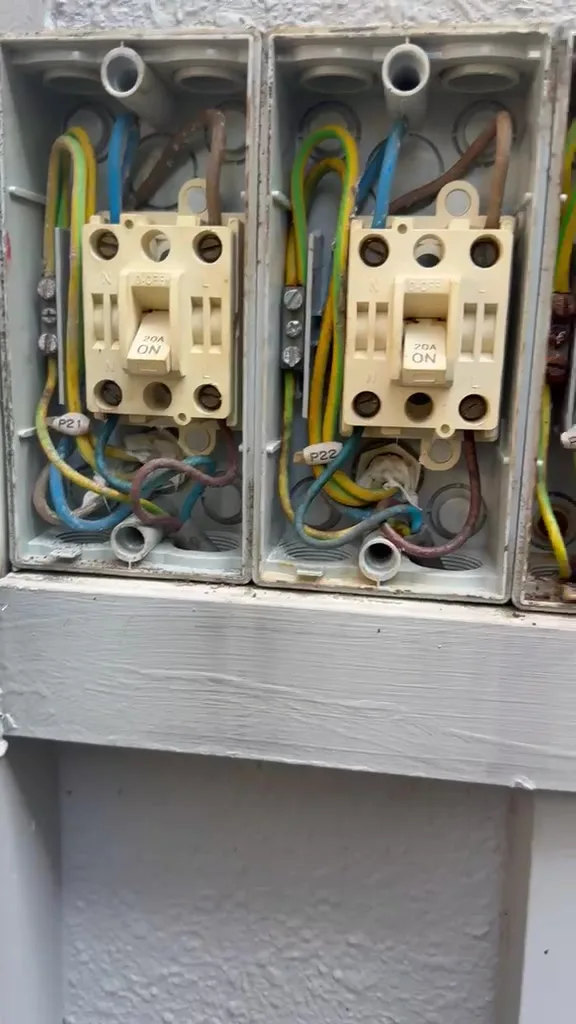
Pictured above: the aircon isolators at a condo near Bedok Reservoir on 23 November 2026, opened up during one of our diagnostic visits. The owner's Mitsubishi inverter kept tripping. Our team inspected the isolators and the outdoor unit, and the visit was for diagnosis only. The photos are on the live job page.
A trip that happens every time is, in a way, the easy case. You switch on, it trips, and whoever comes to look at it sees the same thing you do. This post is about the harder one: the aircon that trips the breaker some days and not others, once in the afternoon and then not again for a week, or only when it rains. That kind of fault is real, and it is also the kind most likely to behave perfectly while a technician is standing next to it.
The best thing you can do before anyone comes is not a repair. It is a record. A short, accurate note of what tripped, when and under what conditions is worth more to the diagnosis than any description given from memory on the day.
First, safety: what to leave alone
- Reset once, not repeatedly. If the breaker has tripped, you may switch it back on once. If it trips again straight away, or the moment the aircon starts, leave it off. A breaker that keeps tripping is protecting you from a fault, and every reset sends current back through it.
- Do not open the isolator box or the outdoor unit. The photo above shows what is inside: live terminals. That is for a technician, with the power off.
- Smell, marks or heat mean stop. A burning smell, brown or black marks on a switch, or a switch plate that feels warm or looks yellowed: switch off at the breaker and do not reset anything. Our post on what to do when an aircon smells like burning covers the first minute.
Which switch tripped? This is the first thing to write down
"The aircon tripped" can mean two quite different things, and the difference points in different directions.
- Only the aircon's own breaker went down. Your aircon normally has its own breaker in the distribution board, plus an isolator, the local switch near the unit or at the ledge. If only the aircon's breaker is down and the lights and sockets still work, the trip happened on the aircon's own circuit. On our repair page, a tripping breaker is listed against two likely causes: an electrical fault or a compressor issue.
- The whole flat, or a large part of it, went dark. That usually means the main safety switch in the board tripped, not the aircon's own breaker. That switch protects many circuits at once, so the aircon may be the cause or may simply be one of the things that went off with everything else. Write down what else lost power.
Take a photo of the distribution board after a trip, before you reset anything. The photo shows which switch is down, and the labels next to the switches often say which one is the aircon. It is the single most useful thing you can send us.
The trip log: what to record each time
Keep it on your phone. Each time it trips, note:
- Date and time. A pattern by time of day is common. Afternoon trips on a sunny ledge and early-morning trips after rain point in different directions.
- Which switch went down, with the photo of the board.
- Which indoor units were running, and at what setting. On a System 2, 3 or 4, every indoor unit shares one outdoor unit. Does it trip with one room on, or only when two or three are on together?
- How long after switching on. The moment you press the remote, a few minutes later when the outdoor unit starts, or after an hour of running. Use your best estimate and say it is an estimate.
- The weather. Heavy rain, a storm, or a hot, still afternoon. Note whether the outdoor unit or the isolator gets rain on it.
- What else was running in the flat on the same board: a water heater, a washing machine, an oven, an induction hob.
- Anything you saw, heard or smelled: a blinking light on the indoor unit, a click or bang from the ledge, a hum from the outdoor unit that did not turn into normal running.
- Whether one reset brought it back, and how long it ran before the next trip.
If a light is blinking, take a short video rather than restarting to watch it again, and photograph the label on the indoor unit. Our post on what a blinking light or error code means explains what to send.
Three or four entries are usually enough to show a pattern. One entry is still far better than none.
What the pattern tends to point to
We cannot tell you from a description what has failed, and nobody can honestly. But the pattern decides where the checking starts, and that saves time on the visit.
- Trips only when it rains, or after rain. Water getting where it should not is the first suspect: the isolator, the cable entry, or the outdoor unit's terminals. Those are places a diagnostic visit can open and look at, as the Bedok visit did.
- Trips only when several rooms are on together. The outdoor unit is working hardest at that moment. That points the checking towards the outdoor unit and the circuit that feeds it.
- Trips at the moment the outdoor unit starts. The start of the compressor is the heaviest moment for the circuit. The breaker-trip guide sets out what is usually behind a trip at start-up and a trip after running.
- Trips the whole flat, and only sometimes when the aircon is off. Then the aircon may not be the cause at all. Keep the log anyway: it is exactly what anyone checking the flat's wiring will ask for.
- Started after a storm or a power cut. Read what to check before restarting after a thunderstorm or power trip first.
What a diagnostic visit checks
Every service booking starts with our 9-point pre-check. The first point is a power and thermostat test, which confirms the electrical supply, the board's response and the remote before anything is taken apart. The others include a refrigerant pressure reading, an outdoor condenser inspection and an operating noise diagnostic, where the technician listens for compressor stress among other things. On the Bedok visit, the isolators and the outdoor unit were inspected: the photos show the isolator boxes open and the outdoor unit's terminals and service valves.
Here is the honest limit. An intermittent trip may not happen while we are there. If it does not, the visit can still find things: a terminal that has been hot, moisture in a box that should be dry, a reading that is off. Sometimes it finds nothing conclusive, and the log you kept becomes the main evidence for what to check next. That is not a reason to skip the log. It is the reason to keep it.
What it costs, on our published prices
- The visit: $55 for 1 unit. It covers the technician visit, the 9-point pre-check and normal servicing. We do not offer a standalone check-only visit, because the pre-check and the service are done in the same visit by the same technician.
- Standard repair (drainage, electrical): $80.
- Compressor or PCB replacement: quoted on site after the pre-check, so there is no figure for it here. If a board is the problem, read what to ask before you approve a PCB replacement.
- If you go ahead with the recommended fix, the $55 is part of the total, so the diagnosis is not charged twice. If you decide not to, the $55 covers the visit and the diagnosis, and nothing more.
- Warranty on repairs: 90 days on workmanship, plus the manufacturer's warranty on parts.
The full list is on our pricing page. The prices there are the prices you pay.
When the problem is the flat's wiring, not the aircon
Sometimes the checking ends at the supply rather than the machine: the circuit feeding the aircon, or work at the distribution board. In Singapore, new wiring, extensions to an electrical installation and work at the distribution board must be done or supervised by a Licensed Electrical Worker. An aircon technician is not automatically one. Our post on the power point and isolator an aircon needs explains where that line sits. If the log shows the whole flat tripping, including with the aircon off, that is usually the point to bring in an electrician.
Questions to ask after the visit
- "Which of the nine pre-check points showed something, and what did it read?" A reading, not just "OK".
- "Did you open the isolator and the outdoor unit's terminals, and what did you see?"
- "If nothing showed today, what should I record next time it trips?"
- "Is this the aircon, or the supply to it?"
- "If a part is needed, what is the price before you start, and what warranty comes with it?"
Send us the log
Tell us the system type (single split, System 2, 3 or 4), the brand, roughly how old it is, which switch trips, when it happens and what you have noticed. Attach the photo of the distribution board and any video of a blinking light. That turns the first message into most of the diagnosis, and it tells the technician what to open first.