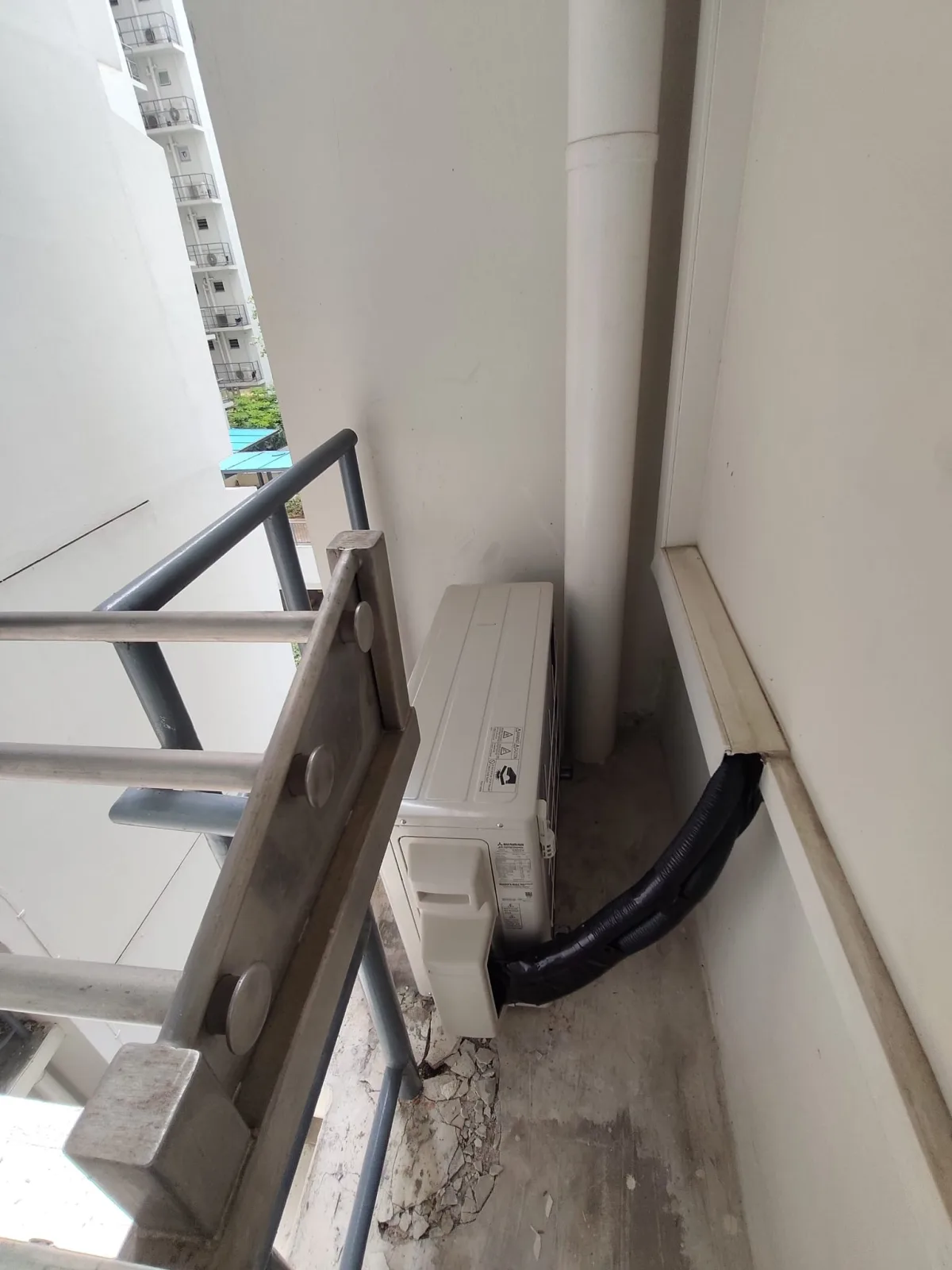
Pictured above: the pipe run of a new installation at a Pasir Ris HDB flat on 27 November 2026. The copper pipes leave the trunking at the edge of the wall, wrapped in their black insulation, and go into the outdoor unit on the aircon ledge. Two wall units were installed that day. The photos are on the live job page.
That is what the pipes on your ledge looked like on the day they went in. A few years of Singapore sun and rain later, many of them look very different: the wrap has faded and split, the foam underneath has gone hard or crumbly, and in places you can see bare copper. Homeowners usually notice it while hanging laundry or looking out of the window, and the question is always the same: does it matter, or is it just cosmetic?
Short answer: one of the two pipes matters a lot more than the other, and the condition of the wrap can hide things worth knowing about. Here is what to look at, what it means, and what to ask before you pay anyone to fix it.
Two pipes, and only one of them is cold
Between the indoor unit and the outdoor unit there are two copper refrigerant pipes, usually a thinner one and a thicker one, taped together with the drain pipe and the power cable into one bundle. When the aircon is cooling, the thicker pipe carries cold refrigerant back to the outdoor unit. On a running system you can often feel that it is cold to the touch at the indoor end.
The insulation is there so that pipe stays cold until it reaches the outdoor unit. Two things go wrong when it fails:
- It sweats. A cold bare pipe in humid Singapore air collects water, the same way a cold drink can does. Outside, that water drips onto your ledge. Indoors, along a trunking run or above a ceiling, it is the cause of the stains in our post on condensation along the trunking.
- It picks up heat. Pipe that sits in direct sun on a west-facing ledge with no insulation is being warmed before the refrigerant gets back to the compressor. The system has to work harder for the same cooling in the room.
The thinner pipe runs warmer, so damaged insulation there matters less. But the two are usually wrapped together, so if one has failed on the ledge, the other usually has too.
Why the wrap on the ledge fails first
The part of the run on the ledge gets the worst of everything: full sun in the afternoon, rain, and wind-blown dirt. The outer wrap protects the foam from sunlight. Once the wrap splits or peels, the foam underneath is exposed and starts to break down. That is why the ledge section often looks far worse than the part of the same run inside the flat.
Other common causes we see on ledges:
- The tape at the end of the run, where the bundle meets the outdoor unit, was never finished properly, so water gets in under it.
- The bundle was pulled or stepped on when the outdoor unit was serviced or replaced.
- Cable ties were pulled so tight that they crushed the foam.
- Birds have pecked at the foam. Our post on ants, geckos and birds covers what else they do.
What to look at from inside the flat
Do not climb out onto the ledge, and do not lean out further than you normally would to hang laundry. You can see most of what matters from the window. With the aircon running for at least 15 minutes, look for:
- Bare copper. Any length where you can see the pipe itself, especially the thicker one.
- Water on the pipe or under it. Drops on the bundle or a wet patch on the ledge directly under the pipes, on a dry day, points to a cold pipe sweating. A wet patch under the outdoor unit itself, or at the end of the drain pipe, is normal drain water and a different thing.
- Frost or ice on the pipes or valves at the outdoor unit. That is not an insulation problem. It is usually low gas, and our post on frost on the outdoor valve explains why.
- Dark, oily staining at the pipe connections on the side of the outdoor unit. Refrigerant carries oil, so an oily mark at a joint is a classic sign of a gas leak at that joint.
- Green or black corrosion on any exposed copper.
Take a photo. It is the most useful thing you can send before anyone comes.
When it is mostly cosmetic, and when it is not
This is our reading, not a rule: if the outer wrap is faded and a little loose but the foam underneath is intact, the room cools well and there is no water on the ledge, it can usually wait and be looked at during the next service visit.
It is worth acting on sooner if any of these apply:
- You can see bare copper on the thicker pipe.
- The pipes drip on a dry day while the aircon is running.
- The room fed by that pipe is not cooling as well as it used to.
- There is oily staining at a joint, or the aircon has needed gas before.
The last one matters because the condition of the insulation is not the real question there. Refrigerant is not used up. If a system has needed a gas top-up, the gas went somewhere. Our gas leak repair page sets out the prices, and the leak needs to be found before anyone re-wraps the pipe over it.
What our pre-check looks at
Every service visit starts with our 9-point pre-check, included in the $55 visit for 1 unit. Two of the nine points are about exactly this:
- Outdoor condenser inspection: a visual check of the fan, the condenser coil and the external pipework.
- Damage and corrosion check: a physical look for rust, refrigerant oil stains, cracked piping and any other visible damage.
The compressor pressure reading, another of the nine points, shows whether the gas is low. So one visit tells you three things: whether the insulation has failed, whether the copper under it is damaged, and whether the system has lost gas.
You get the findings, and the price of any further work, before it starts. If you decide not to go ahead, the $55 covers the visit and the diagnosis, nothing extra.
What the fix can be, and what it costs
It depends on what is under the wrap:
- Insulation failed, copper sound, no leak. The failed section is stripped back and re-insulated. The price depends on how long the run is and how much of it can be reached, so it is quoted after the pre-check, not from a list.
- Gas low. The leak is found first. A gas top-up is a flat price per outdoor circuit on our price list: R22 $115, R410A $130, R32 $170. Where the leak is not at a joint anyone can reach, the nitrogen pressure test is $180 per indoor unit tested, and the aircon cannot be used for 2 to 3 days.
- Copper damaged or corroded. Piping replacement is $520 per fan coil unit in an HDB flat, or $700 per fan coil unit in a condo. Concealed pipe work is quoted after the pressure test.
Repair work carries our 90-day workmanship warranty. If the pipes are being replaced as part of a new system, our installations come with insulated copper piping and carry a 2-year installation warranty, plus the manufacturer's 5-year compressor warranty on the units.
Do not just tape over it
The cheap fix is a roll of tape wrapped around the outside. On a run where the foam underneath is still sound, a fresh outer wrap is reasonable. On a run where the foam has crumbled or the copper is bare, tape on its own does not put the insulation back, and it hides the pipe from the next person who needs to look at it. If anyone offers to "just tape it", ask what is under the tape first.
Six questions to ask before you approve the work
- "Is the thicker, cold pipe bare anywhere, or only the outer wrap damaged?"
- "Is the copper under the damaged section sound, or corroded?"
- "What did the gauge reading show? Is the gas low?"
- "Are there oil stains at any of the joints?"
- "How much of the run will be re-insulated: only the ledge, or inside the trunking too?"
- "Will you photograph the pipe before and after?"
Clear answers to these tell you whether you are paying for a real repair or a cover-up. The photos are your record if the problem comes back.
The short version
- The thicker pipe carries cold refrigerant. Without insulation it sweats and picks up heat.
- The ledge section fails first because of sun and rain.
- Look from the window, never from the ledge: bare copper, drips on a dry day, frost, oily joints.
- Frost or oily joints point to a gas problem, not an insulation problem.
- The $55 pre-check covers the external pipework, corrosion and the gas pressure, and the fix is quoted before any work starts.
Send us a photo
Send us the property type, how many indoor units share the outdoor unit, which room that pipe feeds, whether the aircon has needed gas before, and a photo of the pipes on the ledge taken from the window. That is enough for us to tell you whether it can wait for the next service, or whether it needs a look now.